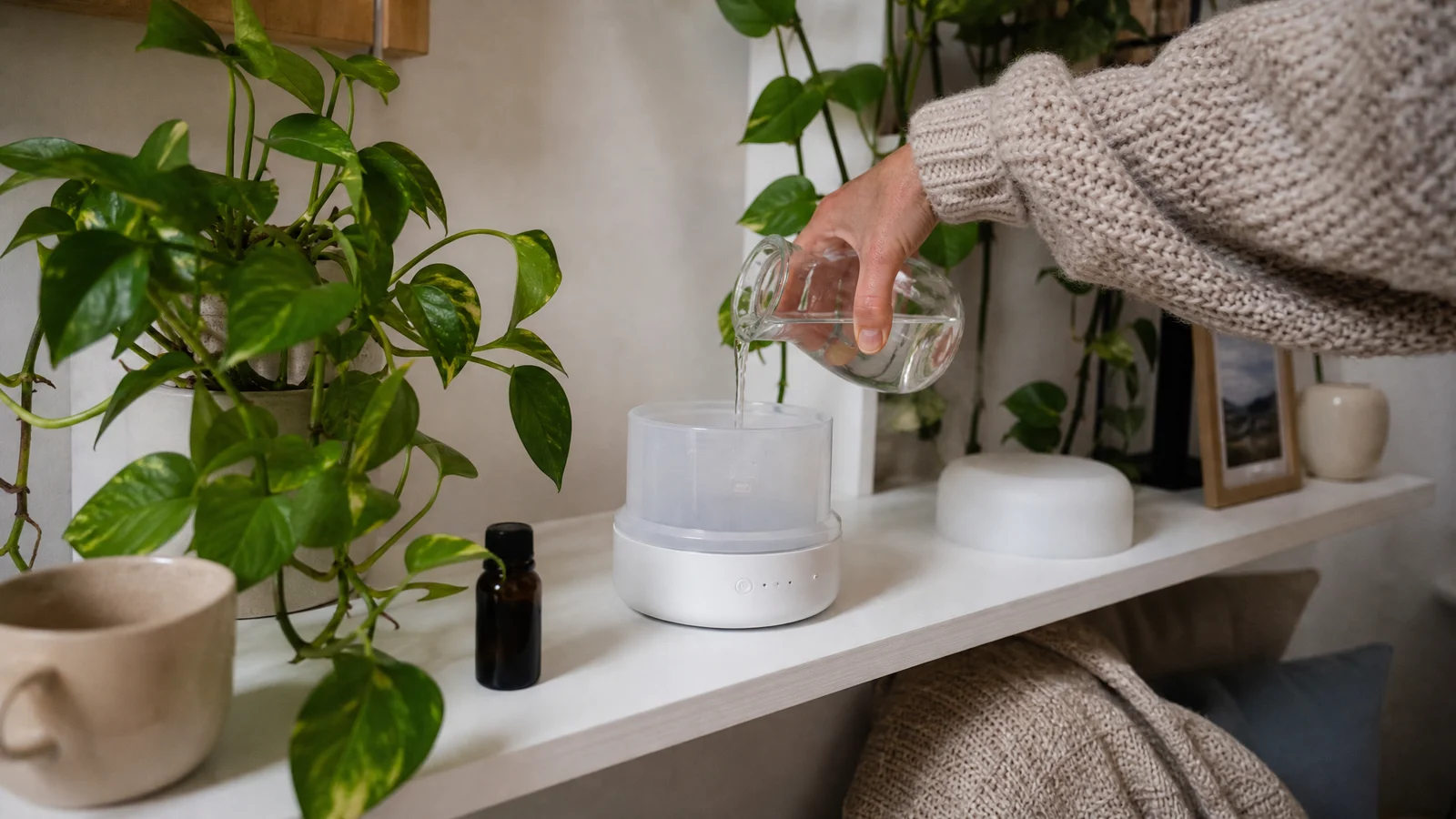
How to Diffuse Camphor Oil: A Cautious Guide
Camphor is a top note with a big voice. That sharp, cooling, crystalline scent over a dry woody base is lovely in small doses, and a diffuser carries it into a whole room, so the whole art of diffusing camphor oil is restraint. Here is how we would go about it, starting with who should not do it at all.
Camphor Essential Oil
Our own Camphor Essential Oil, in sizes from 0.5 oz to bulk.
From $9.99
Shop Now →Three questions before you start
Is there an infant or young child in the home, or likely to be in the room? Does anyone present have a seizure history? Is there a pet that cannot leave the room freely? If any answer is yes, we would not diffuse camphor. Camphor is neurotoxic in quantity and is not suited to infants and young children, which is why our pieces on camphor oil and children and pet safety are worth reading first. Pet Poison Helpline says camphor is readily absorbed through the skin of dogs and cats, which is why it should never be applied to them (Pet Poison Helpline). A diffuser is not skin contact, but airborne oil can settle on a coat, so we want any animal to be able to leave the room. If you are pregnant or breastfeeding, or have asthma or another lung condition, check with your OB/GYN, midwife or physician before diffusing.
Using a workplace limit as a ruler
There is no home standard for camphor in room air, so we borrow the nearest reference and say exactly what it is. The CDC NIOSH Pocket Guide lists a workplace exposure limit for camphor of 2 mg/m3 as an eight-hour average, with symptoms of overexposure including irritation, nausea, headache, dizziness and convulsions (NIOSH Pocket Guide). That is for adult workers and was written for the compound, not for essential oil in a living room, but it makes a useful ruler.
Here is the arithmetic. A drop is roughly 0.05 mL by the common convention of about 20 drops to the millilitre (real drops vary from 20 to 40 per millilitre, per the Tisserand Institute). At the 0.878 g/mL relative density on the batch Certificate of Analysis we publish, one drop weighs about 44 mg. If every bit of it evaporated into a sealed room, that is about 2.2 mg/m3 in a small 20 cubic metre bedroom, 1.5 in a 30 cubic metre bedroom and 0.9 in a 50 cubic metre living room. That treats the whole drop as camphor, which overstates it, and ignores air exchange, which lowers it. The point is not a safety guarantee. It is that a single drop in a small bedroom lands near a limit designed for a working day, which is why we lean toward fewer drops in bigger rooms.
How we would do it
- Pick a big room with a window you can open, used by adults only, with the door shut so scent does not drift to children or pets. Skip rooms where people sleep.
- Start with one drop, and stop adding when you can first notice it. For diffusion in general, Robert Tisserand has commented that 2 to 3 drops over several hours is a reasonable guide (Tisserand Institute, inhalation safety), and for a strong material like camphor we would sit at the bottom of that range or below it. If camphor smells strong, you have used too much.
- Run it in short sessions, something like 30 to 60 minutes on and the same off, and open the window during the off periods. That rhythm is our suggestion rather than a published camphor rule. Stop at once for a headache, dizziness, nausea or an irritated nose, eyes or throat.
- Keep heat out of it. NIOSH lists a flash point of 150 degrees Fahrenheit for camphor. We would avoid candle-warmed burners and open flames and use a cool ultrasonic unit instead.
- Rinse and store. Wipe out the reservoir between uses and keep the bottle capped, upright and high on a shelf. Camphor oil evaporates readily and is never for swallowing.
Those steps are our recommendations from the cited guidance and the arithmetic above.
If you decide to go ahead, think of diffusing camphor the way you would think of salting a dish at the table: add a little, taste, and stop sooner than you think. Come back into the room after a short break rather than sitting in it, because your nose adapts and you will feel tempted to add more than you need. Walking in fresh gives you an honest read of how strong it really is.
A job a diffuser does only so-so
Camphor needs very little help getting into the air. NIOSH gives a vapour pressure of 0.2 mmHg, and a closed closet or drawer holds a small amount of scent much better than a diffuser spreads it across a room. Our closet and wardrobe guide covers that approach. If a blend is what you want, our diffuser blends and the pairings guide keep camphor to the smallest share. A bowl of hot water and oil is not diffusing at all, and our steam piece explains why we steer clear.
Small things that make it easier
- Keep the bottle in a separate spot from the diffuser, so a drop does not turn into a splash.
- Write the start time on a sticky note so you remember to turn it off.
- If the scent still seems strong an hour after you finish, open a window and leave the room for a while.
- Wash your hands after handling the bottle, and keep it away from your eyes.
Camphor oil is a strong-minded oil, and a light hand is what makes it a pleasure to have in a room.
Camphor Essential Oil
Camphor Essential Oil from our own shop, in sizes from 0.5 oz to bulk.
From $9.99
Shop Now →