How to Patch Test Camphor Oil: A Week-Long Method
Most patch test advice amounts to a dab on your arm and a glance the next morning. It is quick, and it can miss the reactions that take their time. If you are going to put camphor oil on your skin, diluted and with care, a slightly longer test is worth the patience.
Camphor Essential Oil
Our own Camphor Essential Oil, in sizes from 0.5 oz to bulk.
From $9.99
Shop Now →Why a week beats a day
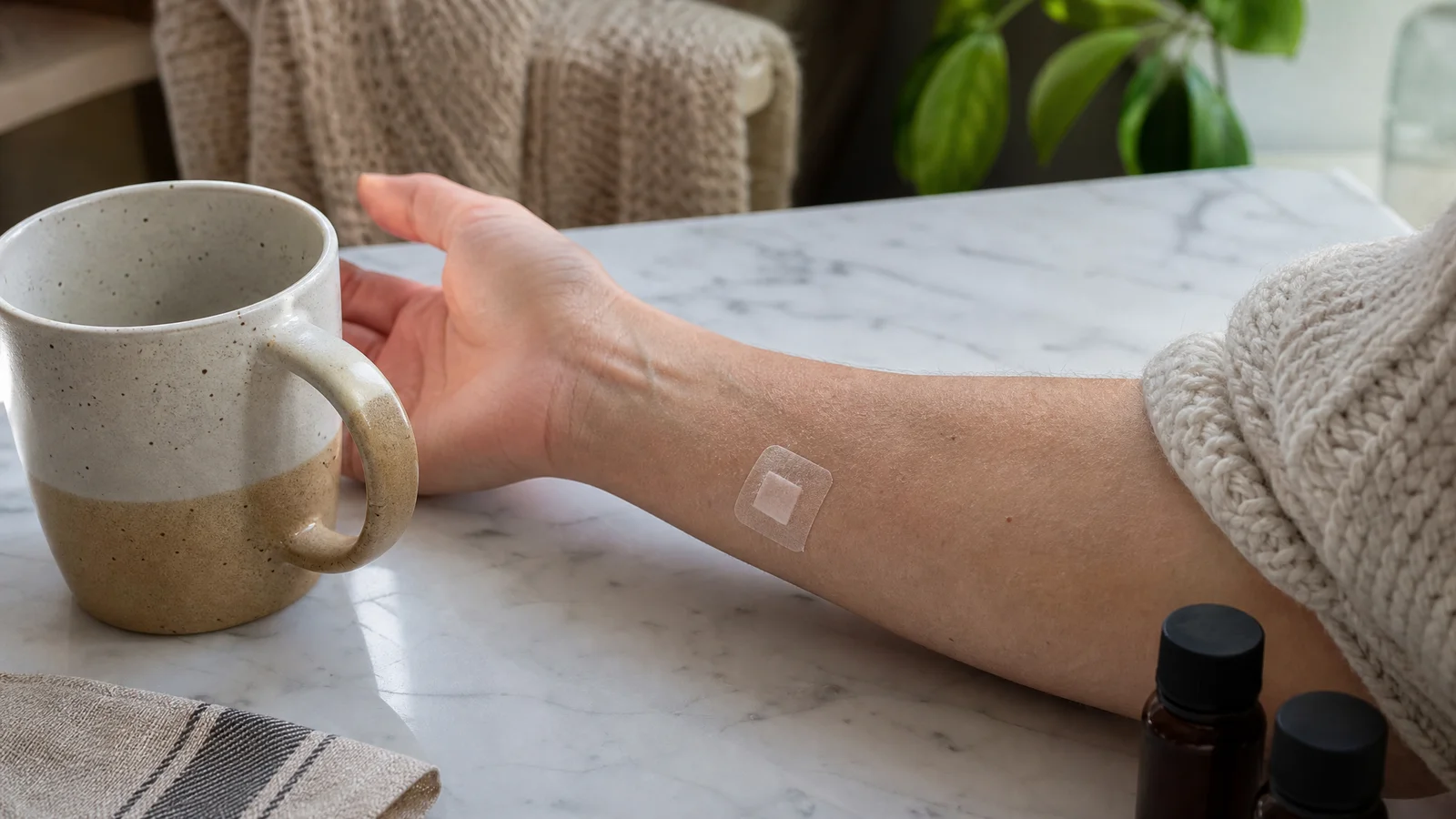
Irritation often shows up quickly, but allergy works on a delay. The American Academy of Dermatology's advice for testing a new skin care product is to apply it to a quarter-sized test spot twice a day for seven to ten days, on a spot where it will not be rubbed or washed off, such as the underside of the arm or the bend of the elbow (AAD, how to test skin care products). Use your normal amount, leave it on as long as you normally would, and if skin gets red, itchy or swollen, gently wash the product off and do not use it again.
That guidance was written for skin care products, not essential oils. Applying it to a diluted camphor oil is our own extension, because the logic of delayed reactions is the same. Treat the 24 and 48 hour looks as checkpoints inside the longer test, not as the test.
Test the blend you will actually use
Decide your dilution and carrier first. Our guidance for skin is 0.5% to 2% camphor oil in a carrier oil, and the test is only informative for the exact blend you plan to use. A weaker mix tells you little about a stronger one, and testing the oil neat answers a question you should not be asking, since we never recommend applying it undiluted. Carrier oils come from a craft supplier or pharmacy, because we sell only the essential oil.
If you can, put the carrier on its own on a second spot a few centimetres away. If both spots react, the carrier is the suspect, not the camphor.
Mixing the blend
Measure rather than guess. Using the loose convention of about 20 drops to the milliliter, a teaspoon of carrier (about 5 ml) takes roughly one drop of oil for a 1% blend and two drops for 2%. Droppers differ, so treat that as rough arithmetic and not a promise. Mix in a clean dish and stir well, then use the same mix for the whole test.
A simple schedule
- Day one. Apply your blend to the test spot, and the carrier alone to the control spot, and leave both as you normally would.
- Hours 24 and 48. Take a look, note any redness, itching, swelling or bumps, and carry on.
- Days three to ten. Keep applying twice a day. Keep the spot free of other new products so a reaction has only one possible cause.
- Any reaction. Wash it off gently and stop. If it is severe or does not settle, see a dermatologist.
Setting up your test
Pick the spot and mark your calendar before you start. The inside of the forearm works well because you can see it without trying and you will not rub it against clothing all day. A quick note on your phone with the date, the blend and the carrier saves you guessing a week later which spot is which. Keep the area otherwise plain: skip new soaps or lotions there so that any change has only one possible source.
What a reaction looks like
The FDA says allergic reactions to cosmetic products most often appear as itchy, red rashes, a condition called allergic contact dermatitis (FDA, allergens in cosmetics). Trouble breathing or swallowing, a rapid weak pulse or faintness is an emergency, so call 911. Keep in mind that fragrance is also inhaled, and a skin test says nothing about airways.
For a sense of scale, a Central European network tested 12 essential oils in 10,930 dermatitis patients and found that sensitization to essential oils occurs, albeit infrequently in most cases (Contact Dermatitis, 2022). Those patients were at skin clinics already, and the abstract does not give a camphor figure. We offer that as context, not comfort, and it is exactly why testing your own skin on your own blend tells you more than any statistic.
Who should skip the home test
A patch test checks skin for irritation and allergy. It is not a clearance for everything else, and the larger story of camphor is in Is Camphor Oil Safe?. People with strong past reactions to fragrance, active eczema or broken skin should ask a dermatologist first. Pregnant or breastfeeding readers should ask an OB/GYN or midwife, and our pregnancy article gives the background. We do not suggest testing camphor oil on a child at all, and camphor oil and children explains why. If you are thinking of the face or scalp, repeat a small test at that site, since skin differs from place to place; that is our reasoning, not a published rule. A new carrier means a new blend and a new test.
Patience pays
It can feel like a lot of fuss for a few drops of oil, and that is rather the point. A concentrated aromatic deserves a slow start, and a week of boring, uneventful checking is exactly the result you hope for. Write "no change" in your note and carry on.
A little patience at the start makes the rest of the routine easier to enjoy.
Camphor Essential Oil
Camphor Essential Oil from our own shop, in sizes from 0.5 oz to bulk.
From $9.99
Shop Now →