Camphor Steam Inhalation: Why the Bowl-of-Hot-Water Method Is Risky
Hot water and camphor is a poor pairing. Steam inhalation has no consistent proven benefit for colds, and it scalds people every year, most often children. FDA labeling for camphor rubs says not to add them to hot water, and our oil comes with no directions for that use. We do not give a method here, on purpose.
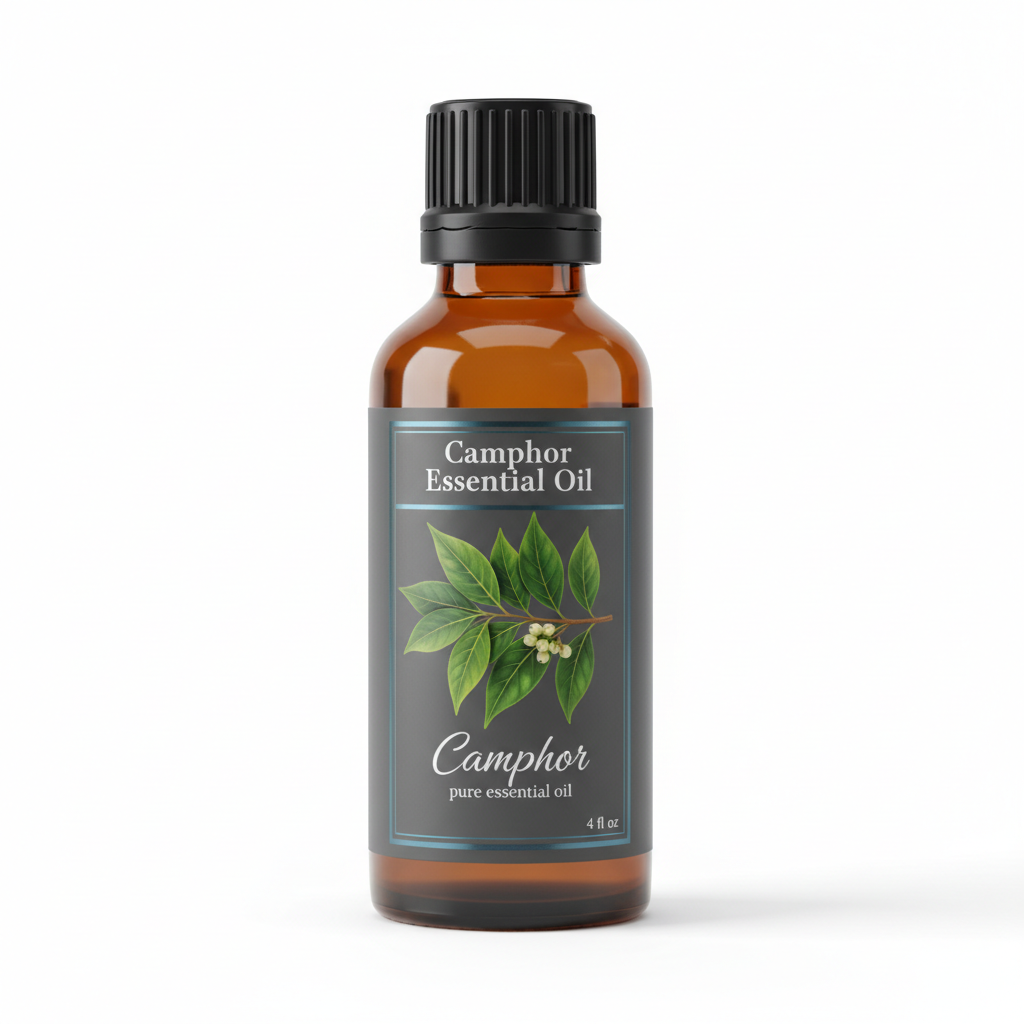
Camphor Essential Oil
Our own Camphor Essential Oil, in sizes from 0.5 oz to bulk.
From $8.69
Shop Now →Where we stand, and why there is no recipe on this page
Search for camphor steam inhalation and most results hand you a method: a bowl, hot water, some drops of oil, a towel over the head. We are not going to write that paragraph. The reason is not caution for its own sake. It is that the method combines two separate problems, each documented, and the people most likely to be hurt are the ones the method is most often recommended for.
Problem one is the hot water. Problem two is the camphor. Our position is that the combination should not be done at home, and the rest of this article lays out the evidence for that so you can judge it yourself. If you are here because someone is congested and uncomfortable, the practical advice is at the end, and it begins with a pharmacist or physician.
Problem one: steam inhalation scalds, and the benefit is unproven
Steam inhalation is not a camphor topic originally. It is a general folk practice for colds, and the burn literature on it is large enough to treat as its own subject.
- A Dutch prospective study (Baartmans and colleagues, British Journal of General Practice, 2012) found that about three people a year were admitted to the country's burn centers for steam inhalation burns, that most victims were children, and that children needed skin grafts more often than adults. Direct medical costs totaled EUR 115,500. The authors concluded that steam inhalation should be considered a dangerous procedure and no longer recommended in guidelines and patient brochures.
- A review at one London burns centre (Scarborough and colleagues, Burns, 2021) covered 19 admitted patients aged from 2 weeks to 91 years over two years. Sixteen of the 19 had lower-body burns, which fits the pattern of a hot bowl spilling into a lap, and six needed surgery. A national database enquiry found 201 cases across the UK in the same two years, and the authors noted that counting only admitted patients understates the true burden.
- A Spanish pediatric review (Belmonte and colleagues, Anales de Pediatria, 2015) described 15 burned children seen between 2006 and 2012, aged 2.5 months to 14 years. Five went to intensive care and eight needed skin grafting. The authors recommended avoiding steam inhalation and educating parents.
Against those harms sits the benefit. The 2017 Cochrane review of heated, humidified air for the common cold (Singh and colleagues) included six trials with 387 participants, found the evidence on symptoms uncertain and low quality, and concluded that it showed neither benefits nor harms. Note what that review studied: air delivered by a specific device, not a bowl of water. It does not show that a bowl works.
Problem two: adding camphor to hot water
The regulatory documents are unusually direct on this. FDA's rule for topical cough-suppressant products (21 CFR 341.74) requires ointment labels to carry a warning that heating may cause splattering and result in burns. For steam products it prohibits heating and microwaving except when the product is added to cold water only in a hot steam vaporizer, and the rule lists camphor steam products at 6.2%, designed for the vaporizer's medication chamber. The Vicks VapoRub label, as mirrored by a drug-label site, says not to heat it or microwave it or add it to hot water or any container in which water is being heated, because it may splatter and cause burns. Poison Control's page says the same and adds "or use it near open flames."
Two physical facts from PubChem are consistent with those warnings, and we offer them as our own reasoning rather than as a test. First, the pure camphor compound has a reported closed-cup flash point of about 66 degrees Celsius (150 degrees Fahrenheit), which is lower than the temperature of boiling water. Second, its water solubility is only about 1.2 to 1.6 grams per liter at 25 degrees Celsius. Our posted certificate of analysis gives a specific gravity of 0.878 for our oil, lighter than water. Put together, the reasoning is that an oil poured onto hot water would be poorly soluble and would float as a layer at the surface, where the face is closest, rather than mixing evenly. We cannot say what a given bowl would do, and we did not try it. We do know that the labels written by the people who make regulated products tell you not to do it.
Camphor also adds a second kind of risk to the first. A poison center guideline (Manoguerra and colleagues, 2006) notes that generalized convulsions are often the first sign of significant camphor toxicity and that people exposed to camphor vapor should be moved to fresh air and referred for care depending on symptoms. Tisserand Institute commentary on a 2021 prospective study of essential-oil-related seizures notes that some of the reported cases involved steam inhalation of eucalyptus oil, though the case reports do not give amounts or whether the oil was diluted. That is thin evidence, and we do not overstate it. It is also why we would not suggest that people breathe concentrated camphor vapor from a bowl while their face is a few inches from the water.
Why this matters most for children
Everything above applies to adults. For children it is worse. Several of the burn series above are mostly children, and both the FDA ointment rule and the Vicks label say children under 2 should not use camphor products without asking a doctor. Health Canada, in its public guidance on camphor and eucalyptus products, lists steam inhalation among the ways these products are used and advises caution and storing them out of children's reach. A child leaning over a bowl, a parent holding a towel and a pot of hot water in a small space is the exact situation the burn literature describes.
If a child may have swallowed a camphor product, call poison control in the US at 1-800-222-1222 immediately. Do not wait for symptoms.
| Question | What the sources say |
|---|---|
| Does steam clear a cold? | Cochrane 2017: neither benefits nor harms shown, low-quality evidence, specific device only |
| Does it injure people? | Yes: documented burn series in Dutch, English and Spanish centres, many in children |
| Can camphor products be heated at home? | No: FDA rule and Vicks label warn against heating, microwaving or adding to hot water |
| Is there a regulated steam format? | Yes: camphor steam products at 6.2% in a hot steam vaporizer, used as the label directs |
| Is camphor safe for under-2s? | Labels say do not use without asking a doctor |
If someone is congested and miserable
We sell one aromatic oil, so we are not the people to prescribe an alternative. Here is how we would think it through.
- Decide whether it is something a doctor should see. CDC guidance on chest colds lists a fever lasting more than 5 days or reaching 104 degrees Fahrenheit, coughing up bloody mucus, shortness of breath or trouble breathing, and a cough beyond 3 weeks as reasons to see a healthcare professional, and a fever of 100.4 degrees Fahrenheit or higher in a baby under 3 months as a reason to seek care right away.
- Ask a pharmacist. A pharmacist can compare labeled products, including regulated steam formats, and tell you what suits your age, medicines and conditions. For children, the American Academy of Pediatrics says over-the-counter cough and cold medicine is not recommended under age 4, and the pediatrician is the right call.
- If you use a labeled product, follow its label exactly. The label is the only tested set of directions. Do not improvise with heat.
- If you want to scent a room instead, that is a different question with different risks, and our diffusing article covers it, including who should not be in the room.
For the broader question of how camphor's cooling sensation compares with actual airflow, see our chest rub article, and for a list of other aromatic oils that people reach for during colds, with a child-safety column, see the essential oils for congestion list. The general safety picture is in the safety guide.
Frequently asked questions
Can I put camphor oil in a bowl of hot water and breathe the steam?
We do not recommend it and will not give a method. The FDA rule and the Vicks label tell users not to heat camphor products or add them to hot water, and steam inhalation has produced documented burns, most often in children.
Is there a safe way to do camphor steam?
The only format we found with regulatory directions is a camphor steam product in a hot steam vaporizer, used exactly as its label says. That is a pharmacist's question, not ours.
Does steam inhalation work for a cold?
The Cochrane review we read found neither benefit nor harm from heated humidified air delivered by a specific device, with low-quality evidence. It did not test a bowl of hot water.
Last reviewed
Sources were last checked in October 2026. This page has not been reviewed by a physician or pharmacist and is not medical advice.
Our Camphor Essential Oil is an aromatic material, described on Inside the Still and available in the shop. It is not sold for inhalation therapy.
Sources & Further Reading
- Baartmans M et al. Steam inhalation therapy: severe scalds as an adverse side effect. Br J Gen Pract 2012
- Scarborough A et al. Steam inhalation: more harm than good? Perspective from a UK burns centre. Burns 2021
- Belmonte JA et al. Severe burns related to steam inhalation therapy. An Pediatr (Barc) 2015
- Singh M et al. Heated, humidified air for the common cold. Cochrane Database Syst Rev 2017
- 21 CFR 341.74, labeling of antitussive drug products
- Vicks VapoRub Drug Facts label (mirror)
- Poison Control: Is Vicks VapoRub safe?
- PubChem: camphor, flash point data and solubility data
- Manoguerra AS et al. Camphor poisoning: an evidence-based practice guideline for out-of-hospital management. Clin Toxicol 2006
- Tisserand Institute: Can eucalyptus essential oil cause seizures?
- Health Canada: Safe use of health products containing camphor and/or eucalyptus oils
- American Academy of Pediatrics, HealthyChildren.org: Coughs and colds, medicines or home remedies
- CDC: Chest cold (acute bronchitis)