Can You Ingest Camphor Oil? The Firm No, With Context
No. Camphor oil is not food, not a supplement and not a flavoring, and swallowing it, even diluted, can cause seizures within minutes. Toxic effects start around 2 grams of pure camphor in adults, and children have died from 0.5 to 1 gram. If anyone has swallowed any, call Poison Control at 1-800-222-1222 now.
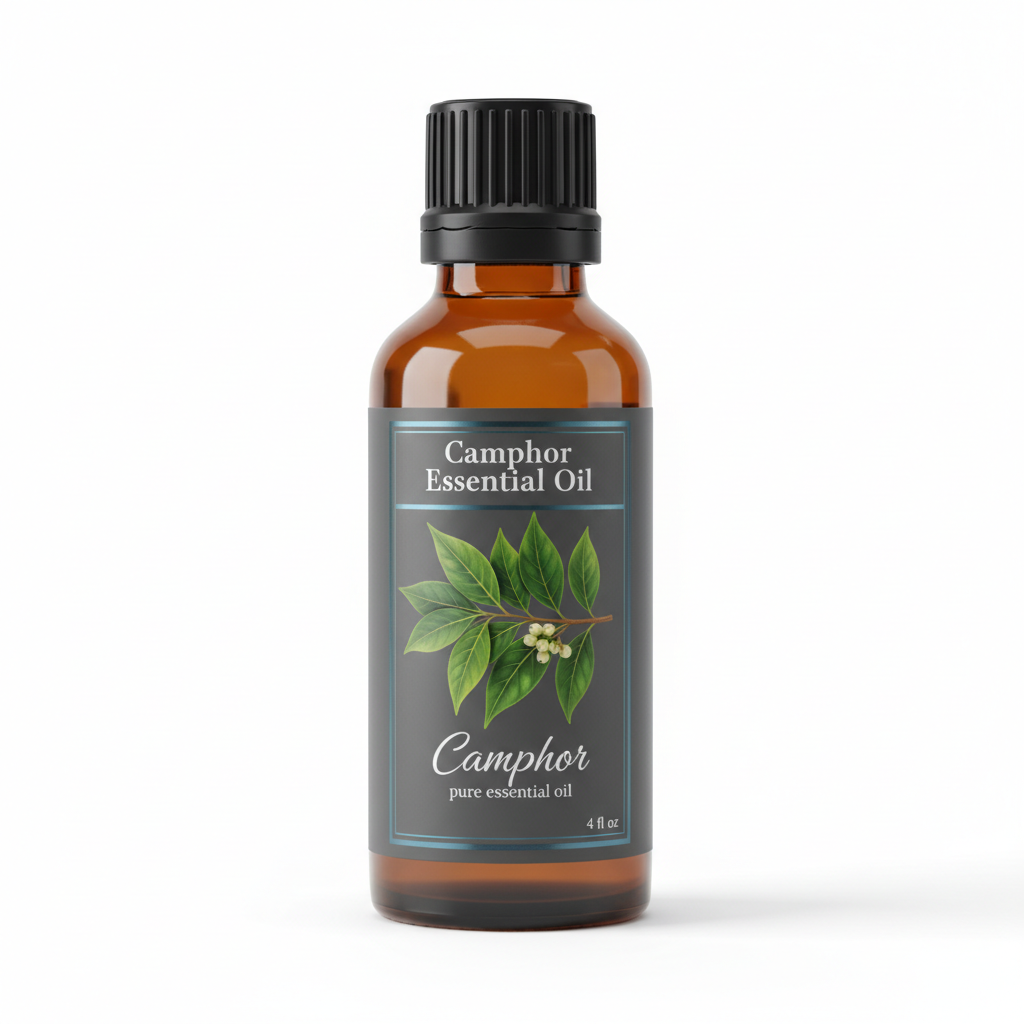
Camphor Essential Oil
Our own Camphor Essential Oil, in sizes from 0.5 oz to bulk.
From $8.69
Shop Now →Myth versus fact
| What people say | What the sources say |
|---|---|
| "A drop in water or honey is fine because it is natural." | Natural origin says nothing about dose. A poison guideline sets 30 mg of camphor per kilogram of body weight as the point where emergency evaluation is needed, and the toxic dose is small. |
| "Diluting it makes it safe to swallow." | Dilution lowers the concentration, not the camphor you swallow if you drink enough of the mixture. Nothing in the FDA labeling for camphor products allows swallowing: the cough ointment label reads "For external use only. Do not take by mouth or place in nostrils." |
| "Edible camphor is a different thing." | The word edible on a label does not change what camphor does in the body. Our edible versus regular camphor article covers the names; the toxicology below applies to camphor itself. |
| "If it was dangerous, nobody would survive." | Some people do survive very large amounts, in intensive care. Survival after an overdose is a hospital outcome, not a safety margin. |
| "Poison control will have me induce vomiting." | The evidence-based out-of-hospital guideline says not to induce vomiting with ipecac after camphor and not to give activated charcoal for camphor alone. Call and follow the instructions. |
How little is too much
The IPCS poison monograph gives the numbers that matter: toxic effects appear after about 2 grams of pure camphor, the potential lethal dose in adults is 4 grams, in children 0.5 to 1.0 gram, and for infants the lowest published lethal oral dose is 70 mg/kg. The 2006 evidence-based guideline for out-of-hospital management (Manoguerra and colleagues, Clinical Toxicology) tells poison centers to send anyone who swallowed more than 30 mg/kg, or who has symptoms by any route, to an emergency department. It was written after poison centers logged roughly 10,000 camphor ingestion exposures a year in 1990 to 2003.
Those figures are for pure camphor. A bottle of oil is a mixture, and our posted certificate of analysis gives physical constants only (specific gravity 0.878, refractive index 1.467, optical rotation +5.80 degrees), not a camphor percentage. So here is the arithmetic, with the camphor share left as the unknown:
| Amount of oil | Weight at specific gravity 0.878 | Camphor share that reaches 30 mg/kg in a 12 kg toddler (360 mg) | Camphor share that reaches the 0.5 g child lethal estimate |
|---|---|---|---|
| 1 mL (about one fifth of a teaspoon) | 0.88 g | 41 percent | 57 percent |
| 5 mL (one teaspoon) | 4.39 g | 8 percent | 11 percent |
This is reasoning, not a prediction: the camphor share of any particular oil is unknown without a GC/MS report, and the toddler weight is an illustration. The point is the scale. A teaspoon of an oil in which camphor is even a modest share can reach a dangerous child dose, and a mouthful is more than a teaspoon.
What happens, and how fast
The Royal Children's Hospital Melbourne guideline puts the onset of symptoms at 5 to 15 minutes after ingestion, with seizures usually within 90 minutes, sometimes preceded by muscle twitching, confusion, delirium and restlessness, and respiratory depression often following a seizure. A 2023 Cureus case report describes a 61-year-old man who swallowed an estimated 500 mL of camphor oil. He had two seizures at home before reaching the emergency department two hours later, had a third there, was intubated, and was extubated 48 hours later. The IPCS monograph describes an adult who swallowed 150 mL of camphorated oil (about 30 grams of pure camphor) and was well 36 hours after intensive hospital care.
Both survived. Both needed airway support or intensive care, and there is no antidote. Read those cases as the outcome of fast hospital care, not as evidence of tolerance. For a symptom checklist, see camphor poisoning symptoms and what to do first.
Why people end up swallowing it: lookalikes and mix-ups
The main documented route is confusion. In 1982 the FDA reviewed 32 camphorated oil poisonings with a known cause: 28 were confusion with another product, 20 with castor oil, 3 with cough medicine and 1 with acetaminophen. In 15 of the 28 the person who made the mistake swallowed it; in 12 someone gave it to another person, often a child. Only 4 of the 32 were young unattended children drinking it themselves (47 FR 41716). The agency noted that camphorated oil and castor oil are both amber, slightly viscous liquids.
That detail matters for any buyer. A dark amber glass bottle protects oil from light, and it also resembles other amber bottles. Our description of our own packaging stops at amber glass with a tight closure; we do not describe it as child-resistant. So the controls have to be yours: a label in plain words, a separate high shelf away from the kitchen and the medicine cabinet, and no transfer into unmarked containers. If a bottle is ever moved, label it before it is set down.
The second route is cultural and commercial. A 2009 Pediatrics report (Khine and colleagues) described three children aged 15 to 36 months treated in the Bronx within two weeks. Two had swallowed camphor and one had camphor rubbed repeatedly on skin. The camphor had been used for spiritual purposes, as a cold-care use or for pest control, and the authors argued that illegally sold products were a public health issue. All three needed medication to stop seizures. If you grew up with camphor in a puja dish or a closet, the thing to take from this is that the same product sits in homes with toddlers.
Storage rules that follow from the mix-up record
Because the documented route to poisoning is a mistaken bottle, the storage rules are about making a mistake hard. These come from the 1982 case patterns, not from any test.
- Keep it in the original labeled container. Never pour it into a water bottle, a cup, a spice jar or an unmarked vial.
- Store it away from food, drinks and medicines, not beside castor oil, cooking oil, cough syrup or other amber bottles.
- Put it high and behind a latch or a closed door. A toddler can drink a bottle that is only out of sight.
- Tell everyone in the household, including visitors and helpers, what it is and that it is never for swallowing. In the 1982 cases, 12 of 28 mix-ups involved one adult giving it to another person.
- If you move the bottle, label it before you set it down.
If someone swallowed camphor
- Call Poison Control at 1-800-222-1222, or use the web tool at poison.org. Call 911 instead if the person has a seizure, has trouble breathing or cannot be woken.
- Do not wait to see whether symptoms start. Seizures can begin within minutes.
- Do not try to make the person vomit and follow the call-taker's instructions about anything by mouth.
- Keep the bottle with you so you can read the exact product and amount missing.
These steps are a summary of public poison-control guidance, not medical advice. Poison Control is free and confidential.
Does adding it to food or drink cover the taste and make it safe?
No. Mixing changes the taste and the volume, not the amount of camphor that reaches the body, and it adds a new hazard: a drink or dish that someone else may consume without knowing. The FDA labeling language for camphor products is consistently about external use only.
Can a very small taste hurt an adult?
The IPCS monograph puts adult toxic effects at about 2 grams of pure camphor, so a lick is far below that. But a small taste of oil is not a measured dose, and for a child it can be close to the dangerous range. Call Poison Control if you are unsure.
Is camphor oil ever used as a food flavoring?
We sell ours as an aromatic and cosmetic material, not for eating, and we found no source that supports eating it.
Where is the rest of the safety picture?
See Is camphor oil safe? for skin, aroma and storage, and camphor oil and children for household rules. The FDA history behind the camphorated oil ban is in FDA camphor rules explained.
Our own position is simple. We sell one Camphor Essential Oil, in sizes from 0.5 oz to 400 lb, for aromatic and cosmetic use only. Details are on the shop page.
Sources & Further Reading
- IPCS INCHEM: Camphor poison information monograph (peer review 1989)
- Manoguerra et al. 2006, Camphor poisoning: an evidence-based practice guideline for out-of-hospital management, Clinical Toxicology (PubMed 16809137)
- Royal Children's Hospital Melbourne: Camphor poisoning clinical guideline
- Jabbour et al. 2023, Camphor oil toxicity: a case report, Cureus
- Khine et al. 2009, A cluster of children with seizures caused by camphor poisoning, Pediatrics 123(5):1269-1272
- Federal Register, Sept. 21, 1982 (47 FR 41716): Camphorated Oil Drug Products for Human Use
- 21 CFR 341.74: antitussive drug product labeling (camphor ointment directions and warnings)
- Poison Control (poison.org)