What Does Camphor Oil Smell Like? A Scent Guide
If you expect white camphor oil to smell like a mothball, prepare to be surprised. The oil sold as white camphor is a lighter fraction of the distillate, and its aroma leans toward eucalyptus, lemon peel and pine needles, with a dry, almost mineral edge underneath. Here is how to read that scent, and how to smell a bottle so you really learn something from it.
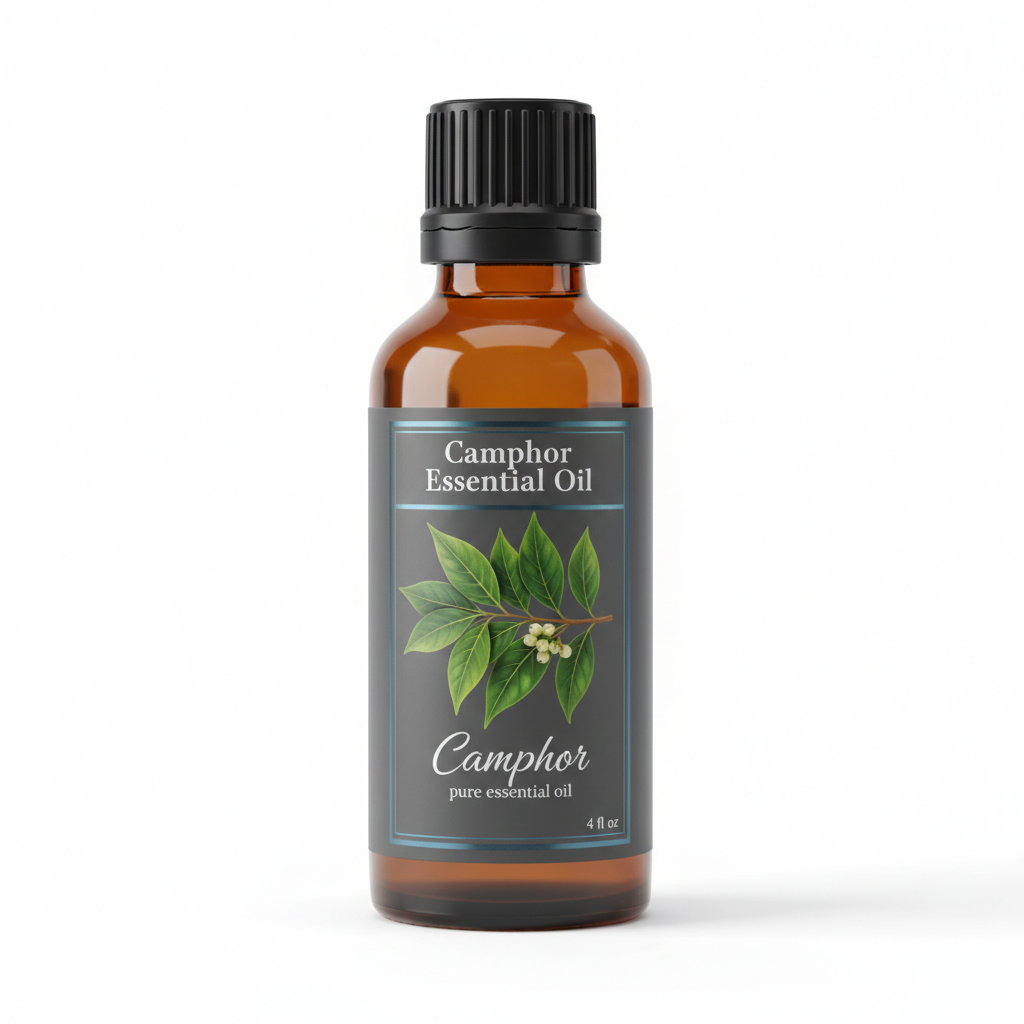
Camphor Essential Oil
Our own Camphor Essential Oil, in sizes from 0.5 oz to bulk.
From $9.99
Shop Now →Why it is not liquid camphor
Most of us meet camphor as a white solid with a penetrating, medicinal smell. It is natural to assume the oil is that same material in liquid form. It is not. The crystals are lifted out of the crude distillate, and what remains is split by boiling point into fractions. The Tisserand Institute says white camphor oil contains very little camphor, up to 9 percent and typically about 3, and treats it as a fraction rather than a true essential oil. Our article on how camphor oil is made walks through the split.
So what is left to smell? The European Food Safety Authority published a specification for a white camphor oil from Taiwan, and its top four ingredients (as percent of the chromatogram) were 1,8-cineole at 27 to 43, limonene at 18 to 27, p-cymene at 6 to 15 and alpha-pinene at 4 to 10, with camphor itself under 0.1. That is one producer's cineole-type oil, so treat it as a typical outline of a white fraction and not a description of any particular bottle. Our own certificate lists density, refractive index and optical rotation for one batch; if you want a composition for your lot, ask us in writing through the contact page.
Reading the scent from the ingredients
PubChem records the odor of each major ingredient, and together they paint a surprisingly clear picture.
- 1,8-cineole is described as "camphor-like," and it is also the leading compound of eucalyptus oil, which is why the two oils feel like relatives.
- Limonene is "pleasant lemon-like," the quiet citrus edge under the sharpness.
- p-Cymene is "sweetish aromatic," a dry, slightly solvent-like facet.
- Alpha-pinene has the "characteristic odor of pine," green and resinous.
Put those together and you get a clean, sharp, faintly lemony, faintly piney opening over a dry base. That fits how we describe our oil: sharp, cooling and crystalline, with a dry woody base, and a top note in perfumery terms. That is also a hint about its role. A top note is the first thing you smell and the first to fade, so camphor oil in a blend behaves like a quick lift, not a foundation.
How to smell a bottle properly
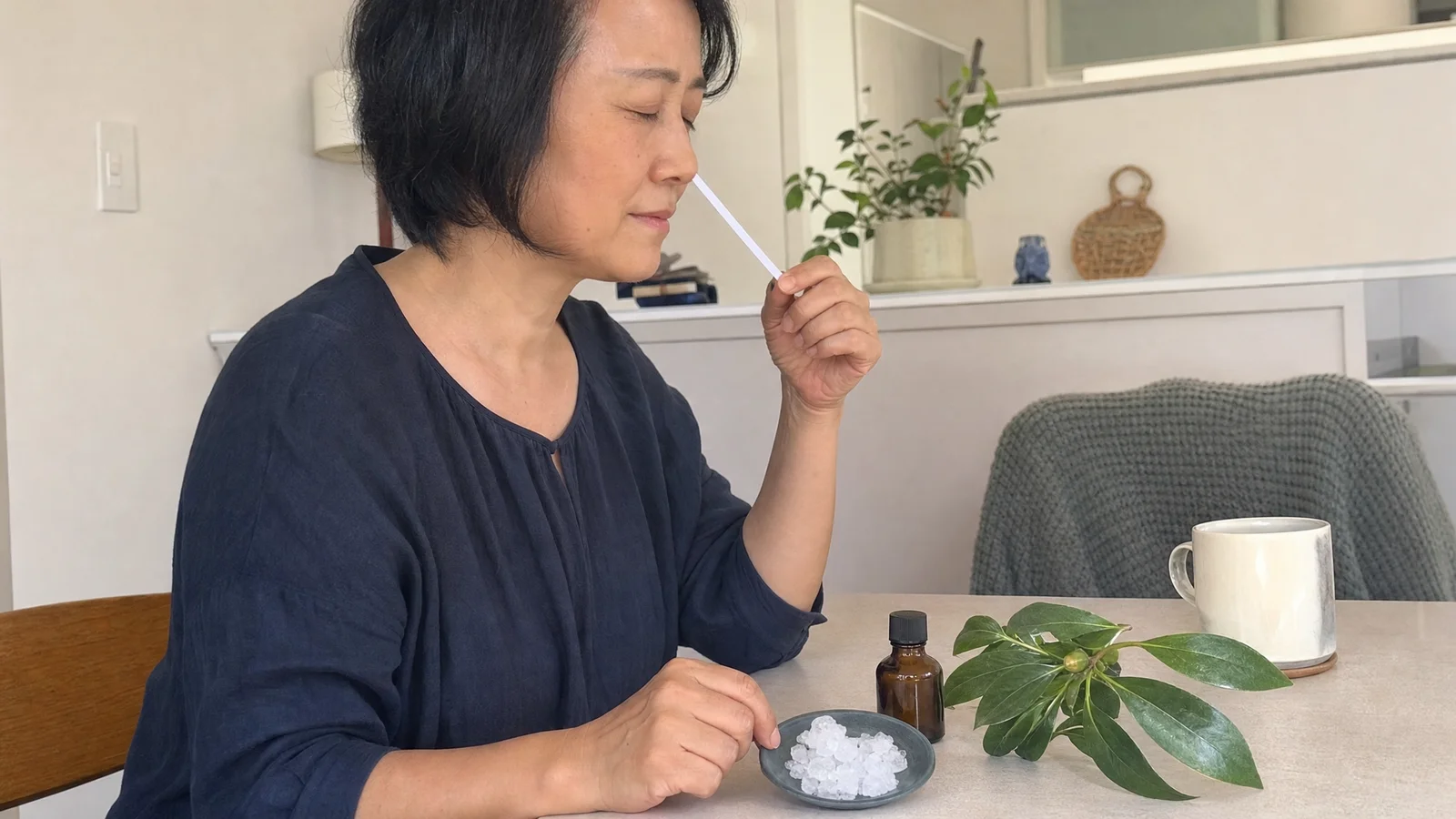
- Use a paper strip, not the bottle neck. Vapor at the neck is as concentrated as the oil ever gets and mostly says "strong." Put one drop on a blotter and start at arm's length.
- Sniff briefly, then stop. Sharp materials tire the nose quickly, so a long sniff teaches you little after the first few seconds. Pause a minute and try again.
- Come back at three moments. Smell at once, after ten or fifteen minutes, and after an hour. The most volatile parts leave first, so the sharp opening gives way to something drier and woodier.
- Put a neighbor beside it. A eucalyptus strip next to the camphor strip shows the difference. Camphor oil should read drier and less sweet.
Keep the strip a little away from your face if you are sensitive to strong aromas, and keep the bottle where children and pets cannot reach it. We keep camphor away from infants and young children and from anyone with a seizure history, and if that describes your household, a physician or veterinarian is the right person to ask, not a scent guide.

The "cool" feeling is a separate event
People call camphor's scent cool, and it is worth knowing why. Cineole, limonene and pinene have no temperature, so part of the word is simply vocabulary. The other part is physiology. A 2013 study in Chemical Senses found that camphor activates TRPM8, the cold-sensing channel in sensory neurons, and a 2013 mouse study in the Journal of Neuroscience found it makes some cold-sensing nerve fibers more responsive. Both used the compound camphor, and both concern skin nerves, not smell.
Reasoning from that, the coolness people associate with camphor probably owes more to products containing real camphor than to the smell of the white fraction, which sits closer to the eucalyptus-and-citrus family. We offer that as a way to understand the word "cool," not as a claim about what the oil does for anyone. If you like comparing sensations, camphor versus peppermint is a good next read.
Give yourself a second round another day. Come back with a fresh nose and the second impression often catches things the first one missed: a hint of lemon peel here, a mineral dryness there. Write a few words down each time and you will build your own scent vocabulary rather than borrowing ours.
Putting the scent to work
Because it is a top note, camphor oil is a seasoning. A drop or two sharpens lavender, rosemary, citrus and conifer notes, and our guide to perfumery and blending shows how to size a first trial. If you are new to it, smell first and blend second. Store the bottle tightly capped in a cool, dark place, and retire it if the scent turns flat, sour or resinous.
Try it next to something you already know, too. A drop on one strip and your favourite lavender or a slice of orange peel beside it shows you where camphor oil sits among familiar smells.
Smell is personal, and the best test is the simple one: a drop on a strip, a quiet minute, and an honest opinion.
Camphor Essential Oil
Camphor Essential Oil from our own shop, in sizes from 0.5 oz to bulk.
From $9.99
Shop Now →Sources & Further Reading
- EFSA FEEDAP Panel, 2022. Safety and efficacy of an essential oil from Cinnamomum camphora (camphor white oil). PMC8756382
- Tisserand Institute. Ho wood, ravintsara and camphor oils from the same plant. tisserandinstitute.org
- PubChem. Odor records for 1,8-cineole, limonene, p-cymene and alpha-pinene. pubchem.ncbi.nlm.nih.gov
- Selescu T et al., 2013. Camphor activates and sensitizes TRPM8 to cooling and icilin. Chem Senses 38(7):563-75. europepmc.org
- Vetter I et al., 2013. Amplified cold transduction in native nociceptors by M-channel inhibition. J Neurosci 33(42):16627-41. PMC6618521