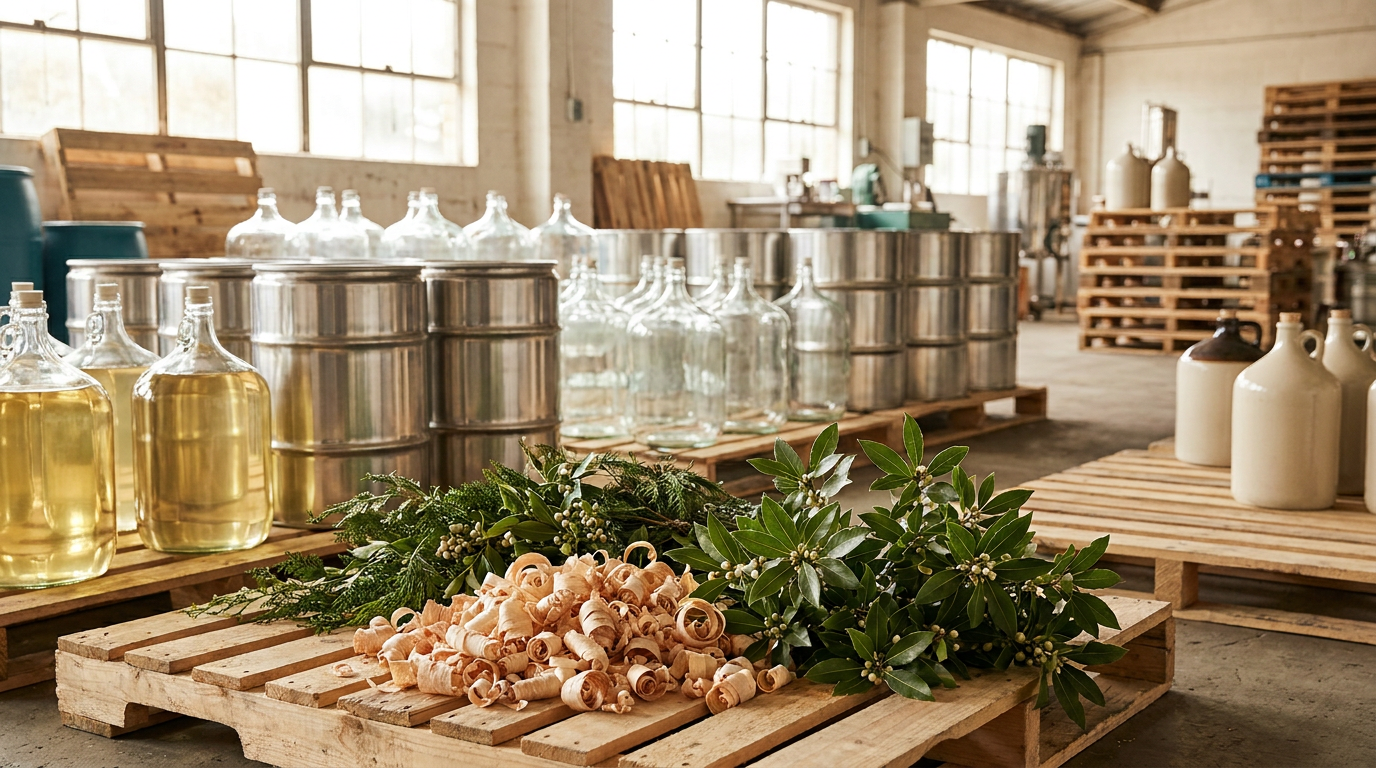
Camphor essential oil moves through several distinct wholesale channels, from candle and soap production to perfumery and wardrobe sachet lines. This guide covers what the oil actually is, how to verify a supplier, and how sizing typically scales from a first sample to a standing drum order.
Tell us your volume and we will get back with sizing and pricing.
Camphor essential oil begins as the wood of Cinnamomum camphora, a stately evergreen native to East Asia, steam-distilled and then fractionated. The white fraction we carry is the clean, camphoraceous cut used across the fragrance and craft trade, distinct from the fractions kept out of open commerce; the full path from felled wood to bottled oil is laid out in how camphor oil is made.
For wholesale buyers, the question of whether this is even a genuine essential oil comes up often enough that it is worth answering plainly: yes, camphor oil is a true steam-distilled essential oil, not a synthetic isolate dressed up with a familiar name, a distinction covered in full in myths and facts about camphor. What varies between suppliers is grade, fraction, and documentation, not the basic botanical process.
A broader introduction to the oil's aroma, sourcing, and use cases sits in our complete guide to camphor oil, and buyers pricing out a purchase order should read how the raw material trades globally in the camphor oil market before requesting a quote.
| Sold as | What it actually is | How to recognize it |
|---|---|---|
| White camphor oil | The white fraction of the wood distillate, the portion used in perfumery and craft scenting. | Labeled specifically as white or as a white fraction, backed by a published Certificate of Analysis. See white versus brown camphor oil. |
| Brown or yellow camphor fractions | Other fractions of the same distillate, generally kept out of open fragrance trade. | A seller who cannot say which fraction they are shipping, or who lists camphor oil with no fraction specified at all. |
| Camphor fragrance oil | A synthetic aroma compound blended to mimic camphor's scent, not a plant distillate at all. | Ingredient listings mentioning diluents, fixatives, or nature-identical language. See white camphor oil versus camphor fragrance oil. |
| Organic camphor oil | Oil carrying a certified-organic claim on the raw wood or the distillation process. | A certificate number tied to a named certifying body, not just the word organic printed on a label. |
Buyers new to the category should also understand what a fair price looks like before negotiating a first order, since camphor trades on a global raw-material market that shifts with harvest and fraction availability.
The most common sourcing trap in this category is a supplier who ships whichever camphor fraction is cheapest that week without saying so on the label. Ask specifically for the white fraction, ask for a Certificate of Analysis tied to that fraction, and treat any seller who cannot answer both questions as a pass.
The wholesale buyers we hear from most are candle and soap makers scaling a wardrobe-fresh or apothecary-style line, independent perfumers building camphoraceous top notes into a composition, and studios blending body oils for a service menu that wants a cooling, clarifying note. A full rundown of who buys in volume and why sits in our wholesale and bulk buyer's guide.
Order size tends to track the buyer's own production run rather than any fixed rule; a home-studio candle maker restocking for a season often starts at a size most crafters never move past, while a formulator running a continuous fill line plans around a standing drum order. Which bottle size to order first walks through that decision for smaller buyers stepping up.
Before signing a purchase order, run every prospective camphor oil supplier through the same short checklist.
We publish our own Certificate of Analysis for the white fraction we sell, available at /docs/camphoressentialoil-coa.pdf, so a buyer can compare it against any other quote line item by line item before committing to an order.
Camphor oil buyers tend to move through our sizing in stages rather than jumping straight to a drum. A craft business testing a new closet-freshener or candle line usually starts at 4 oz or 8 oz, moves to 16 oz once a formulation is locked, and steps up to 5 lbs for a first production run.
Formulators and manufacturers running a continuous line skip straight to 25 lbs, 100 lbs, or 400 lbs, and often set up a standing order once volume is predictable. Full pricing across every size, including the drum tiers, is available on the bulk order page.
Order a 0.5 oz or 1 oz bottle to confirm the aroma and clarity against your own nose before committing to anything larger.
Run a 4 oz or 8 oz batch through your actual formulation, whether that is a candle pour, a sachet fill, or a blend base, to confirm the oil performs at scale.
Place a production order at 5 lbs to 25 lbs once the formulation is locked, and request the Certificate of Analysis for that specific batch.
Set up a standing order at 100 lbs or 400 lbs once your volume is predictable, so pricing and fraction stay consistent from one production cycle to the next.
The sections below break down the specific ways wholesale buyers put camphor oil to work, from candle and soap runs to studio blending.
Bulk camphor oil for craft candle pours and cold-process soap runs that want a sharp, cooling top note.
Read the sourcing guide →Camphor as a top note for independent perfumers and fragrance houses building camphoraceous compositions.
Read the sourcing guide →Camphor oil for brands making closet fresheners, wardrobe sachets, and seasonal sachet lines.
Read the sourcing guide →Camphor oil for brands formulating room sprays and linen mists with a crisp, clarifying finish.
Read the sourcing guide →Camphor oil for brands producing pre-blended diffuser oils with a cool, clarifying profile.
Read the sourcing guide →Camphor oil for cosmetic brands formulating cooling scalp-scenting hair products.
Read the sourcing guide →Camphor oil for studios and body-oil brands blending a cooling note into massage and body oil formulas for their service menu.
Read the sourcing guide →Browse every size from a 0.5 oz sample to a 400 lb drum.