Camphor vs Peppermint Oil: How They Differ in Scent, Chemistry and Evidence
Peppermint oil is built on menthol and menthone and has a published clinical literature for topical use. White camphor oil is a drier, woodier distillation fraction with no comparable trial record that we could find. They are not substitutes. Nothing here claims that either oil does anything for a condition.
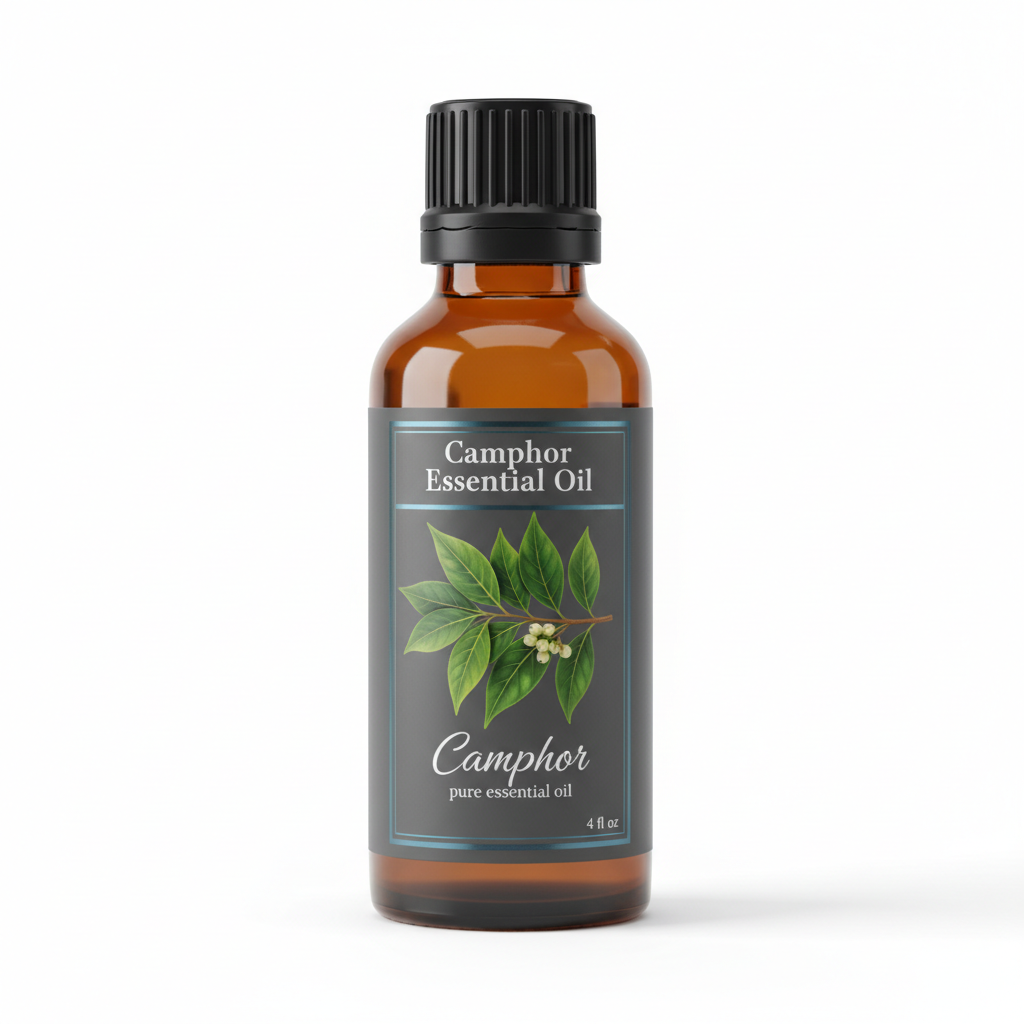
Camphor Essential Oil
Our own Camphor Essential Oil, in sizes from 0.5 oz to bulk.
From $8.69
Shop Now →The question behind the question
People who type "camphor vs peppermint oil" are usually weighing two cool-smelling bottles for the same shelf. Some of them have a headache or a stuffy room in mind. We take the scent question and the evidence question separately, because they have different answers, and because only one of the two oils has a trial record. The wider map of camphor grades is in types of camphor oil.
What is in each bottle
Peppermint oil is dominated by two compounds. In one analysis of Mentha x piperita grown in Turkey, the major constituents were menthol (22.5 to 44.6 percent) and menthone (13.8 to 37.4 percent). That spread says what the table below says too: the label "peppermint" fixes the species, not the percentages.
White camphor oil is a fraction rather than a whole oil. The Tisserand Institute notes that the crude oil is filtered to remove crystalline camphor and then fractionally distilled, and that the white fraction contains very little camphor (up to 9 percent, more typically 3 percent). So the smell of camphor oil is not "the smell of camphor crystals." Our own white fraction is described on Inside the Still; the posted certificate lists physical constants, not a GC/MS, so we cannot quote its composition.
| Peppermint oil | White camphor oil | |
|---|---|---|
| Source | Leaves of Mentha x piperita | Wood distillate of Cinnamomum camphora, white fraction |
| Main constituents | Menthol 22.5 to 44.6%, menthone 13.8 to 37.4% (one study) | Varies by lot and chemotype; camphor itself low (Tisserand Institute: up to 9%, typically 3%) |
| Scent | Sweet, minty, bright | Dry, woody, cool, more mineral |
| Published trials on topical use | Yes, mainly for tension-type headache | None found in our search |
| Taken by mouth | Sold in enteric-coated capsules, discussed by NCCIH | Never; a poisoning hazard |
What the evidence looks like for each
The headache literature is the main reason peppermint oil gets compared to anything. A 2016 review by Göbel and colleagues states that 10 percent peppermint oil in ethanol is licensed for tension-type headache in adults and children above 6 years in the place the authors describe, and that it appears in clinical guidelines. The same abstract describes efficacy as comparable to aspirin or paracetamol. Two cautions. This is a short review, and the authors of the original trials are among its authors. And the preparation is a defined 10 percent ethanol solution, not a bottle of oil.
The NIH's NCCIH is more guarded. It says only that a limited amount of evidence suggests topical peppermint oil might help tension headaches, and lists rashes and irritation as possible skin side effects. We take the more cautious statement as the baseline and use Göbel as the upper bound.
For camphor, we ran a title search of Europe PMC for camphor with headache or migraine. It returned no clinical trial. It returned a 2011 report of camphor poisoning after mothballs were swallowed for a headache and a patent record. That absence is information: if a seller implies camphor oil does what peppermint's headache studies examined, there is no matching trial behind the claim. We say more in Camphor Oil and Temple Rubs.
Safety, side by side
Both oils are irritants on skin at strength, and both need dilution. The differences lie in children and swallowing.
- Children. NCCIH states that peppermint oil should not be applied to the face of infants or young children, because menthol can affect breathing in small children. Our Inside the Still page makes the same kind of warning for camphor, calling it contraindicated for infants and young children.
- Swallowing. NCCIH describes oral peppermint oil as appearing safe at commonly used doses, with heartburn, nausea and abdominal pain as possible side effects. Camphor has no equivalent. A poison-center guideline panel recommended emergency department referral for anyone who has ingested more than 30 mg/kg of a camphor product or who has convulsions, lethargy or ataxia.
Never let the first bullet suggest the second. The fact that peppermint oil is sold in capsules says nothing about camphor oil. If anyone swallows camphor oil, call US Poison Control at 1-800-222-1222 at once, and call 911 for seizures or breathing trouble.
How we would choose, in a purchase conversation
This is judgment, not a trial result.
- If you want a sweet, minty top note for a room spray or soap, peppermint is the right material and camphor is not an upgrade.
- If you want a dry, clean, woody cool note under blends of conifer or citrus, a white camphor fraction does a different job. That is the oil we sell, in dark amber glass from 0.5 oz to 400 lb, in the shop.
- If your real question is about headaches, neither oil is our product recommendation. Ask a physician or pharmacist, and read the evidence above for what peppermint trials actually examined.
- If a child will be anywhere near the bottle, store it out of reach and use neither on the face.
Our recommendation against buying camphor to substitute for peppermint is deliberate. The two do not share a scent, a trial record, or a safety profile.
What to ask a seller before buying either
The two composition figures above are the practical reason to ask questions. For peppermint, the species on the label matters. The Soltanbeigi study names Mentha x piperita and Mentha arvensis as the two prominent menthol-bearing species in the oil trade, and a bottle sold simply as "mint" may be either. Ask which species it is and what the menthol and menthone percentages are on the lot report.
For camphor, ask which fraction it is. A "camphor oil" without a fraction named could be the white cut, the brown or yellow cuts that the Tisserand Institute says are high in safrole and not usually sold on the open market, or something else. Safrole is described by the same source as a carcinogen, which is why we ask for a safrole result on every lot and give it when you ask. That is a statement about our process, not a published figure: no safrole number appears on our certificate, and we would rather you ask than assume.
The same questions apply to any other seller. A shop that cannot say which fraction, which species, or which lot has told you something, whichever oil you are buying. The longer buying checklist is in how to choose high-quality camphor oil, and the grade system is laid out in types of camphor oil.
Scent in a blend, reasoned rather than tested
We have no scent-panel data and are not claiming any. What follows is reasoning from the composition above. Menthol-rich peppermint is a sweet, high, forward note, and a little goes a long way in a blend. A white camphor fraction with little camphor in it is a drier, quieter, more woody cool note. The practical consequence for a blender is that they occupy different places in a blend: mint at the front, the camphor fraction as a dry base under it. If the mint is overwhelming, adding more camphor will not rebalance it. Cutting the mint will. Treat that as a starting hypothesis to test with a blotter and a notebook, not a result.
Use the same hesitation on skin. Both oils are irritants at strength, which is why NCCIH lists rashes and irritation among peppermint oil's possible skin effects and why our own page tells camphor users to dilute hard. Patch-test any new oil on a small area before wider use, and stop if the skin reacts.
Where the pair gets blended
Camphor and mint are paired often in fragrance work because the dry note gives the mint some depth. Start with the scent logic in our three-way comparison. For the molecular side of mint versus camphor, see Camphor vs Menthol; for eucalyptus see Camphor vs Eucalyptus Oil. For dilution arithmetic use the dilution guide, and keep in mind that peppermint oil's published headache preparation (10 percent in ethanol) is not a general dilution rule for either oil.
Questions we get asked
Does camphor oil do what peppermint oil does for headaches?
We found no trial of camphor oil for headaches. Peppermint oil has trials, mainly of a 10 percent ethanol preparation. We do not offer our oil for that purpose.
Is peppermint oil safer than camphor oil?
It has a different profile, not a simple ranking. Peppermint oil has a published record of oral use and topical trials; camphor has a documented poisoning risk and never goes in the mouth. Both are kept from children's faces.
Can I blend them?
In a diffuser or room blend, yes, with the usual caution about potency. We keep ratios modest.
This article is an evidence review, not medical advice. For headaches or any health concern, consult a physician or pharmacist.
Camphor Essential Oil
Camphor Essential Oil from our own shop, in sizes from 0.5 oz to bulk.
From $8.69
Shop Now →Sources & Further Reading
- Soltanbeigi A et al. Planting date and cutting time effects on the essential oil of Mentha x piperita and M. arvensis. 2022
- Tisserand Institute. Cinnamomum camphora: its many names and chemotypes
- Göbel H et al. Peppermint oil in acute tension-type headache (review). 2016
- NCCIH. Peppermint oil
- Camphor poisoning following ingestion of mothballs "for headache". 2011
- Manoguerra AS et al. Camphor poisoning: an evidence-based practice guideline. 2006
- Poison Control (US poison centers), 1-800-222-1222