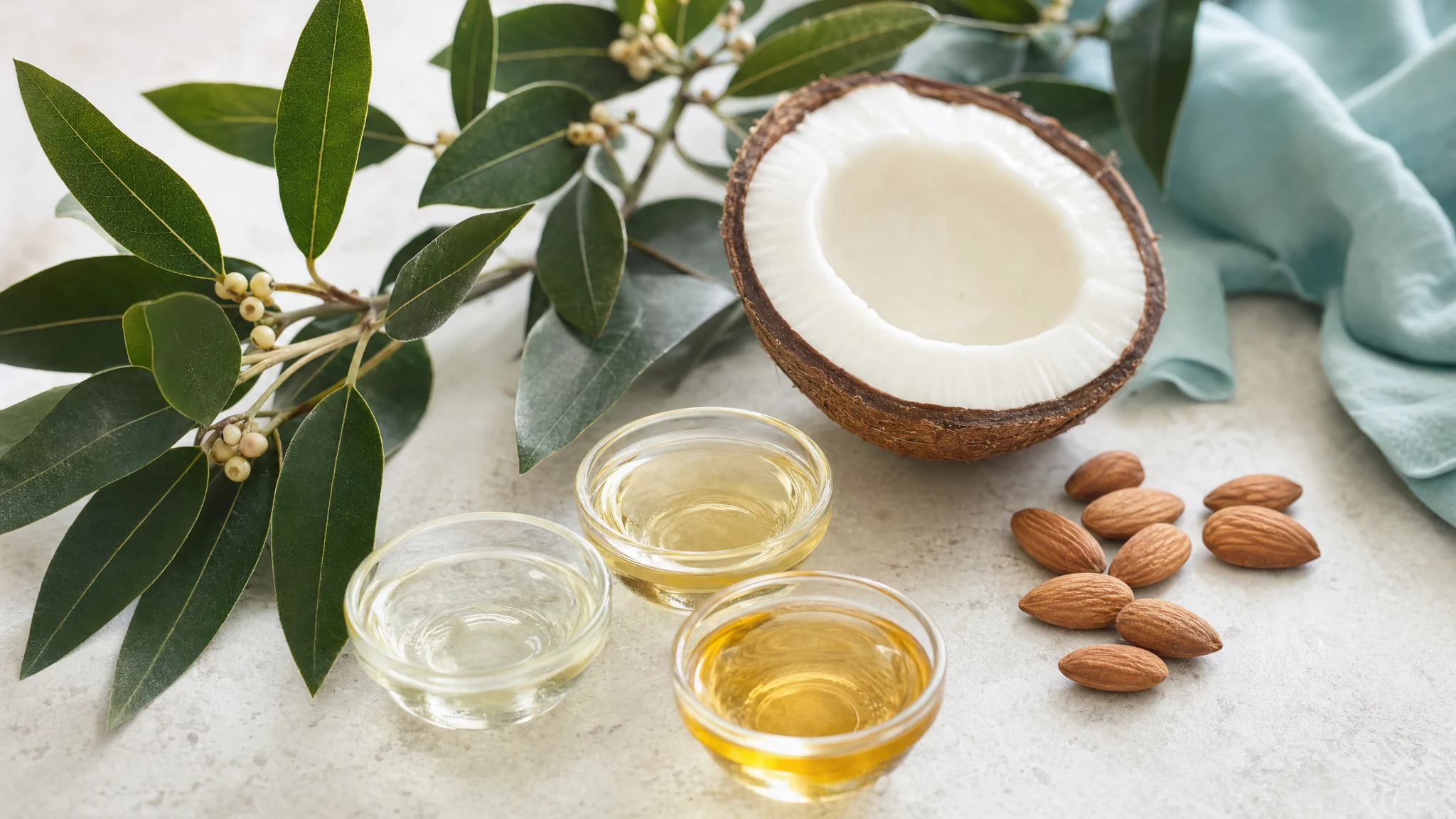
Best Carrier Oils for Camphor: Jojoba, Almond, Coconut
Jojoba for a blend that will sit on a shelf, sweet almond for a small batch you will finish quickly, coconut where you want firmness, as in a balm. That is our short answer for pairing a carrier with camphor oil, and the reasoning behind it is about storage, not about which oil is the most "nourishing".
Camphor Essential Oil
Our own Camphor Essential Oil, in sizes from 0.5 oz to bulk.
From $9.99
Shop Now →Ask how long it will sit
Most carrier lists rank oils by feel. Camphor oil raises a more practical set of questions. It is potent and volatile, so it has to be spread through a good amount of carrier. A blend in a bottle that gets opened repeatedly will age, and the skin it lands on may react. The European Food Safety Authority's opinion on a commercial white camphor oil describes the material as an irritant to skin and eyes and a skin and respiratory sensitiser (EFSA, camphor white oil). That assessment covers one specification for animal feed, not our oil, but it is a fair reminder that the carrier is not the only thing on the skin. We would start with the dilution, since it decides how much carrier you need to buy at all. We recommend 0.5% to 2% in a carrier and a patch test first; if you are formulating for others, check IFRA standards for your product type.
What we know about the three
A review of plant oils for skin describes jojoba as having a high oxidative stability and resistance to degradation, and notes its high wax-ester content. The same review lists coconut oil as mostly saturated fat, with lauric acid at 49% (Lin, Zhong and Santiago, Int J Mol Sci, 2018). Sweet almond is the more unsaturated of the three, which is why it is not the one to leave for months. That is reasoning from how fats behave, not a measured shelf life, and we will not invent a number of months for any of them. Buy the smallest bottle you will use up, date the jar and smell it before each batch.
| Carrier | Why we reach for it | Best for | Worth knowing |
|---|---|---|---|
| Jojoba | High oxidative stability; wax ester | Roll-ons and blends made ahead | Choose plain jojoba with nothing added |
| Sweet almond | Light and easy to work with | Small body-oil batches used quickly | Almond is a tree nut, and FDA lists tree nuts among the major food allergens (FDA, food allergies), so skip it for anyone with a tree-nut allergy |
| Virgin coconut | Mostly saturated and stable | Balms and solid blends | Sets firm in a cool room, so it behaves differently in a roll-on than in a jar; see camphor and coconut oil |
The firmness comment is reasoning too: fats that are mostly saturated tend to be firmer at room temperature. Try a small jar before filling a roll-on.
Why we do not talk about absorption
You will see claims that one carrier "carries camphor deeper" or that another is "absorbed faster". We have found no source comparing how carriers change the amount of camphor or cineole that reaches or passes through skin, so we leave those claims out. With a potent oil, advice built on a guess is not worth much.
Our order of choices
- Will the blend be stored? If yes, jojoba. If you will use it in one batch, sweet almond is a sound, often cheaper option for anyone without a nut allergy.
- Does it need to be firm? If so, coconut, or a wax-based balm as in the DIY vapor rub and muscle balm articles.
- Does the person have any sensitivity to the carrier? If so, that carrier is out, whatever the list said.
One habit we would drop is mixing a big batch to save time. A large batch left standing is where a less stable carrier is most likely to go off, and where the bottle will have been opened the most.
Smell the carrier first
Before you add any camphor, open the carrier on its own. Jojoba is nearly scentless, sweet almond has a faint, soft nutty note, and virgin coconut smells unmistakably of coconut. That matters because camphor is a top note: it will sit over the carrier for the first few minutes and then the carrier is what remains. If the carrier smells stale or like old crayons, it has gone off, and no amount of camphor will hide it.
Measuring
The Tisserand Institute reports that across three studies the average weight of 20 drops of essential oil was 0.66 g, about 30 drops per millilitre, with studies ranging from roughly 20 to 40 (Tisserand Institute, drop size). Percent times volume gives millilitres of oil, and millilitres times 30 gives average drops:
| Oil in carrier | In 15 ml | In 30 ml |
|---|---|---|
| 0.5% | about 2 drops | about 4 to 5 drops |
| 1% | about 4 to 5 drops | about 9 drops |
| 2% | about 9 drops | about 18 drops |
Those totals cover all essential oils combined, so a blend such as those in our camphor pairings guide has to share them. Past a few drops, weigh the oil on a small scale.
Who should skip a camphor blend
A camphor and carrier blend is a skin product, and it is not for everyone. Keep it away from children and from the face. If you are pregnant or breastfeeding, have a seizure history or asthma, speak to a physician or pharmacist first. A blend also looks like plain body oil, so label it and store it high up. If anything is swallowed, call Poison Control at 1-800-222-1222. We sell camphor oil only, so carriers come from a carrier-oil supplier or the grocery or pharmacy shelf.
Whichever carrier you choose, a small, dated batch in a dark bottle will serve you better than a large one that sits.
Camphor Essential Oil
Camphor Essential Oil from our own shop, in sizes from 0.5 oz to bulk.
From $9.99
Shop Now →Sources & Further Reading
- EFSA. Safety and efficacy of camphor white oil as a feed additive. PMC8756382
- Lin TK, Zhong L, Santiago JL. Review of topical plant oils and skin barrier repair. Int J Mol Sci. 2018. PMC5796020
- Tisserand Institute. How big is a drop? tisserandinstitute.org/learn-more/drop-size
- FDA. Food allergies. fda.gov