Camphor Rubs and Joints: The Cooling Distraction Explained
A camphor rub on a sore knee feels like something is happening, and something is: the skin goes cool and tingly. The more interesting question is whether that cooling does anything for the joint underneath, and the honest answer is that it is a distraction, not a change in the joint.
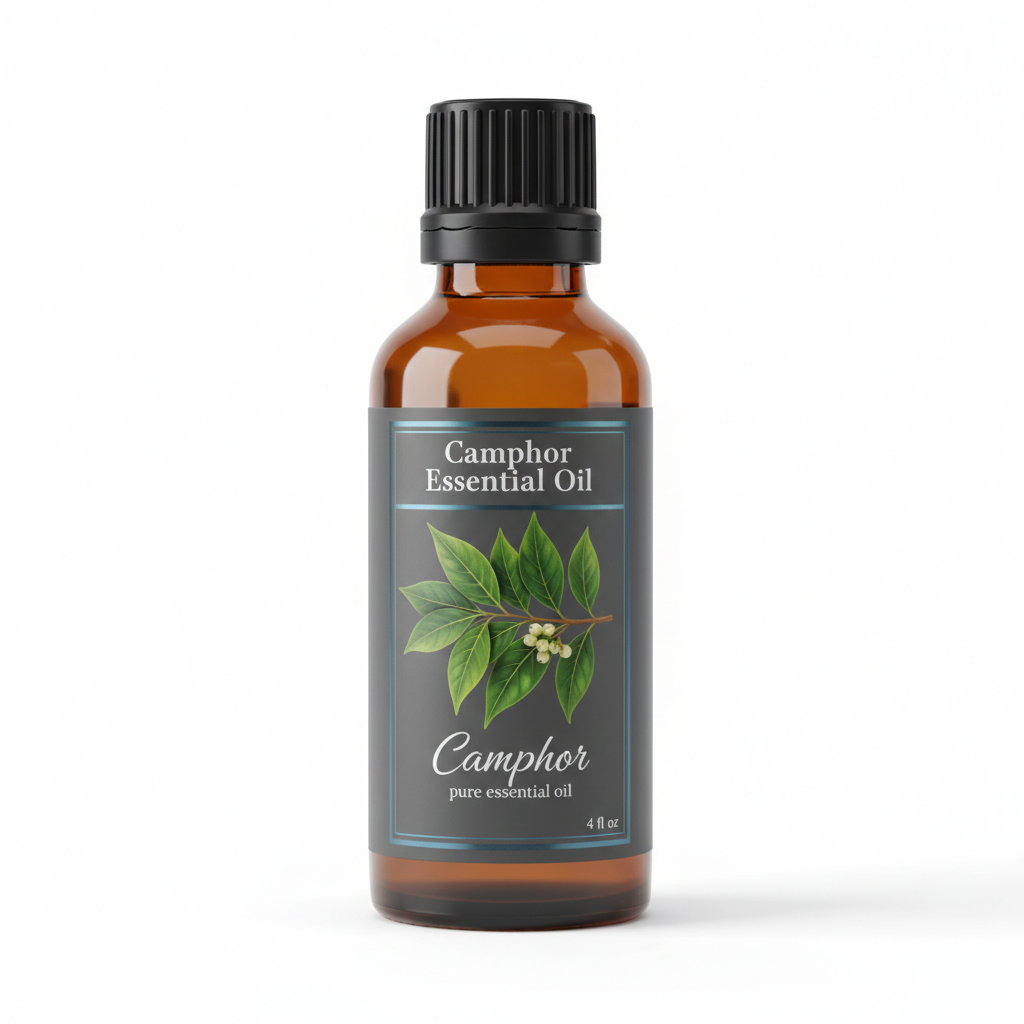
Camphor Essential Oil
Our own Camphor Essential Oil, in sizes from 0.5 oz to bulk.
From $9.99
Shop Now →Anyone who has stood in a pharmacy aisle smelling the jars knows the pull of a cooling rub. There is something almost theatrical about it. The smell announces itself, the skin tingles, and you feel as though you have done something. We think that is a perfectly human thing to enjoy, as long as the story you tell yourself matches what is really happening.
What a counterirritant is
The Arthritis Foundation groups menthol and camphor products as counterirritants. In its words, they "don't affect pain signals or inflammation, but rather work by producing a cooling sensation to distract from the pain," and improvements "may disappear once the cooling sensation wears off." We like that candor. It gives a clear mental picture: a loud, pleasant sensation on the surface competing for your attention with the quieter ache below.
The science of the sensation is solid. Camphor activates the cold-sensing channel TRPM8, according to a 2013 Chemical Senses study, so the cooling is real. Whether it matters to a particular person is a subjective call, and the studies show how hard it is to test fairly.
The camphor trial, and what it can and cannot say
The camphor study people reach for is Cohen and colleagues in the Journal of Rheumatology in 2003: 63 people with knee osteoarthritis used a topical cream containing glucosamine sulfate, chondroitin sulfate and camphor, or a placebo cream, as needed over 8 weeks. Pain on a visual analog scale fell by an average of 3.4 cm in the active group and 1.6 cm in the placebo group, a gap of 1.8 cm at 8 weeks.
It is tempting to read that as "camphor cream helps knees." The cream had three ingredients and there was no camphor-only group, so camphor's own contribution cannot be separated. It is a signal about one combination, not about camphor. The menthol study people often cite, by Topp and colleagues in 2013, tested 3.5% menthol gel against an inert gel in 20 people with knee osteoarthritis and found no significant differences between the gels, though that is a menthol study, not a camphor one. Together they show how hard this question is to answer cleanly.
Enjoying the sensation honestly
If you simply love the idea of a cool, crisp aroma, that is a good enough reason to keep a bottle on the shelf. Open it and you will notice the sharp, crystalline front and the dry woody base, and that is the experience our oil offers. It is a pleasure of the nose, and it is best kept in that lane.
It also helps to keep the order of operations clear: if a joint is bothering you, the first step is somebody who can look at it, and the cooling, scented extras come second.
What guidelines name
The 2019 American College of Rheumatology and Arthritis Foundation guideline for osteoarthritis of the hand, hip and knee strongly recommends topical NSAIDs for knee osteoarthritis and conditionally recommends topical capsaicin for the knee. Camphor is not named in the abstract we read. We read that as camphor not being part of the headline recommendations and nothing stronger. If you want to compare what is in common rubs, camphor rubs compared looks at that, and our sore muscles article covers the neighboring question.
Practical points from the Arthritis Foundation and the labels
The Arthritis Foundation advises applying topicals only to intact skin and avoiding tight bandages and heating devices with them. Heat plus a counterirritant is a combination we would repeat to anyone. Persistent joint discomfort, swelling, redness, warmth or lost movement is a physician's question, and a rheumatologist's if arthritis is suspected. A pharmacist can talk through the options for your situation and any interactions.
A bottle of our oil is a different thing from a labeled rub. It is a neat, undiluted aromatic with no drug labeling, so it does not come with a known percentage or directions. We recommend diluting to 0.5% to 2% in a carrier before any skin contact, patch testing first, keeping it away from the eyes, and keeping it away from children and pets; our safety guide covers who should skip it, and our benefits overview shows the wider picture. We sell an external cosmetic oil, and nothing here is medical advice.
A note on the bottle in your hand
Because our oil is neat and undiluted, treat the bottle with the respect you would give any strong aromatic. Close the cap tightly after each drop, wipe up spills straight away, and wash your hands before you touch your face or eyes.
It is rather lovely that a scent can feel like an event on the skin. Enjoy it for what it is, and bring the joints to someone who can examine them.
Camphor Essential Oil
Camphor Essential Oil from our own shop, in sizes from 0.5 oz to bulk.
From $9.99
Shop Now →Sources & Further Reading
- Arthritis Foundation, topical treatments for arthritis pain
- Cohen et al., topical cream with glucosamine, chondroitin and camphor for knee osteoarthritis, J Rheumatol 2003
- Topp, Brosky and Pieschel, topical menthol or placebo in knee osteoarthritis, J Geriatr Phys Ther 2013
- Kolasinski et al., 2019 ACR/Arthritis Foundation osteoarthritis guideline
- Selescu et al., camphor activates and sensitizes TRPM8, Chemical Senses 2013