Is Camphor Oil Safe? A Complete Safety Guide
Camphor oil is not safe to swallow, and it is not a casual oil around young children, pregnant or breastfeeding people, or pets. Swallowed camphor can cause seizures within minutes to an hour. For a healthy adult using it only as an aroma, in a ventilated room, with the bottle locked away, the risk is manageable. It is never zero.
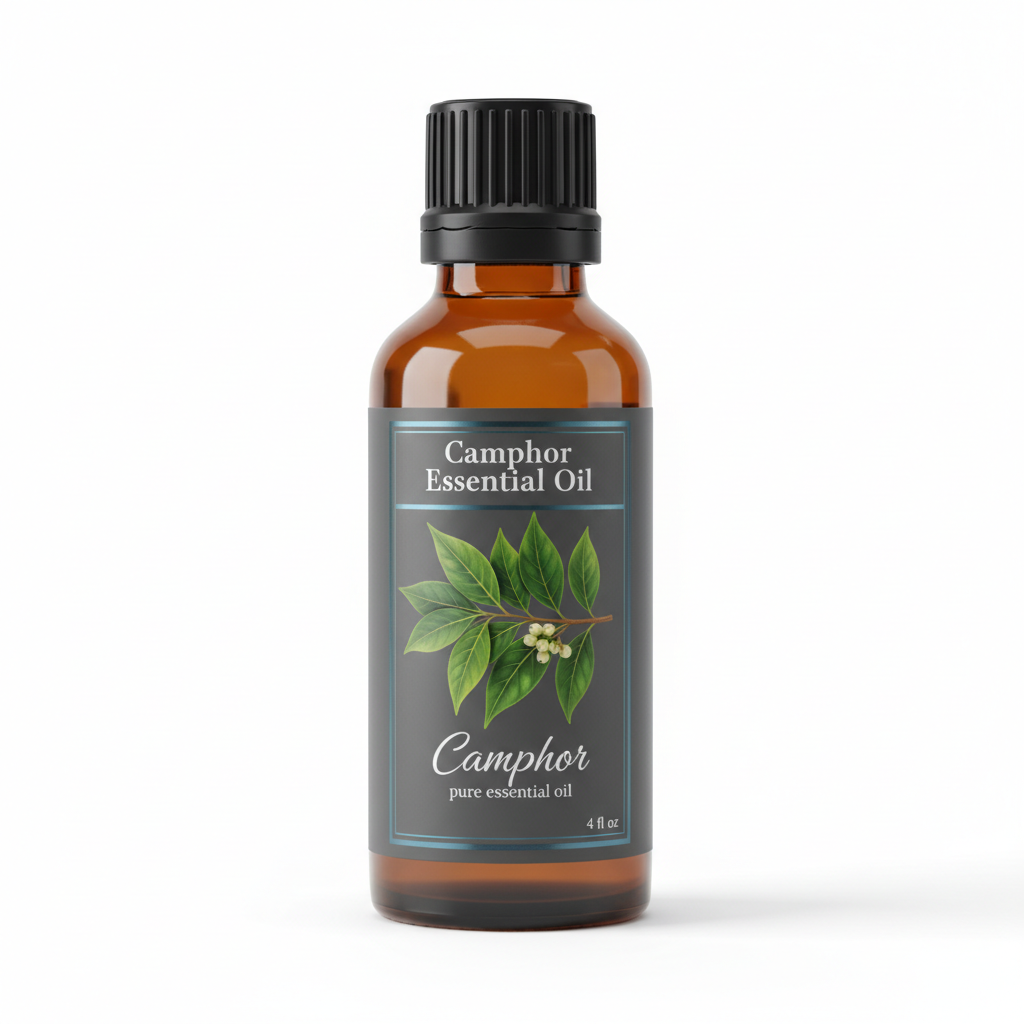
Camphor Essential Oil
Our own Camphor Essential Oil, in sizes from 0.5 oz to bulk.
From $8.69
Shop Now →
Quick answer
- Swallowing: the main danger. Poison center experts treat more than 30 mg of camphor per kilogram of body weight as the point for emergency department referral, and symptoms can start within minutes.
- Children: the highest-risk group. Toddlers have been hospitalized with seizures after swallowing camphor or after repeated rubbing on the skin.
- Pregnancy and breastfeeding: we found no authority that establishes safe use, and camphor crosses the placenta. The conservative answer is to ask an OB-GYN or midwife first.
- Pets: Pet Poison Helpline says camphor should never be applied to dogs or cats.
- Grade: white camphor is the only fraction we sell, because brown and yellow fractions carry safrole.
- If someone swallowed it: call Poison Control at 1-800-222-1222, or 911 if there is a seizure, trouble breathing, or the person cannot be awakened.
The rest of this guide explains the reasoning, so you can judge your own household instead of following a generic rule. Our shorter handling notes are in this dilution and handling guide.
Why camphor is hazardous
Camphor is a small, fat-soluble molecule that is absorbed quickly. The Royal Children's Hospital Melbourne poison guideline says gastrointestinal irritation and central nervous system depression may occur above 10 mg/kg, serious toxicity has been reported above 30 mg/kg, and symptoms can begin 5 to 15 minutes after swallowing. Seizures usually occur within 90 minutes (Royal Children's Hospital).
A US poison center guideline by Manoguerra and colleagues reviewed national data and found about 10,000 camphor ingestion exposures per year from 1990 to 2003. Most were minor: roughly 70 to 90 a year reached moderate outcomes and 10 to 15 reached severe outcomes. Most people without complications recovered within 24 hours (Manoguerra et al., Clinical Toxicology, 2006). Both readings are true at once: most exposures stay mild, and the severe ones can come on fast and without warning.
The same guideline notes that, in the cases it reviewed, toxicity did not progress after the product had been thoroughly washed off the skin. That is not a reason to be relaxed about skin. A 2009 report in Pediatrics described three children aged 15 to 36 months with seizures from imported camphor; two swallowed it and one was exposed through repeated rubbing on the skin (Khine et al., 2009).
The mechanism of camphor-induced seizures is unknown, according to a case report from a Paris children's hospital (Guilbert et al., 2007). That matters for how you read the risk. Nobody can tell you a dose below which an individual child is certainly fine.
One more limit worth stating plainly. Almost all of the dose data come from camphor products sold as drugs, such as camphorated oil and chest rubs, and from case reports. Our COA lists physical constants only, so it does not tell you what percentage of the oil is camphor. Do not convert drops of any essential oil into a milligram dose and assume it is safe. If you need the arithmetic for a real exposure, the poison center will do it with the actual product in hand. For symptoms and first steps, see the poisoning section below.
Safety by person: who should avoid camphor oil
This matrix is our reading of the sources above, written as a position. It is not medical advice. Anyone with a medical condition should ask a physician or pharmacist.
| Who | What the sources say | Our position |
|---|---|---|
| Children under 2 | OTC camphor product labels under the FDA external analgesic monograph read: children under 2 years of age, do not use, consult a doctor. The AAP Committee on Drugs recommended in 1994 that camphor not be used in children. | Do not use or diffuse it in a child's space. Ask a pediatrician. |
| Children 2 and older | No authority we found sets an age at which camphor essential oil is established as safe. Camphor-containing OTC rubs exist for ages 2 and up as regulated drug products. | Keep it out of reach. Treat the oil as unsuitable for children's skin and rooms. |
| Pregnant people | Camphor crosses the placenta (Guilbert, 2007). | Ask an OB-GYN or midwife before any use. |
| Breastfeeding | The e-lactancia database rates camphor as limited compatibility and says no milk excretion data are published. | Ask your OB-GYN, midwife, or pediatrician. |
| People with epilepsy or past seizures | The mechanism of camphor seizures is unknown. Case series of seizures after camphor-containing herbal products exist; none isolate camphor alone. | Ask a neurologist before use. We found no rule worth trusting beyond that. |
| Asthma or sensitive airways | Authors of a 2017 paper on infant balm use cite animal evidence that camphor and menthol balms may worsen breathing. | Skip strong aromatics unless a physician says otherwise. |
| Dogs and cats | Pet Poison Helpline: camphor is readily absorbed across the skin and should never be applied to dogs or cats. | Keep the oil away from pets. See the pet safety article. |
| Healthy adults | Skin irritation is a recognized effect; allergic contact dermatitis to camphor is described in a few case reports. | Aroma use only, ventilated space, patch test before any skin use. |

Which grade is safest: white, brown or yellow
Crude camphor oil is split into fractions, and they are different materials. Brown and yellow fractions are where safrole concentrates. IARC reviewed safrole in 1976 and found it carcinogenic in mice and rats, producing liver tumours after oral administration; that evaluation is the basis of its Group 2B listing, which describes hazard rather than risk at a given exposure (IARC Monographs Vol. 10). This is why we only sell the white fraction, and why the safer-grade question is about safrole, not about camphor itself. White camphor is still camphor. All the neurotoxicity above applies to it.
The comparison, with the limits of what we can show:
| Fraction | Safrole concern | Where we stand |
|---|---|---|
| White | Lowest; the cut that should not carry safrole | What we sell. See white vs brown vs yellow camphor oil. |
| Brown | Safrole concentrates here | We do not sell it and would not recommend buying it for home use. |
| Yellow | Safrole concern as with brown | We do not sell it. |
Here is what we can and cannot document. Our Inside the Still page says our oil is the white fraction of the wood distillate, distilled and fractionated in China by a producer held on file against each lot, and that a safrole result at or below detection is asked for on every lot and given when you ask. The posted COA (batch CMPQGACCCNC003A) reports appearance, specific gravity 0.878, refractive index 1.467 and optical rotation +5.80 degrees. It has no GC/MS and no safrole figure, so the COA alone cannot prove the fraction. If safrole matters to you, ask for the lot result before you buy. If a seller will not give one for a product sold as white, that tells you something. Our one product is on the shop page in sizes from 0.5 oz to 400 lb, in dark amber glass.
Using it more safely
These are principles drawn from the hazards above, not a prescription. The details of dilution and testing belong in their own pieces: dilution and patch testing.
- Storage is the control that matters most. Most severe cases involve swallowing. Keep the bottle high, locked, and out of any child's reach. Our page describes the closure as tight, which is not the same as child-resistant, so do not rely on it to stop a child.
- Do not put it on or near the nose, face or mucous membranes. The FDA's monograph wording for camphor ointment is: for external use only, do not take by mouth or place in nostrils.
- Skin: irritation is a recognized effect, and an allergist writing for the AAAAI notes case reports of allergic contact dermatitis to camphor. Do a patch test and dilute. Never use it on broken skin.
- Diffusing: we found no study measuring camphor vapor from a diffuser in a home. Reasoning from camphor's volatility and the child and pet risks, diffuse briefly, in a ventilated room, with children and pets out of it.
- Never apply it to babies or give it by mouth, under any home-use tradition.

US regulations in brief
The rules apply to drug products, and our oil is sold as an aromatic and cosmetic material, not a drug. They still show how seriously regulators treat camphor. In 1982 the FDA issued a final rule on camphorated oil (47 FR 41716, 9/21/1982), and camphorated oil drug products now appear in 21 CFR 310.502(a)(4) among drugs requiring an approved new drug application (FDA rulemaking history; eCFR). OTC camphor products are limited to 11% camphor, a figure confirmed by a pharmacology review (Healio, citing the AAP and AAPCC) and by the case report authors cited above. FDA's external analgesic monograph lists camphor at 0.1 to 3% and, as a counterirritant, exceeding 3% to 11% (FDA OTC monograph M017). The full story is in FDA camphor rules explained.
If someone has swallowed camphor
Call Poison Control at 1-800-222-1222 right away. If the person is having a seizure, has trouble breathing or cannot be awakened, call 911 (poison.org). Keep the container. The poison center will ask the person's weight, what was swallowed, how much, and when. Do not wait for symptoms to appear. The guidelines say seizures can be the first sign of significant toxicity. Poison centers do not recommend syrup of ipecac for camphor. The full first-steps page is camphor poisoning symptoms and what to do first.
FAQ
Can camphor oil be fatal?
Yes, in sufficient doses. The Royal Children's Hospital guideline states that 0.5 to 1 g is considered a lethal oral dose in children. Deaths are rare, and a US poison center review found no fatal reports from unintentional exposures to camphor products from 1990 to 2003, but that is not a margin to test.
Is camphor oil safe for babies?
No. The AAP Committee on Drugs recommended in 1994 that camphor not be used in children, and OTC labels say not to use camphor products under age 2 without a doctor. See camphor oil and children.
Can I diffuse camphor oil around kids?
We do not recommend it. We found no data showing a safe diffuser exposure for children. A poison center guideline advises moving someone with a camphor inhalation exposure to fresh air and seeking care if symptoms develop. Ask a pediatrician before diffusing anywhere a child sleeps or plays.
Sources & Further Reading
- Royal Children's Hospital Melbourne: Camphor poisoning clinical guideline
- Manoguerra AS et al. Camphor poisoning: an evidence-based practice guideline for out-of-hospital management. Clin Toxicol 2006;44:357-70
- Khine H et al. A cluster of children with seizures caused by camphor poisoning. Pediatrics 2009;123:1269-72
- Guilbert J et al. A case of camphor intoxication with status epilepticus. Emerg Med J 2007;24:859-60
- Bell EA. Camphor use entails unique safety concerns. Infectious Diseases in Children, 2008
- FDA: Rulemaking history for OTC camphorated oil drug products
- eCFR: 21 CFR 310.502
- FDA OTC Monograph M017: External analgesic drug products
- eCFR: 21 CFR 341.74 (cough and cold, camphor labeling)
- IARC Monographs Vol. 10: Safrole
- Pet Poison Helpline: Camphor
- e-lactancia: Camphor and breastfeeding
- Bazzano AN et al. Use of camphor and essential oil balms for infants in Cambodia. J Trop Pediatr 2017
- AAAAI Ask the Expert: Camphor and menthol allergy
- Poison Control (National Capital Poison Center)