Camphor Oil Benefits and Uses: What the Evidence Says
Camphor's best-supported property is sensory: it activates and then desensitizes certain nerve channels in skin and nasal tissue, which produces a cooling feeling. The FDA recognizes camphor at set concentrations in over-the-counter drug products. Evidence for anything beyond that is thin, and our oil is sold as an aromatic material, not a drug.
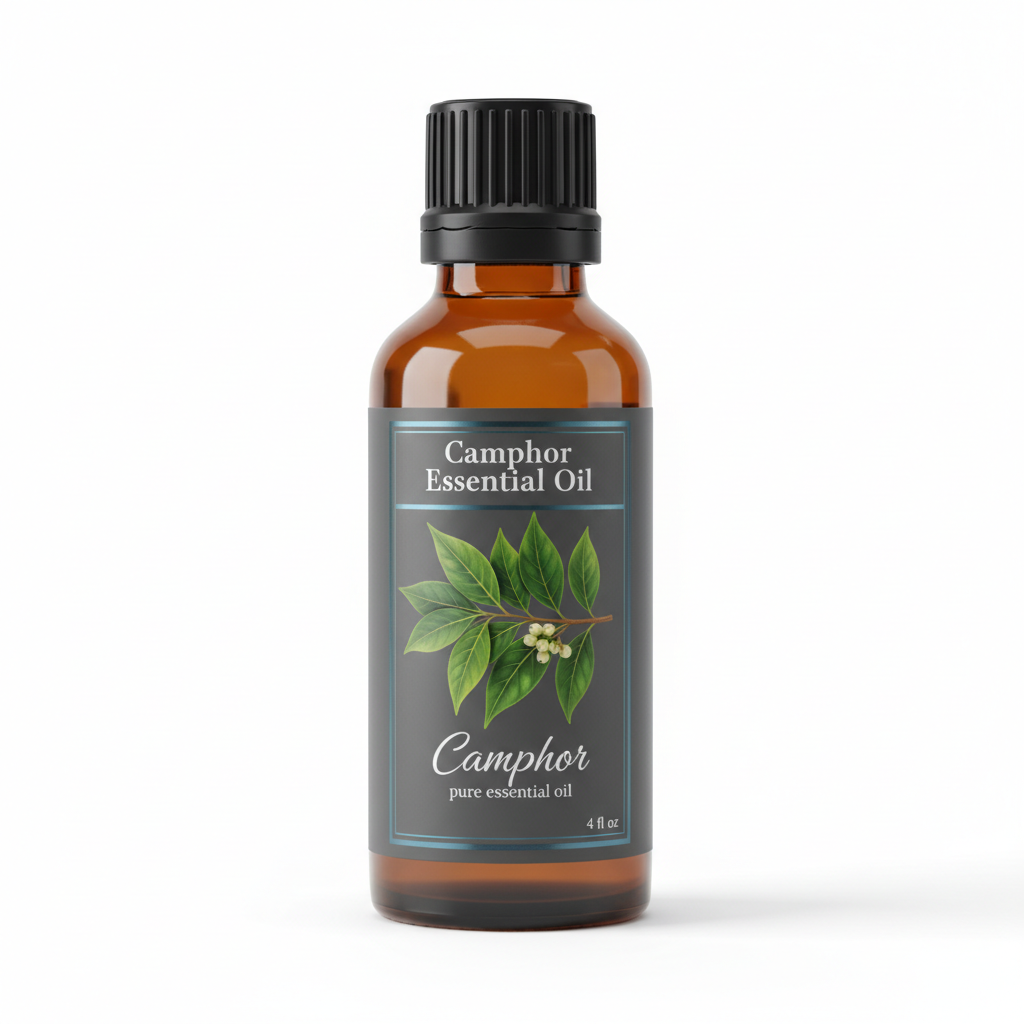
Camphor Essential Oil
Our own Camphor Essential Oil, in sizes from 0.5 oz to bulk.
From $8.69
Shop Now →How to read this page
Most pages about camphor oil benefits list ten or twelve claims and attach the word "may" to each. This one does the opposite. It sorts what is known into four kinds of evidence, says which kind each claim rests on, and says plainly where a claim stops. If you want the broader background on the plant and the oil first, start with what camphor essential oil is.
One boundary applies to everything below. We sell one product, Camphor Essential Oil from Cinnamomum camphora, as an aromatic and cosmetic material. It is not an over-the-counter drug, and nothing here says it does what a drug does. When this page mentions what regulators examined, it is describing regulated drug products with a fixed, labeled camphor percentage, which is a different thing from a bottle of undiluted oil.

The evidence table
The labels in the last column are our own reading of the sources linked in this article, not a regulator's grading. We use four levels: Moderate (several consistent human studies), Limited (a small number of human studies, or mixed results), Mechanism only (laboratory or cell work, no human outcome), and Traditional only (long use, no modern trials we could verify). No camphor use earns "Strong" here, and we would rather say so than stretch a label.
| Claim often made | What the sources show | Evidence level |
|---|---|---|
| Produces a cooling sensation | Camphor activates and then strongly desensitizes the TRPV1 channel in cell experiments, and camphor vapor produced a cold sensation in human volunteers. | Moderate for the sensation, Mechanism only for the pathway |
| Makes the nose feel more open | In a 1983 study, camphor vapor did not change measured nasal resistance, yet most subjects reported a feeling of improved airflow. | Limited (sensation, not airflow) |
| Quiets a night-time cough in children | One partly blinded trial of a camphor, menthol and eucalyptus ointment, funded by its maker, found parent-rated improvement and frequent skin and eye burning. | Limited |
| Eases sore muscles | Camphor at more than 3% up to 11% is a listed counterirritant active in the FDA OTC monograph. We did not find a placebo-controlled trial of camphor alone. | Regulatory recognition, Limited human data |
| Eases joint discomfort | One 8-week knee trial tested a cream combining glucosamine, chondroitin and camphor. Camphor's own contribution cannot be isolated. | Limited |
| Fights infection or fungus | No human evidence for camphor oil that we could verify. | Mechanism only at best |
| Traditional uses (ritual, closet, folk practice) | Long histories, no controlled human trials we could verify. | Traditional only |
What is solid: the sensation
The most defensible statement about camphor is also the least dramatic. In a 2005 paper in The Journal of Neuroscience, Xu, Blair and Clapham reported that camphor activates the TRPV1 channel, the same channel capsaicin acts on, though it needs higher concentrations, and that it desensitizes the channel faster and more completely than capsaicin does. The same paper found that camphor repeatedly applied sensitizes TRPV3 and inhibits TRPA1. That is cell-level work, and the authors themselves noted the TRPV3 result sits awkwardly with a numbing role.
The human counterpart is older. Burrow, Eccles and Jones (Acta Oto-Laryngologica, 1983) compared five minutes of camphor, eucalyptus or menthol vapor with exercise. The vapors did not change nasal airflow resistance. Most subjects nonetheless reported a cold sensation and a feeling of improved airflow, and the authors concluded that all three stimulate cold receptors in the nose. A 1990 menthol study from the same group, in 62 people with colds, found the same split: measured resistance did not change while the feeling of an open nose did.
This is the point we think matters most for a buyer. Cooling is a real, reproducible sensation. It is not the same as a change in how much air moves, and it is not a health outcome. Anyone selling camphor on the strength of "opens the airways" is quoting the sensation as if it were the airflow.
What regulators examined
The FDA's over-the-counter monograph for external analgesic products, posted as Monograph M017 (a final administrative order effective March 27, 2020, carrying forward the earlier rulemaking), lists camphor in two places. At 0.1% to 3% it appears among the analgesic, anesthetic and antipruritic active ingredients. At more than 3% up to 11% it appears as a counterirritant, in the group it calls "irritants that produce cooling sensation," alongside menthol at 1.25% to 16%. The same order requires label warnings such as "For external use only," "Avoid contact with the eyes," and "Do not apply to wounds or damaged skin," and its directions say children under 2 should not use these products without consulting a doctor.
| Regulatory fact | Source |
|---|---|
| Camphor 0.1% to 3% listed among external analgesic, anesthetic and antipruritic actives | FDA OTC Monograph M017, section M017.10 |
| Camphor exceeding 3% to 11% listed as a counterirritant (cooling sensation) | FDA OTC Monograph M017, section M017.12 |
| Topical cough-suppressant ointment containing 4.7% to 5.3% camphor | 21 CFR 341.74(d)(2) |
| "Camphorated oil" drug products require an approved new drug application | 21 CFR 310.502(a)(4) |
| Over-the-counter camphor products cannot exceed 11% camphor | Manoguerra et al., 2006 (AAPCC guideline) |
Read those rows as facts about drug products. A drug product has a stated percentage, a labeled use, and warnings tested through a regulatory process. A bottle of essential oil has none of those. Its camphor share is a property of the lot, and undiluted oil is nowhere near a 3% to 11% preparation. Our posted certificate of analysis lists physical constants (specific gravity 0.878, refractive index 1.467, optical rotation +5.80 degrees), not a camphor percentage, so it cannot tell you what percentage of camphor is in the bottle either.

Where the evidence is thin
Three limits are worth stating plainly, because they are the places where a benefits list usually overreaches.
The cough trial. Paul and colleagues (Pediatrics, 2010) randomized 138 children aged 2 to 11 to a camphor, menthol and eucalyptus ointment, petrolatum, or nothing. Parents rated the ointment group best. But the no-intervention arm was not blinded, parents of children with a burning sensation likely knew which arm they were in, every group improved, and the funder was the product's manufacturer. Of 44 children in the ointment group, 20 had at least one adverse event, mostly skin, eye or nose burning. The ointment was a finished product with all three ingredients, so camphor's share cannot be separated.
The joint trial. Cohen and colleagues (Journal of Rheumatology, 2003) randomized 63 people with knee osteoarthritis to a cream containing glucosamine sulfate, chondroitin sulfate and camphor or a placebo cream and reported lower pain scores at 8 weeks. There was no camphor-only arm. The 2019 American College of Rheumatology and Arthritis Foundation guideline, in the abstract we read, recommends topical NSAIDs for knee osteoarthritis and conditionally recommends topical capsaicin, and does not mention camphor.
The review that does not apply. The Cochrane review of rubefacients for musculoskeletal pain (Derry and colleagues, 2014) concluded the evidence does not support salicylate-containing rubefacients. Every included trial used a salicylate, so it neither supports nor undermines camphor. We mention it because it is often cited in both directions.
Uses that do not need a medical claim
Much of what people actually do with camphor oil is aromatic or practical: scenting a diffuser, a closet, a candle or a linen spray. Those uses have no clinical trials because nobody needs one to decide whether they like the smell. Our guide to camphor oil at home covers them in the order we would decide them. For topical use, the questions are about dilution and skin tolerance first, which we cover in the dilution guide.
If an aromatic material is what you want, our oil is described on the Inside the Still page: the white fraction of the wood distillate, distilled and fractionated in China by a producer held on file against each lot, in dark amber glass, from 0.5 oz to 400 lb. Browse the sizes in the shop. We regard it as an aromatic ingredient and make no claim that it does anything medical.
Who should not use it, and why we are blunt about it
Camphor is neurotoxic in quantity. The 2006 American Association of Poison Control Centers guideline reports that national poison center data from 1990 through 2003 showed roughly 10,000 camphor ingestion exposures a year, that generalized convulsions are often the first sign of significant toxicity, and that severe toxicity still occurs with the lower-concentration products on the market. It recommends emergency department referral for anyone who has ingested more than 30 mg/kg of a camphor-containing product or shows moderate to severe symptoms. A Bronx case series in Pediatrics (Khine and colleagues, 2009) described three children aged 15 to 36 months with seizures, two after swallowing camphor and one after repeated skin rubbing.
So the practical rules are short. Never swallow it. Keep it where a child cannot reach it. Do not use it on or near the face of a small child. People with a history of seizures, people who are pregnant or breastfeeding, and anyone with a health condition should ask a physician or pharmacist first. In the US, poison control is 1-800-222-1222. Our safety guide goes through the groups one by one.

Our position
If you came here asking whether camphor oil "works" for a body complaint, the honest answer from the sources is that camphor reliably produces a cooling sensation, regulators recognize it at specific percentages in finished drug products, and the human trials that exist are small, partly industry-funded or confounded by other ingredients. That is not nothing, but it is not a case for buying an essential oil to use as medicine. For muscle and joint questions, read the muscle article and the joint article; for chest rubs, read the chest-rub article, which explains why a cooling feeling and clearer breathing are different things. The wider literature is mapped in our research roundup.
When a health question is real, a physician or pharmacist is the right person, and an OTC product with a labeled percentage is a better-defined thing to ask them about than a bottle of oil.
Frequently asked questions
Is camphor oil the same as the camphor in a product like Vicks VapoRub?
No. That is a finished OTC product with a stated camphor percentage (the Drug Facts label we read lists 4.8%, as synthetic camphor), an ointment base and drug labeling. Essential oil is a mixture whose camphor share varies by lot.
Is there a strong study showing camphor oil works?
Not one we could verify. The human work is small, mixed, often a combination product, and sometimes industry-funded. The sensation is well documented. Outcomes beyond the sensation are not.
Can I use camphor oil as a replacement for an OTC rub?
We would not suggest that. An OTC rub has a labeled percentage, directions and warnings. Undiluted essential oil has none of them, and camphor toxicity is dose-related.
Last reviewed
Sources were last checked in October 2026. This page has not been reviewed by a physician or pharmacist, and nothing on it is medical advice.
Sources & Further Reading
- FDA OTC Monograph M017: External Analgesic Drug Products for OTC Human Use
- 21 CFR 341.74, labeling of antitussive drug products (camphor ointment and steam inhalation percentages)
- 21 CFR 310.502, certain drugs accorded new drug status (camphorated oil)
- FDA: Rulemaking history for OTC camphorated oil drug products
- Vicks VapoRub Drug Facts label (camphor 4.8%, menthol 2.6%, eucalyptus oil 1.2%)
- Manoguerra AS et al. Camphor poisoning: an evidence-based practice guideline for out-of-hospital management. Clin Toxicol 2006
- Xu H, Blair NT, Clapham DE. Camphor activates and strongly desensitizes TRPV1. J Neurosci 2005
- Burrow A, Eccles R, Jones AS. Effects of camphor, eucalyptus and menthol vapour on nasal resistance and sensation. Acta Otolaryngol 1983
- Eccles R, Jawad MS, Morris S. Oral menthol, nasal airflow resistance and sensation in common-cold congestion. J Pharm Pharmacol 1990
- Paul IM et al. Vapor rub, petrolatum, and no treatment for children with nocturnal cough and cold symptoms. Pediatrics 2010
- Cohen M et al. Topical cream with glucosamine sulfate, chondroitin sulfate and camphor for knee osteoarthritis. J Rheumatol 2003
- Kolasinski SL et al. 2019 ACR/Arthritis Foundation guideline for osteoarthritis of the hand, hip and knee
- Derry S et al. Salicylate-containing rubefacients for musculoskeletal pain in adults. Cochrane 2014
- Khine H et al. A cluster of children with seizures caused by camphor poisoning. Pediatrics 2009