What's in White Camphor Oil? A Look at Its Chemistry
Say "camphor oil" and most people picture a bottle that is mostly camphor, the crystalline compound behind that sharp, cool scent. White camphor oil turns that idea upside down. In the published analyses, camphor is a minor player, and the lead role goes to a compound better known from eucalyptus.
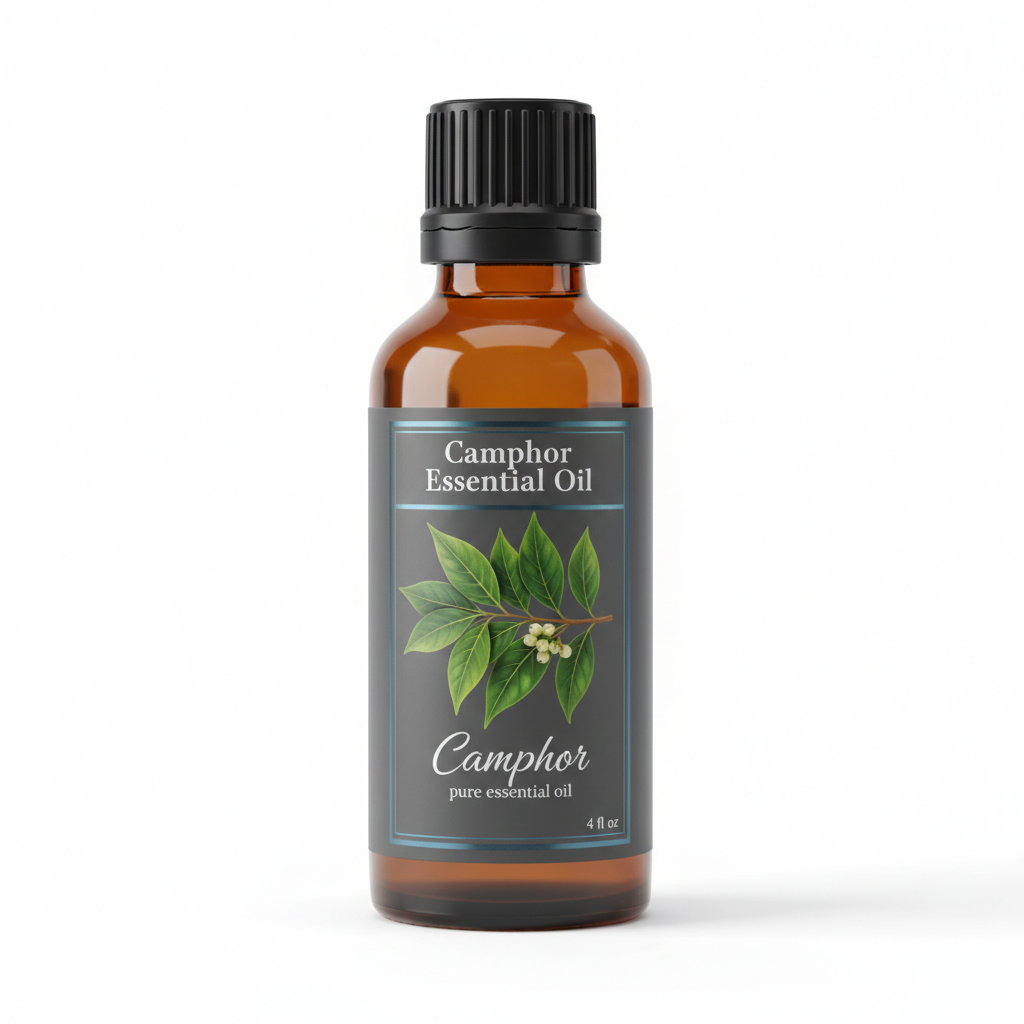
Camphor Essential Oil
Our own Camphor Essential Oil, in sizes from 0.5 oz to bulk.
From $9.99
Shop Now →A name that points at the wrong compound
The oil we sell is the white fraction of camphor distillate. After the crystals are taken out, what remains is split by boiling point into cuts, and the lightest one is white. That cut is a different material from the crystal and from the oil you would get by distilling the leaves, which is why the species name alone tells you very little.
The tree itself is a shape-shifter. A 2023 survey of 974 Cinnamomum camphora trees across 13 Chinese provinces sorted their leaf oils into families led by camphor, by 1,8-cineole (also called eucalyptol), by linalool and by trans-nerolidol, and the authors concluded that environment strongly shapes the profile. Same species, very different chemistry. You can wander through those types in our guide to the tree.
What the white cut is made of
The clearest public picture comes from a 2022 European Food Safety Authority opinion on white camphor oil, which gave a specification as GC area percentages. The main players were 1,8-cineole at 27 to 43%, limonene at 18 to 27%, p-cymene at 6 to 15% and alpha-pinene at 4 to 10%. Camphor itself came in below 0.1%. The Tisserand Institute makes the same point from a different direction: the fractions hold camphor at "up to 9%, more typically 3%."
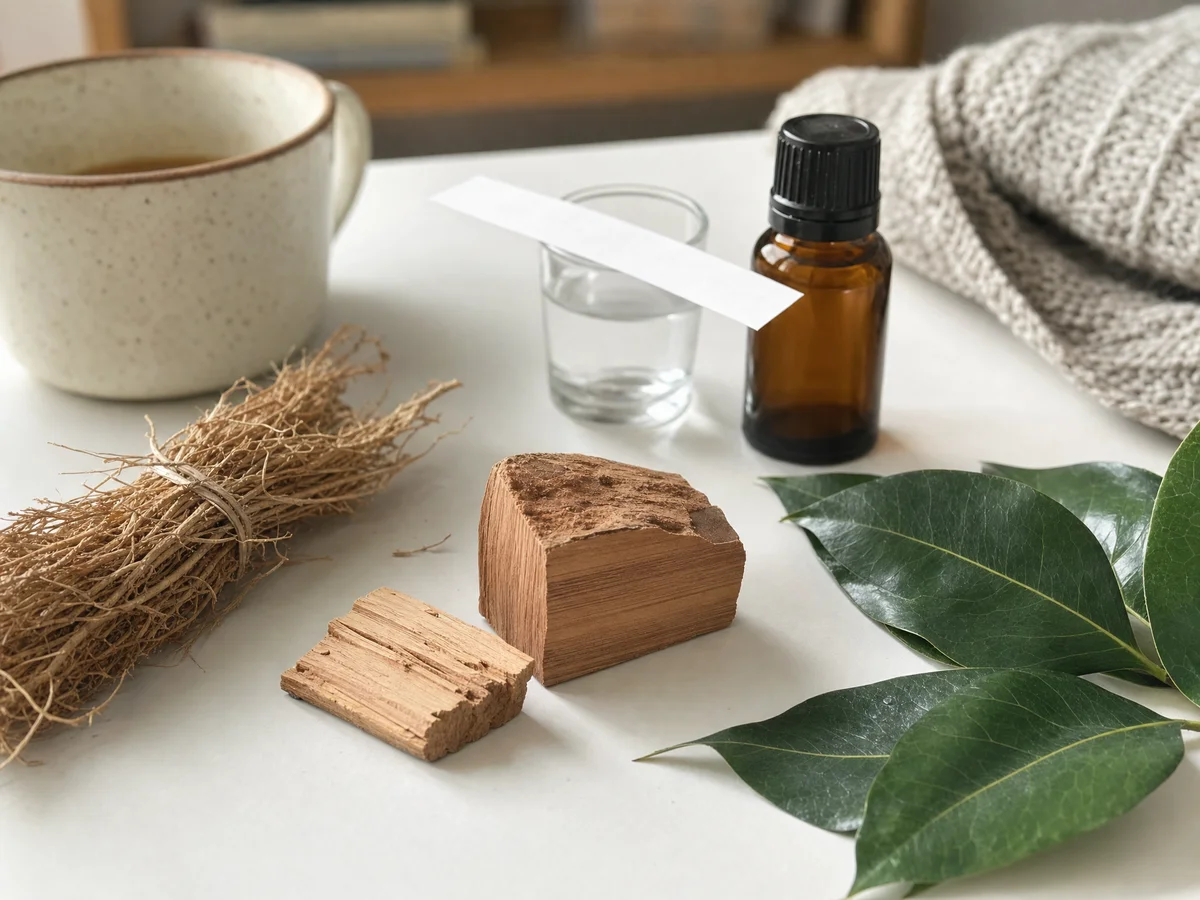
That is a pleasant surprise when you think about scent. PubChem records the odor of 1,8-cineole as "camphor-like," limonene as lemon-like, alpha-pinene as pine and p-cymene as sweetish and aromatic. So a bottle of white camphor oil can smell cooler and greener than people expect, with eucalyptus, pine and citrus threads around that dry, crisp center. If that is what you are curious about, our scent profile goes further.
One practical note on those percentages. They describe a share of the signal in a gas chromatography run, not weight, and they belong to a particular lot on a particular instrument. Treat them as a portrait of the type, not a promise about every bottle. Our walkthrough of how to read a GC/MS report shows what to look for when you have a real chromatogram in hand.
Reading the scent like a map
Once you know the names, the smell becomes a game of spotting the threads. Open the bottle and try to find them one at a time: a cool, eucalyptus-like brightness, a flicker of lemon peel, something green like pine needles, and then the dry, woody floor underneath. You may not pick out all of them on the first go, and that is fine. Come back after a few minutes and a different thread usually steps forward.
It is a small pleasure to smell something and know roughly why it smells that way, and it makes blending far more intuitive.
Why the heavier cuts are set aside
The reason anyone separates the cuts is safrole, a compound that concentrates in the heavier brown and yellow fractions. The International Agency for Research on Cancer classes safrole as possibly carcinogenic to humans (Group 2B), based on liver tumors in mice and rats given it by mouth. The Tisserand Institute notes that those heavier fractions are high in safrole and not usually sold on the open market. We sell the white fraction only, with no heavier cuts blended in. Our fractions comparison lays out the whole family if you want the full picture.
What we can put in your hands
For the oil we sell, the Certificate of Analysis we publish covers one batch, number CMPQGACCCNC003A. It lists a relative density of 0.878 at 20 C (standard range 0.870 to 0.890), a refractive index of 1.467 (standard 1.455 to 1.475) and an optical rotation of +5.80 degrees (standard +2 to +20), and it records the oil as steam distilled. Those are identity checks on how the oil behaves as a liquid, and they sit comfortably inside the stated ranges. They do not list individual compounds.
If your formula depends on a constituent profile, such as a cineole level or a safrole result with its detection limit, ask us in writing through the contact page before you order and we will tell you what is available for your lot.
Handling follows composition
The EFSA opinion lists white camphor oil as an irritant to skin and eyes and as a skin and respiratory sensitizer, so a gentle-sounding profile is not a reason to skip the basics. We recommend diluting to 0.5% to 2% in a carrier before any skin contact, patch testing first, and checking IFRA standards for your own formulation. Keep the bottle capped, away from the eyes, and out of reach of children and pets, and never swallow it. If anyone does, call Poison Help at 1-800-222-1222 right away. Questions about pregnancy, seizures or medicines belong with a pharmacist or physician; we sell an external cosmetic oil, nothing more.
Treat the bottle's label as a starting point and the lot report as the real portrait. A name tells you a family; a report tells you who is actually in the room.
The nice thing about a chemistry-first view is that it makes the bottle less mysterious. Once you know the stars are cineole, limonene, cymene and pinene, the scent starts to make sense.
Camphor Essential Oil
Camphor Essential Oil from our own shop, in sizes from 0.5 oz to bulk.
From $9.99
Shop Now →