Organic Camphor Oil: Does the Label Matter?
An organic label answers a specific question: how were the plants grown and handled? With camphor oil, though, the question that shapes the bottle is a different one, namely which part of the distillate is in it. We do not market our camphor oil as organic, so this is not a pitch. It is a look at what the word does and does not promise, and when paying extra for it is worth it.
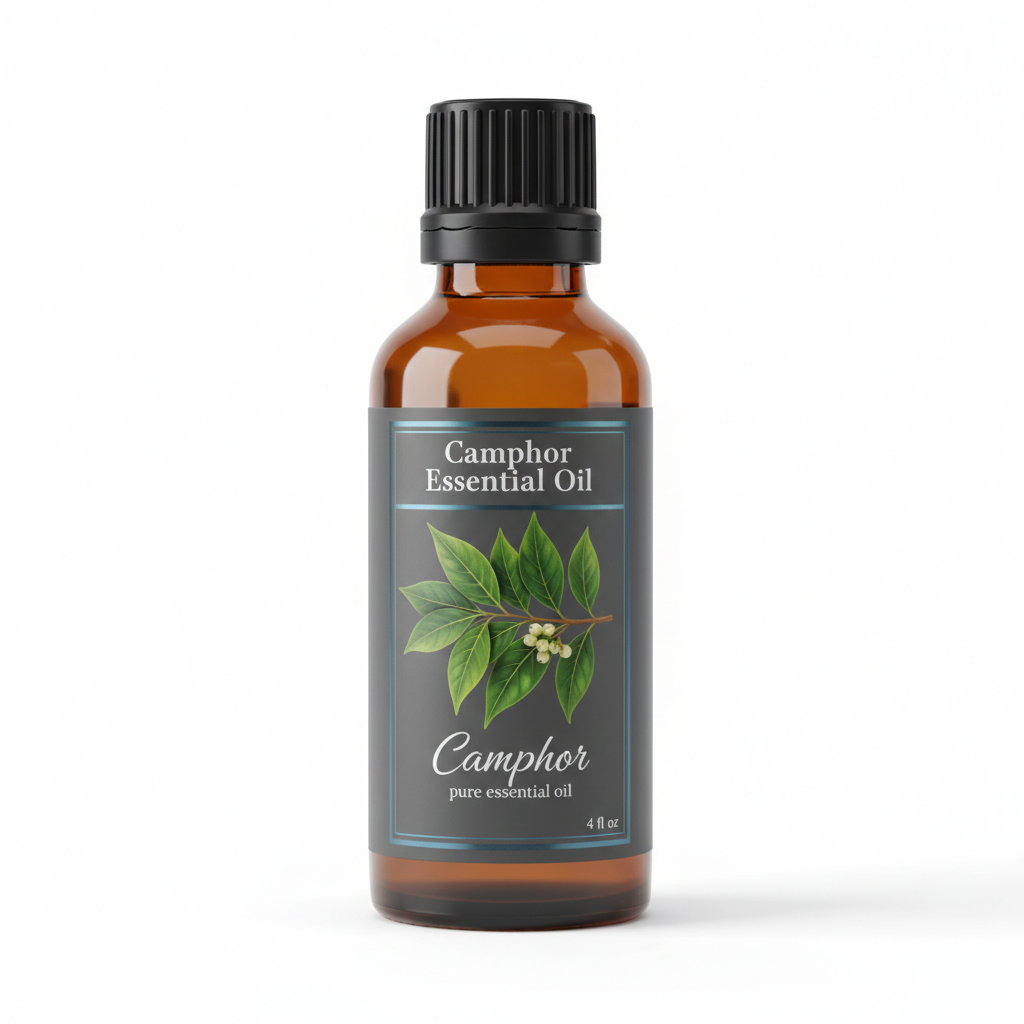
Camphor Essential Oil
Our own Camphor Essential Oil, in sizes from 0.5 oz to bulk.
From $9.99
Shop Now →What "organic" means on paper
Under the U.S. National Organic Program's rule on product composition, a product can be labelled "100 percent organic," "organic" (at least 95% organically produced ingredients, excluding water and salt) or "made with organic" followed by the named ingredients (at least 70%) (7 CFR 205.301). It is a rule about production systems and what goes into a product. It sets no limit on any compound in the finished oil, and it does not say which fraction you are holding. If you plan to put the word on a product of your own, a USDA-accredited certifier is the person to ask about how the rule applies to a cosmetic or fragrance item.
What decides what a camphor oil is actually like
Three things shape the oil far more than the farming system.
- The cut. Crude camphor distillate is separated by boiling range. The Tisserand Institute describes the yellow and brown fractions as high in safrole and not usually sold on the open market, and the white oil as a fraction with only a little camphor left in it, "up to 9%, more typically 3%" (Tisserand Institute, Cinnamomum camphora). A tree grown organically can yield a heavy cut as easily as a light one.
- The tree type. A 2023 survey of 974 trees from 35 populations in 13 Chinese provinces found camphor-rich, linalool-rich and eucalyptol-rich chemical types, among others (Zhang et al., Molecules, 2023). The study sampled leaf oil and did not compare farming systems, so it cannot say whether organic practice changes composition. It does show how much natural variation there already is.
- How it was distilled and fractionated. Process choices, not the plantation, determine what ends up in the bottle.
Put together, an organic certificate on a camphor oil tells you about the plantation and the chain of custody. It does not tell you the oil is the white cut, and it does not replace a GC/MS report. Our buying checklist covers those checks.
When paying for organic makes sense
Pay for it when organic is the point. If your own product carries an organic claim, your certifier may require organic ingredients wherever they are available. If the people you sell to buy on that label, or you have a purchasing policy about pesticide use, the premium is buying something real. A seller who can document the chain behind the claim has done real work, and it is worth paying for.
Scale matters too. In a skin blend made at our recommended 0.5% to 2% in a carrier, camphor oil is at most 2% of the weight. Whether a 2% non-organic ingredient fits inside an organic product's allowance depends on whether an organic version is commercially available and on the other ingredients, so ask your certifier before you design the label around it.
Why traceability is the hard part
The plant-resources handbook entry on camphor says "no comprehensive information is available on the production and trade" of camphor and its oils, and that large Chinese plantations were established from the 1990s (Windadri and Rahayu, PROSEA, 1999). It is a 1999 source, so it describes history rather than today's market, but the point stands: where public records are thin, a certificate is only as useful as the paper behind it. A certificate that names the product, the producer and the certifier can be checked with the certifier. A bare logo cannot.
A fair question to ask yourself
Before you pay more for any label, picture the bottle on your own shelf and ask what you want from it. If the answer is a certain scent in a blend, put your attention on the aroma and the cut. If the answer is a farming story you can verify, put your attention on the paperwork. Neither is wrong; they are simply different shopping lists.
When it adds little
If you want camphor oil for a closet sachet, a candle or a diffuser, an organic label buys a farming claim and nothing about the scent or the hazards. That money is better spent on a clear statement of the cut and a report for your lot. Camphor is neurotoxic in quantity. We do not recommend it for infants or young children or anyone with a seizure history, and it is never swallowed. No label changes that, as our pages on whether camphor oil is safe and camphor and children explain.

What to ask a seller who says "organic"
- Who is the certifier, and does the certificate name this product, not just the farm?
- Is the oil the white fraction, and is that written on the batch document as well as the listing?
- Is there a GC/MS report for this lot, and does it report safrole?
- Which plant part and which country, and do the listing and the paperwork agree?
A seller who answers the second and third as readily as the first is selling you the material, not just the label. We hold ourselves to the same questions. The Certificate of Analysis we publish for one batch lists density, refractive index and optical rotation, and if you need GC/MS, ask us in writing through our contact page before ordering.
Organic is a defined, checkable claim about farming and handling. Choose the cut first, and decide about the label afterwards.
Camphor Essential Oil
Camphor Essential Oil from our own shop, in sizes from 0.5 oz to bulk.
From $9.99
Shop Now →Sources & Further Reading
- U.S. eCFR, 7 CFR 205.301. Product composition. law.cornell.edu
- Tisserand Institute. Cinnamomum camphora: its many names and chemotypes. tisserandinstitute.org
- Zhang T. et al., 2023. Molecules 28(3):973. PMC9919661
- Windadri F.I. and Rahayu S., 1999. Cinnamomum camphora, PROSEA. prosea.prota4u.org/655