Camphor Oil on Skin: Evidence, Irritation Risk and Limits
Camphor is an active ingredient in FDA-regulated over-the-counter skin products at set concentrations, but that does not make camphor essential oil a skin-care ingredient. The research is thin, irritation and allergy are documented, and our oil is sold as an aromatic material, not a drug. This page sorts what is known from what is assumed.
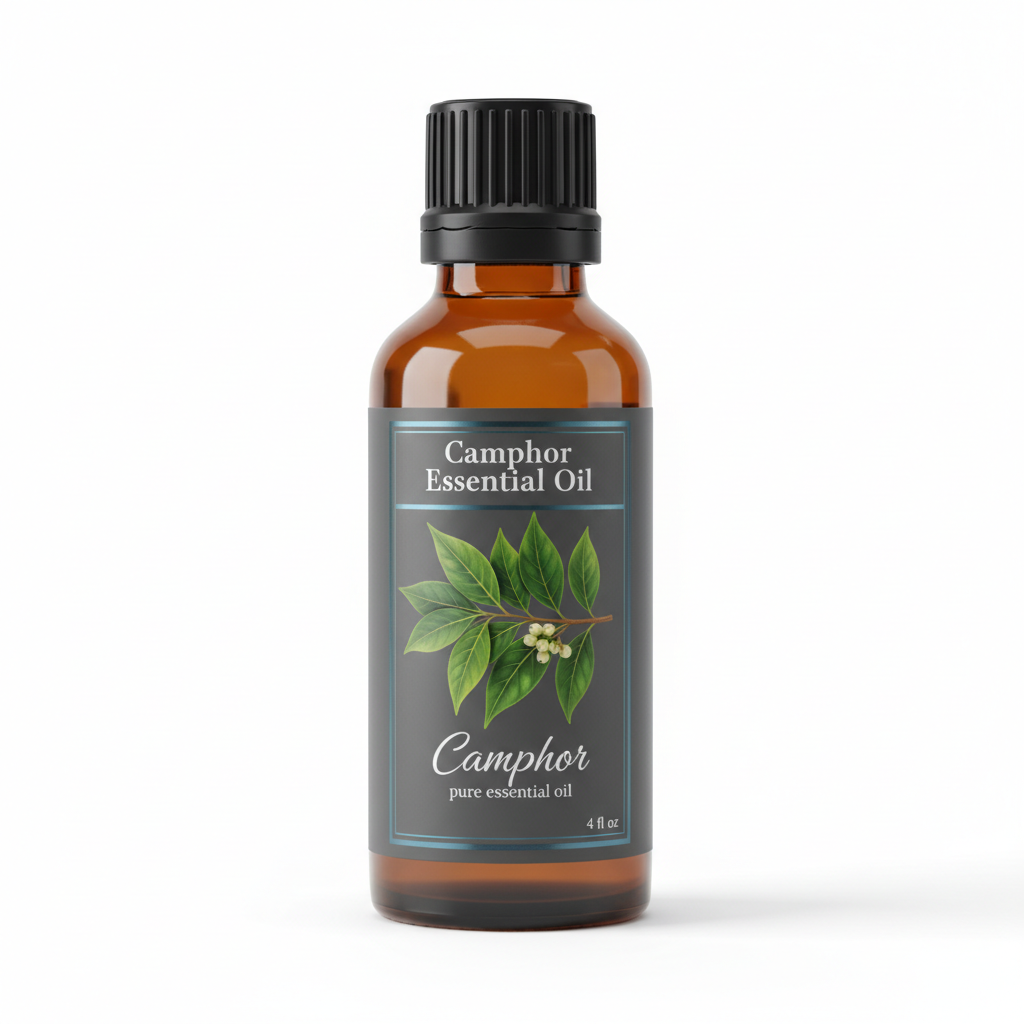
Camphor Essential Oil
Our own Camphor Essential Oil, in sizes from 0.5 oz to bulk.
From $8.69
Shop Now →Two different things get blended together online. One is camphor as a regulated ingredient in finished over-the-counter products, made to a fixed percentage, with a Drug Facts label and warnings. The other is a bottle of camphor essential oil used by hand. The first has a regulatory framework. The second has only the framework you build around it, and that is the part we want to walk through, in the order you would actually decide. For the wider evidence picture start with what the evidence says about camphor oil benefits and uses, and for two specific skin questions see camphor oil and acne and camphor and itching.

Start with what regulators actually say
FDA's over-the-counter monograph for external analgesic drug products (M017) is the clearest primary document on camphor applied to skin. It lists camphor in two places. In the section for topical analgesic, anesthetic and antipruritic ingredients, the listed concentration is camphor 0.1 to 3 percent. In the counterirritant section, the listed range is camphor exceeding 3 percent up to 11 percent. The monograph defines a counterirritant as a drug that causes irritation or mild inflammation of the skin to distract from pain in muscles or joints beneath it.
Read that definition twice. By regulatory definition, a camphor counterirritant works by irritating the skin. That is not a flaw in the monograph, it is the mechanism, and it is the single most useful fact for anyone thinking about camphor and skin: the sensation is the intended effect, and the same sensation is the warning sign.
The required warnings for the counterirritant group are blunt. The labels must say "For external use only," "Avoid contact with the eyes," "Do not apply to wounds or damaged skin," and "Do not bandage tightly." They also tell the user to stop and consult a physician or doctor if symptoms persist more than 7 days or clear up and return within a few days.
The ceiling above 11 percent is a separate rule. FDA's rulemaking history for camphorated oil products lists a final rule dated September 21, 1982 (47 FR 41716), codified at 21 CFR 310.502. For the full story of that rule, see our explainer on the FDA camphor rules and the 11 percent limit.
One point of discipline: those percentages describe finished over-the-counter drug products. They are regulatory facts about those products. They are not a dosing recommendation for essential oil, and our oil is not such a product.
What the research on skin actually shows
Here is the honest summary. A 2023 bibliometric analysis in Cureus by Hoang and colleagues looked at English-language PubMed articles from 2010 to 2022 on camphor- and menthol-containing agents. Of 103 results, 15 addressed health-related use. The authors described topical use for pain, itch and upper respiratory symptoms as potentially effective, but said each use rests on a limited number of studies and made no definitive recommendation. They called for randomized, double-blind controlled trials, and their abstract is worth reading in full.
That is a review of camphor- and menthol-containing agents generally, not of camphor essential oil applied to healthy skin for cosmetic reasons. The sources cited here describe no controlled trial of camphor essential oil as a skin-care product. If a site tells you otherwise, ask for the trial.
The mechanism research is more solid, and it is cell and animal work. A 2013 paper in Chemical Senses by Selescu and colleagues reported that camphor activates the cold-sensing channel TRPM8 in cells and in rat sensory neurons, while also dampening its response to menthol. That is cell and neuron work, and it does not establish what happens on a person's skin over weeks of use.
| Claim you will see | What the cited sources support | Evidence label |
|---|---|---|
| Camphor produces a cooling or tingling sensation | Cell and neuron studies on TRPM8 (Selescu 2013) | Mechanism, not clinical |
| Camphor is a legitimate ingredient in OTC skin products | FDA monograph M017 lists defined concentration ranges | Regulatory fact about OTC drug products |
| Camphor oil improves skin appearance or tone | No controlled trial in the sources cited here | Unsupported |
| Camphor oil is gentle if it is natural | Case reports of contact allergy to camphor in several product forms | Contradicted |
| Small amounts on skin are harmless for everyone | AAP Committee on Drugs advice (1994) that camphor not be used in children, as summarized in Healio | Contradicted |
Irritation and allergy are the documented problems
The AAAAI "Ask the Expert" page on camphor and menthol allergy notes a few case reports of allergic contact dermatitis to different forms of camphor, in sunscreen and ear drops, plus a report involving Vicks VapoRub. The expert adds a caveat that matters for blends: the VapoRub reaction may have been due to other essential oils rather than camphor. A 2025 narrative review of VapoRub in PeerJ by Valido and colleagues counted dermatological conditions among documented complications, alongside several more serious ones linked largely to misuse, such as heating, swallowing or applying the product near the nose and eyes.
Our position follows from that. Irritation is common enough in the counterirritant definition itself that we would treat any stinging, redness or heat as a stop sign, not as evidence the oil is "working." The usual real cause of a bad skin experience with essential oils is not a bad batch. It is too much oil, applied too often, to skin that was already compromised.
A decision order for adults who still want to try it
If you are an adult who wants camphor in a scented body product for its aroma, we would walk through it in this order. None of this is medical advice, and anyone with a skin condition, eczema, broken skin or a history of reactions should ask a dermatologist first.
- Skip it on broken or inflamed skin. The M017 label language for counterirritants says not to apply to wounds or damaged skin. We apply the same rule to essential oil.
- Dilute in a carrier first. Our dilution guide shows the arithmetic and why drop size varies. Start at the low end of any range you find and treat higher numbers as something you have to justify, not a default.
- Patch test. Our patch test walkthrough explains the steps. A patch test on a small area does not rule out every reaction, but a reaction on a small area is far better than one on a large one.
- Keep it off the face, eyes, lips and nostrils. The M017 label warning says to avoid contact with the eyes, and the 2025 review lists ocular injury among reported complications.
- Keep it away from children. Camphor is the subject of a long record of childhood poisonings. A pharmacy column in Healio by Edward Bell, PharmD, cites AAP Committee on Drugs advice from 1994 that camphor not be used in children. For the full child-safety picture, see camphor oil and children.
- Stop at the first sign of trouble. Redness, burning that builds, itching or rash means wash off, stop, and ask a clinician if it persists.

Where we think the common advice goes wrong
Most online advice on camphor and skin makes two mistakes. The first is borrowing from over-the-counter products. A rub made at a fixed percentage by a manufacturer, with a label, is not the same thing as a home mixture where the percentage depends on drop size, carrier volume and how well it was stirred. The 0.1 to 3 percent and 3 to 11 percent ranges are not a recipe for anybody's kitchen.
The second mistake is treating "natural" as a safety statement. Allergic contact dermatitis to camphor-containing products is documented in case reports. A reaction you suspect should go to a dermatologist, who can say whether camphor or something else in the product is the cause.
There is also a trade-off worth saying plainly. A cooling or tingling sensation is easy to mistake for effectiveness. Because camphor produces that sensation by design, it will feel like something is happening on skin even when nothing useful is. That is a reason to be skeptical of anecdotal praise, including ours.
Who should not use camphor on skin
- Children and infants, for all the reasons in the child-safety article.
- Anyone pregnant or breastfeeding without an OB-GYN or midwife's guidance. See our pregnancy page, which is deliberately conservative.
- Anyone with eczema, dermatitis, open lesions, a recent sunburn or any skin that is already irritated.
- Anyone who has reacted to camphor, menthol, Vicks products or similar rubs before.
- Anyone looking for a skin product to deal with a skin condition. That is a conversation for a dermatologist.
What our oil is, and is not
We sell one product: Camphor Essential Oil, Cinnamomum camphora, described on our pages as the white fraction of the wood distillate, bottled undiluted in dark amber glass with a tight closure, from 0.5 oz to 400 lb. It is sold as an aromatic and cosmetic material. It is not a drug and it is not offered for any skin condition. The posted certificate of analysis for batch CMPQGACCCNC003A lists physical constants such as specific gravity (0.878) and refractive index (1.467). It does not include a GC/MS profile or a safrole figure, so it cannot by itself show which fraction the oil is. Our Inside the Still page explains what we ask for on every lot.
If you want to see the sizes we carry and how the oil is packed, our shop page has that information. That is the full extent of the pitch: an honest description of an aromatic material and a reminder that you hold the responsibility for how it is diluted and used.
Questions we would expect
Is camphor oil good for skin?
The sources reviewed here do not show that camphor essential oil improves skin. They do show that camphor is a regulated counterirritant ingredient in finished products and a documented cause of contact allergy in some people.
Can I put camphor oil on my skin undiluted?
We would not. The regulated over-the-counter ranges top out at 11 percent in finished products, and undiluted essential oil is far above that. Dilution and a patch test come first.
Is it the same as the camphor in Vicks?
Not exactly. A listing for Vicks VapoRub on a drug-label aggregator shows camphor at 4.8 percent, eucalyptus oil at 1.2 percent and menthol at 2.6 percent, made as a finished ointment. A bottle of essential oil is a different thing to handle.
This page was written from published sources and is not reviewed by a medical professional. For skin conditions, see a dermatologist.
Camphor Essential Oil
Camphor Essential Oil from our own shop, in sizes from 0.5 oz to bulk.
From $8.69
Shop Now →Sources & Further Reading
- FDA OTC Monograph M017: External Analgesic Drug Products for OTC Human Use
- FDA: Rulemaking history for OTC camphorated oil drug products
- Hoang D, Wong A, Olympia RP. Current state of research on camphor- and menthol-containing agents. Cureus 2023
- Selescu T et al. Camphor activates and sensitizes TRPM8 to cooling and icilin. Chemical Senses 2013
- Valido A et al. There's the Rub: benefits and complications of Vicks VapoRub use. PeerJ 2025
- AAAAI Ask the Expert: Camphor and menthol allergy
- Healio: Camphor use entails unique safety concerns
- Drug label listing: Vicks VapoRub active ingredients