Camphor Oil and Children: Age-Based Guidance for Parents
No age has been established as safe for camphor essential oil on a child. For children under 2, US over-the-counter camphor labels say not to use it without a doctor, and the American Academy of Pediatrics Committee on Drugs recommended in 1994 that camphor not be used in children at all. Keep the oil locked away from every child.
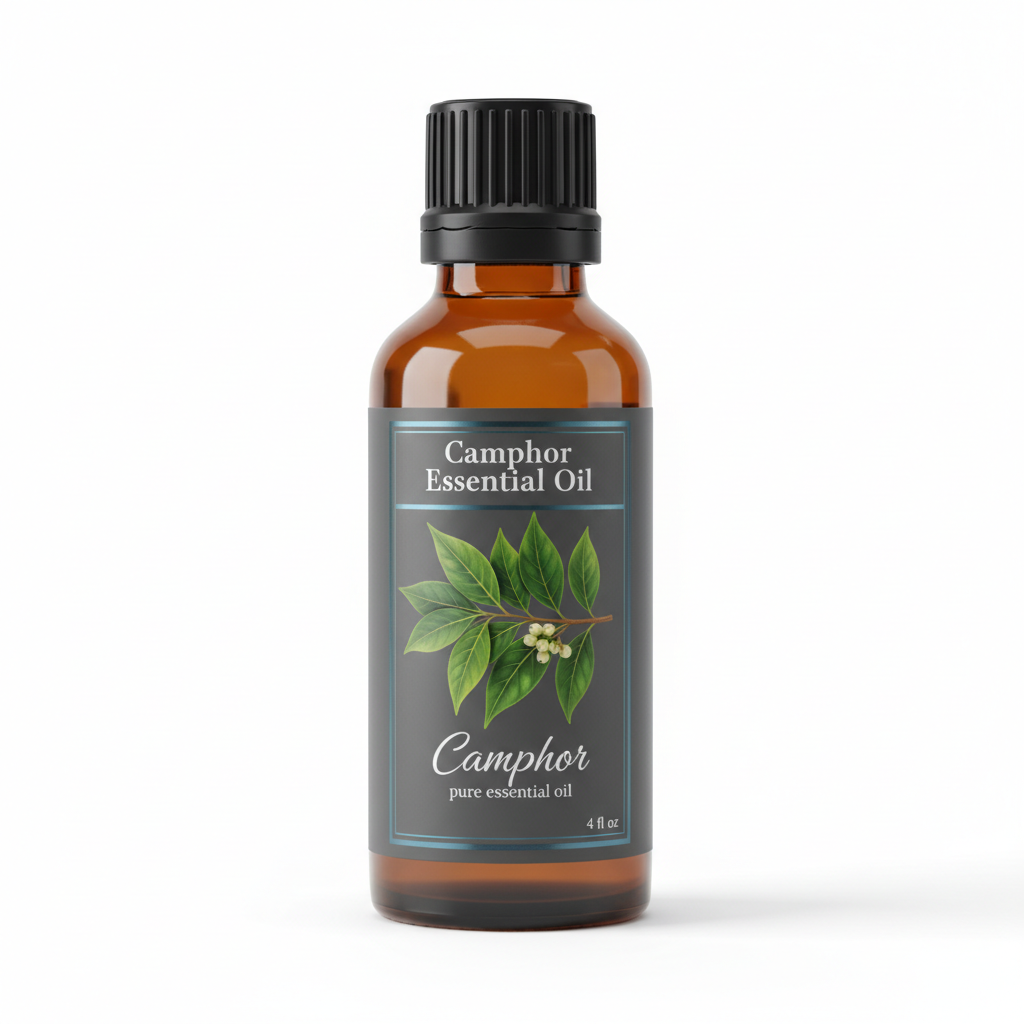
Camphor Essential Oil
Our own Camphor Essential Oil, in sizes from 0.5 oz to bulk.
From $8.69
Shop Now →
Quick answer by age
| Age | What authorities and studies say | Practical position |
|---|---|---|
| Under 2 | FDA's OTC monograph labeling for camphor products reads: children under 2 years of age, do not use, consult a doctor. Camphor ointment labeling also says do not place in nostrils. | No camphor oil on skin, in the room air, or near the nose or face. Ask a pediatrician. |
| 2 to under 6 | OTC chest rubs with 4.7 to 5.3% camphor are labeled for ages 2 and up as regulated drug products. The AAPCC guideline reviews dose data for children under 6 as its own group. No age has been established for essential oil. | Do not use the oil on a child. Store it where a child cannot reach it, ever. |
| 6 to 11 | No age-specific rule for camphor essential oil found. The AAP position from 1994 recommends against camphor in children. | Not recommended. Ask a pediatrician before any use. |
| 12 and older | No age-specific rule found. | A pediatrician's call. Adult cautions about swallowing and skin still apply. |
The table is our reading of published sources, not clinical advice. The sources are the FDA OTC monograph M017, 21 CFR 341.74 (eCFR), and a pharmacology review summarizing the AAP statement and AAPCC guideline (Healio). That review also notes FDA approves camphor as a topical cough suppressant for children 2 and older, and that its efficacy in pediatric cough has no published support. Whether a regulated OTC product is right for your child is a question for a pediatrician or pharmacist, not for a seller of essential oils.
Why children are different
Two reasons, both stated in the literature.
Body weight. Poison center thresholds are per kilogram. The AAPCC guideline recommends emergency referral above 30 mg/kg (Manoguerra et al., 2006). The arithmetic shows how little that is. For a 10 kg toddler, 30 mg/kg is 300 mg. For a 15 kg child it is 450 mg. For a 70 kg adult it is 2,100 mg. The Royal Children's Hospital guideline says 0.5 to 1 g is considered a lethal oral dose in children (RCH). These are referral and hazard thresholds, never safe doses. We cannot convert them into drops of our oil, because our COA lists physical constants only and does not report the camphor content.
Metabolism and skin. Authors of a Paris case report state young children lack the enzymes to process camphor, so neurotoxic substances can accumulate (Guilbert et al., 2007). A paper on infant balm use notes such products are not recommended under age 2 because of accidental ingestion and absorption through delicate skin, and cites animal evidence that they may worsen breathing (Bazzano et al., 2017).
Where children are actually exposed
The pattern in the case literature is not parents rubbing a measured amount on a child. It is exposure from products nobody thought of as dangerous.
- Imported or unlabeled camphor. In a 2009 cluster, three children aged 15 to 36 months had seizures after exposure to imported, illegally sold camphor used for spiritual purposes, for colds or for pest control. Two swallowed it and one was exposed by repeated rubbing on the skin (Khine et al.).
- Products that look harmless. In June 2006 FDA warned consumers to stop using the Triaminic Vapor Patch, which contained camphor, eucalyptus oil and menthol, after accidental ingestion by children, and the manufacturer recalled it (Drug Topics).
- Rubs, inhalers and some mothballs. RCH lists these as common sources.
- Folk liquids. In a study of 15 Indian children with a first seizure after a camphor-containing herbal liquid, most were under 5, and the oldest seized after about 3 drops. The liquid contained other ingredients, so camphor could not be isolated (Bandi et al., 2021).
In 2013, 11,521 camphor exposures in US children under 5 were reported to poison centers, according to Bazzano and colleagues. Our reasoning from that number is that access, more than technique, is the thing to control.

Storage that actually stops a child
Most severe cases involve swallowing, so the practical question is whether a child can reach the bottle.
- Locked, not just high. A latched cabinet or lockbox is better than a high shelf. Children climb.
- Do not rely on the closure. A screw cap described as tight is not the same as child-resistant. Our pages describe the closure as tight and do not claim it is child-resistant, so assume a cap will not stop a child.
- Keep it in the original bottle. The Paris and Bronx cases involved an unlabelled solution and imported, illegally sold camphor. Do not pour camphor into a drink bottle or unmarked jar.
- Count every camphor source. Rubs, inhalers and mothball-style blocks sit in the same locked place.
- Know the number. Poison Control is 1-800-222-1222. Write it on the cabinet. The page camphor poisoning symptoms and what to do first lays out the steps.
Diffusing around children
We found no study measuring camphor vapor from a diffuser in a child's room, so nothing here can be called proven safe or unsafe. Reasoning from the sources above (small body weight, narrow airways, the animal evidence cited by Bazzano and colleagues, the OTC advice against placing camphor in the nostrils), we do not recommend diffusing camphor oil in any room where a child under 6 sleeps, plays or spends time. If an adult household still chooses to diffuse, the conservative version is with children out of the home and the room aired out afterward. Practical diffuser steps are in how to diffuse camphor oil. That is a position we hold, not a tested standard. Ask a pediatrician.
Visitors, siblings and babysitters
Storage rules fail at the edges. A relative visits with a camphor balm in a handbag. An older sibling decides to be helpful. A sitter finds an unlabeled jar. The case reports above were not about careless households; they involved products that did not look like hazards. We would add these to your list:
- Tell adults who stay with your children that camphor products live in the locked place, and why.
- Ask visitors to keep rubs, inhalers and balms in a bag that is out of reach.
- Do not let older children measure, pour or apply camphor products for younger ones.
- Check what is already in the house. Camphor appears in OTC rubs and ointments, and the side effects article explains why stacking sources matters.
Questions to bring to a pediatrician
If a family member suggests using camphor on a child, a short list helps the conversation: the child's age and weight, the exact product and what else is in it, what the person hopes it will do, and whether the child has asthma, past seizures or eczema. We can tell you what the published sources say. We cannot tell you what is right for your child, and we would not claim to.
For household handling of adult products, our dilution and handling guide covers the practical steps, with the child question settled first by the sections above.
If a child is exposed
Call Poison Control at 1-800-222-1222, or 911 if there is a seizure, trouble breathing, or the child cannot be awakened (poison.org). Do not wait for symptoms. The guideline says seizures can be the first sign. The full first steps are in the poisoning article. For an adult's view of the risk, see Is camphor oil safe?
FAQ
At what age is camphor oil safe for a child?
We found no authority that sets one. The AAP Committee on Drugs recommended in 1994 that camphor not be used in children. Ask your pediatrician.
Is a camphor chest rub different from the essential oil?
Yes. OTC chest rubs are regulated drug products with a stated camphor percentage, labeled for ages 2 and up, with directions. An essential oil has no such label and is sold as an aromatic. We do not suggest the oil as a substitute for either.
What if my child touched or smelled the oil?
Wash skin with soap and water, move to fresh air, and call Poison Control for guidance, which is what the AAPCC guideline advises for skin and inhalation exposures.
Our camphor essential oil is sold to adults, in sizes from 0.5 oz to 400 lb; if you have decided it belongs in your home, the shop page lists them, and the cabinet comes first.
Sources & Further Reading
- Manoguerra AS et al. Clin Toxicol 2006;44:357-70
- Royal Children's Hospital Melbourne: Camphor poisoning
- Bell EA. Camphor use entails unique safety concerns. Infectious Diseases in Children, 2008
- FDA OTC Monograph M017
- eCFR: 21 CFR 341.74
- Khine H et al. Pediatrics 2009;123:1269-72
- Guilbert J et al. Emerg Med J 2007;24:859-60
- Bazzano AN et al. J Trop Pediatr 2017
- Bandi R et al. Indian Pediatrics 2021;58:71-73
- Drug Topics: FDA warns consumers not to use Triaminic Vapor Patch (June 26, 2006)
- Poison Control (National Capital Poison Center)