Camphor Oil During Pregnancy and Breastfeeding
We do not recommend camphor oil during pregnancy or breastfeeding, and nobody should swallow it at any time. Camphor crosses the placenta, and the human harm on record comes from swallowing it. For skin or aroma exposure at low levels, nobody has measured safety either way, so that decision belongs with an OB-GYN or midwife.
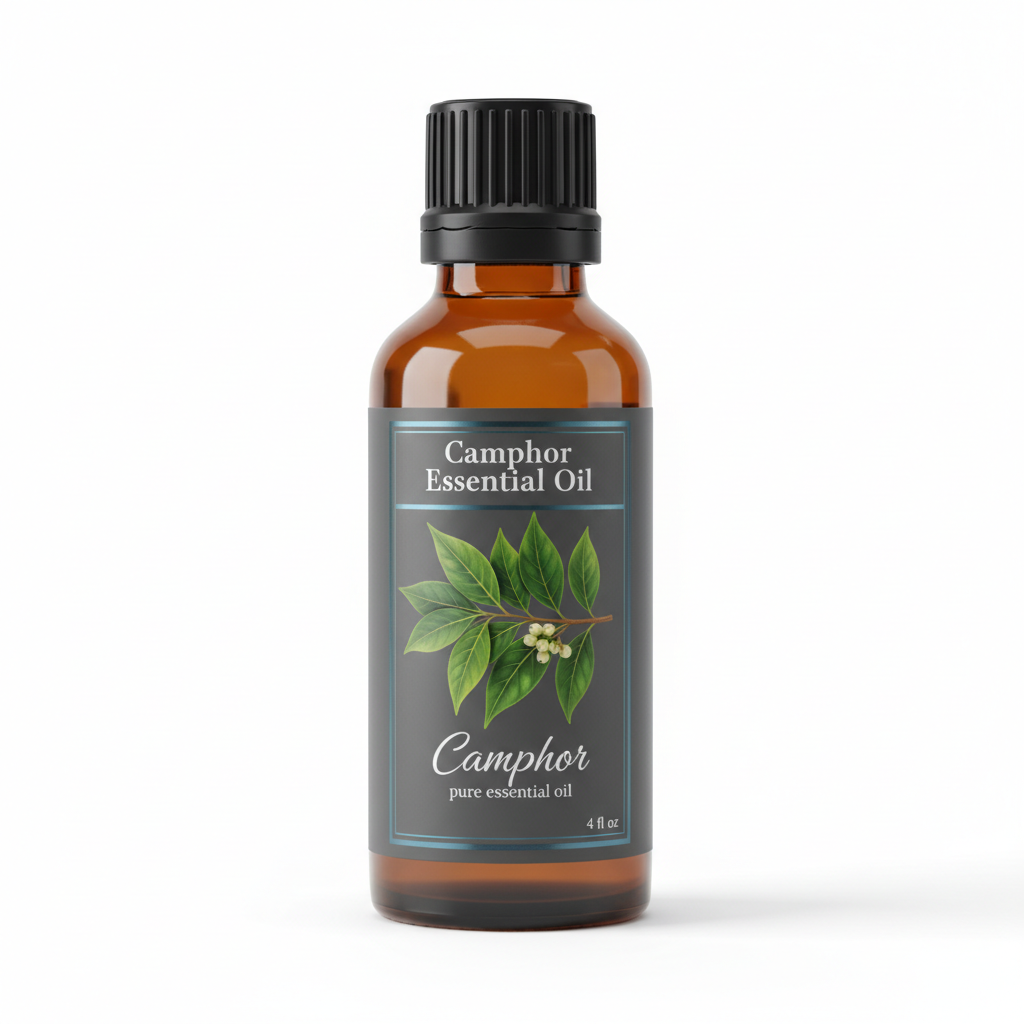
Camphor Essential Oil
Our own Camphor Essential Oil, in sizes from 0.5 oz to bulk.
From $8.69
Shop Now →
What the evidence actually covers, and what it never measured
Most pregnancy advice for essential oils is built from caution, not from measurements. Camphor is a rare case where some real data exist, and it helps to see exactly which exposure each piece of data describes before deciding what it means for a bottle on your shelf.
| Exposure | What exists | What it can tell you | What it cannot tell you |
|---|---|---|---|
| Swallowed camphorated oil | Case reports compiled by the IPCS poison monograph: four poisonings in pregnancy, each time camphorated oil mistaken for castor oil | Camphor reaches the fetus and has been implicated in fetal and neonatal death | Anything about small skin or vapor exposures |
| Camphorated oil on the skin in pregnancy | One sentence in the same monograph: topical use was not associated with teratogenic effects | No birth-defect signal was reported | How much was used, how often, or how many women; no study design is given |
| Oral camphor in pregnant rabbits | A National Toxicology Program contract study, 0, 50, 200 and 400 mg/kg/day by gavage in corn oil | No effect on fetal growth, viability or form at those doses in rabbits | Human safety; skin or air exposure; the NTP notes the findings may not have been peer reviewed |
| Diffusing or inhaling camphor oil | Nothing we could find specific to pregnancy | Nothing | Everything |
| Breast milk | A lactation database reports no published data on camphor in milk | Its authors expect passage is plausible, based on camphor's properties | Whether an infant would receive a meaningful amount |
Read down the last column. The honest summary is that the evidence is thin, comes from ingestion, and says almost nothing about the way essential oils are actually used.
The human record is about swallowing, not smelling
The IPCS poison information monograph on camphor (peer reviewed in 1989) states that camphor crosses the placenta, has been implicated in fetal and neonatal death, and has been used to induce abortions. It lists four poisonings in pregnancy, and in every one the product was camphorated oil mistaken for castor oil. That mix-up pattern is not unique to pregnancy. When the FDA banned camphorated oil in 1982, it reported that among 32 poisoning incidents where the cause was known, 28 were confusion with another product, and in 20 of those the other product was castor oil (47 FR 41716). For the full regulatory story, see our explainer on the FDA camphor rules.
The lesson is practical. The documented danger is a swallowed dose, and the usual route to it is a bottle that looks like something else. A household with a pregnant person needs that risk controlled before it needs any debate about vapor.
Why "diluted" and "diffused" do not settle the question
Advice that swaps in a friendly number, such as a very low dilution, sounds precise. We could not find a camphor-specific pregnancy study that supports any such number, so we do not repeat one.
The reasoning behind our caution is short. Placental transfer is a property of the molecule, not of the route, and both the IPCS monograph and the NTP abstract describe camphor as readily crossing the placenta. The Royal Children's Hospital Melbourne guideline notes camphor is readily absorbed from the skin, although most toxic exposures come from swallowing it. What nobody has measured is how much reaches the bloodstream from a diluted rub or a diffuser, and how long a fetus is exposed. When the unknown is that central, we decline to guess on someone else's behalf.
The rabbit study deserves a fair reading. At doses up to 400 mg/kg/day by mouth, it found no effect on fetal growth, viability or morphology. But the same abstract reports that a preliminary range-finding dose of 500 mg/kg/day caused 60 percent maternal mortality in the does, so the study sat close to a lethal edge, in one species, by gavage. It is a reassuring data point for one question (birth defects in rabbits at survivable oral doses) and silent on the question you are asking.

How to read the advice you will find online
Pregnancy and essential oils attracts confident, specific-sounding advice. Three patterns are worth checking before you trust a page. First, a precise dilution figure presented as the safe level for pregnancy: for camphor we could not find a study behind any such number. Second, a trimester rule ("fine after the first trimester") with no citation. Third, an attribution to a professional body. We looked for a current ACOG statement specific to camphor and did not find one, so we do not cite one, and we would be wary of any page that quotes ACOG on this without linking the document.
What a good source does is say which exposure it studied, in whom, at what dose. By that standard, the sources we can cite here support caution about swallowing, support the statement that camphor reaches the fetus, and are silent on everything in between.
Breastfeeding: two separate concerns
The first concern is what reaches milk. The e-lactancia breastfeeding database rates camphor "Poco seguro" (limited compatibility, the third of its four levels), reports no published data on milk excretion, and calls camphor neurotoxic and hepatotoxic even in small doses and by skin, especially in children. It advises against use during breastfeeding and against applying it to the breast. The page is in Spanish, and the rating is that database's own judgment, not a regulator's.
The second concern is direct contact. An infant's mouth meets skin. The FDA's over-the-counter labeling for camphor topical products tells users to ask a doctor before using them on children under 2, and the 1982 ruling recorded infants and young children who died from swallowing camphorated oil. Skin that an infant will lick, mouth or nuzzle is not a place for camphor oil.
A clear yes or no, by situation
| Situation | Our answer | Who to ask |
|---|---|---|
| Swallowing camphor oil, in any amount or "diluted in water" | Never, at any time | Poison Control if it happens: 1-800-222-1222 |
| Applying camphor oil to skin while pregnant | We do not recommend it | OB-GYN or midwife |
| Diffusing camphor oil while pregnant | We do not recommend it | OB-GYN or midwife |
| Applying camphor oil near the breast or where an infant will touch | No | Lactation consultant, pediatrician |
| Using an over-the-counter camphor rub | Not our call: it is a drug product with its own label | Pharmacist, OB-GYN or midwife |
If you are pregnant and camphor is already in the house
These are precautions from the reasoning above, not tested protocols. Keep any bottle sealed, labeled in plain words, and stored high and away from food and from other oils that look alike, because confusion is the documented route to poisoning. Remember that camphor also sits in moth blocks and some rubs; the Melbourne guideline lists mothballs and chest rubs among common camphor sources, with some mothballs containing other chemicals instead. Ask someone else in the household to handle the bottle if you would rather not.
If anyone swallows camphor, do not wait for symptoms. Call Poison Control at 1-800-222-1222, or 911 if there is a seizure, trouble breathing or the person cannot be woken, as poison.org directs. Tell your OB-GYN or midwife about the exposure afterward. For symptoms and first steps in detail, read camphor poisoning symptoms and what to do first.
Is a tiny amount of camphor in a cosmetic a problem?
We found no study that answers this for camphor in pregnancy, and we will not invent a comfortable answer. Ask your OB-GYN or midwife, and bring the ingredient list.
Is white camphor oil safer than brown in pregnancy?
The white-versus-brown question is about safrole, which concentrates in the heavier cuts, as explained in our fractions guide. The placental data above concern camphor itself, and we found nothing comparing fractions in pregnancy. Choosing white over brown is a sourcing decision, not a pregnancy-safety decision.
What should I ask my OB-GYN or midwife?
Ask three things: whether any camphor exposure is acceptable at your stage, whether the products already in your home (rubs, moth blocks, oils) need to go, and what to do if a child or pet gets into one. Write the answers down for the household.
Where do I read the general safety picture?
Start with Is camphor oil safe? and the avoidance matrix in camphor oil side effects and who should avoid it.
Where our oil fits
We sell one Camphor Essential Oil, sold as an aromatic and cosmetic material, not a drug, and we do not market it for use during pregnancy or breastfeeding. Product details and sizes are on the shop page, and the plain-language handling basics are in our dilution and handling guide.
This article summarizes published sources and reflects our own cautious position. It is not medical advice and has no medical reviewer. Last reviewed: October 2026.
Sources & Further Reading
- IPCS INCHEM: Camphor poison information monograph (PIM), peer review 1989
- NTP abstract TER91019: Developmental toxicity of d-camphor in New Zealand White rabbits (1992)
- e-lactancia: Camphor and breastfeeding compatibility (in Spanish)
- Federal Register, Sept. 21, 1982 (47 FR 41716): New Drugs; Camphorated Oil Drug Products for Human Use
- Royal Children's Hospital Melbourne: Camphor poisoning clinical guideline
- FDA OTC Monograph M017: External Analgesic Drug Products (posted May 2, 2023)
- Poison Control (poison.org)