Camphor Oil for Acne: Limited Evidence and Safer Alternatives
The sources we reviewed contain no clinical trial of camphor oil for acne. Camphor is also defined by FDA as a counterirritant, meaning it works by irritating skin, and acne-prone skin is often already irritated. Our position is plain: leave camphor oil off blemishes and ask a dermatologist about acne itself.
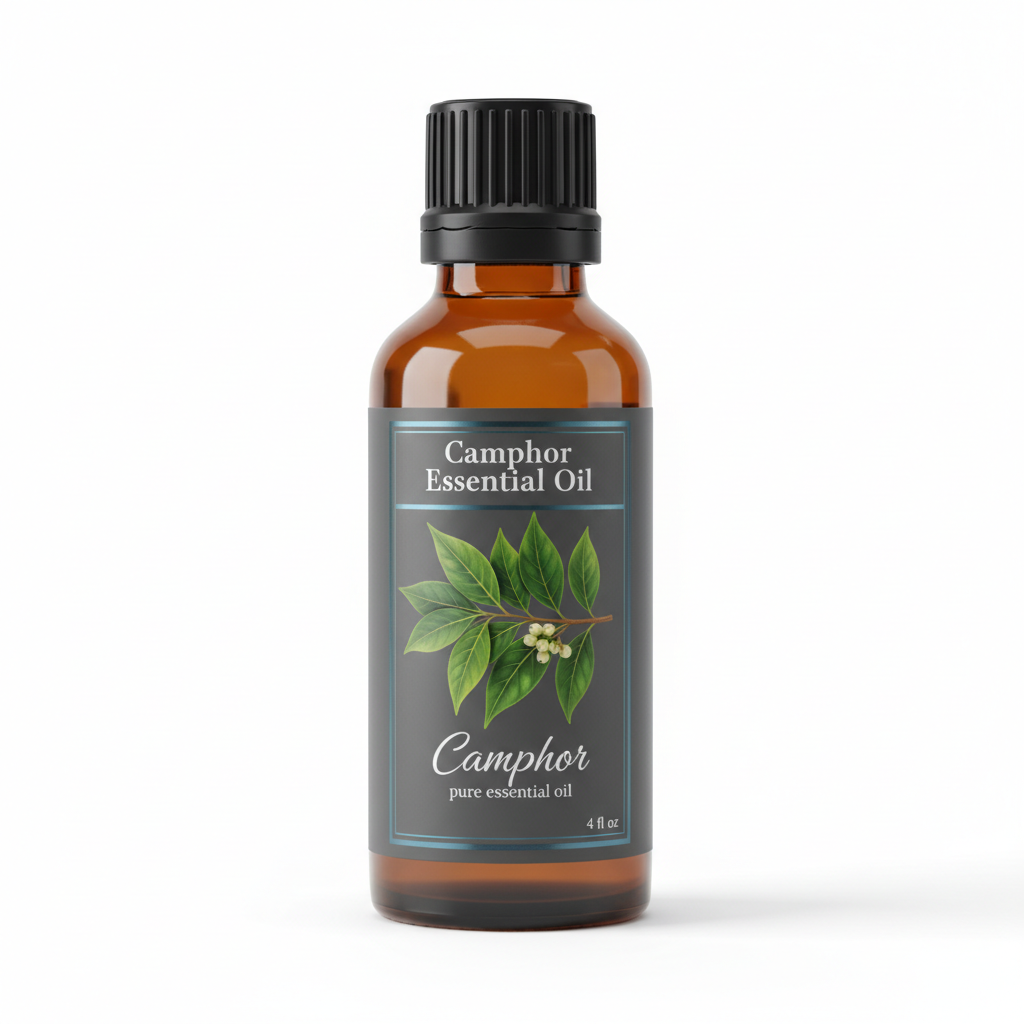
Camphor Essential Oil
Our own Camphor Essential Oil, in sizes from 0.5 oz to bulk.
From $8.69
Shop Now →Searches for "camphor oil for acne" return pages that read as if the question were settled. It is not. What exists is a regulatory definition that cuts against the idea, a small body of general research on camphor on skin, and a different essential oil, tea tree, that has been studied for acne and still cannot support firm conclusions. This page lays those pieces out in the order that matters for a decision. For the broader skin question, our article on camphor oil on skin: evidence, irritation risk and limits is the companion piece.

The mechanism problem
FDA's external analgesic monograph (OTC Monograph M017) defines a counterirritant as a topically applied drug that causes irritation or mild inflammation of the skin to distract from pain in muscles, joints or organs beneath it. Camphor above 3 percent and up to 11 percent sits in that group. Camphor at 0.1 to 3 percent is listed in a separate group for topical analgesic, anesthetic and antipruritic ingredients.
Put those definitions next to what a blemish is. A papule or pustule is already red, swollen and tender. Adding a material whose regulatory definition is "irritation or mild inflammation" to inflamed skin is the opposite of what anyone would design. That is reasoning from the definition, not a trial result, but it is the strongest argument available, and it is why we start from caution rather than from curiosity.
The monograph's required warnings for counterirritants add to this: do not apply to wounds or damaged skin, avoid contact with the eyes, and stop and see a physician if symptoms persist beyond 7 days or clear and return. Picked or open blemishes are damaged skin by any ordinary reading.
What the research on camphor and skin covers
A 2023 analysis in Cureus examined English-language PubMed articles from 2010 to 2022 on camphor- and menthol-containing agents. Of 103 results, 15 addressed health-related use, and the authors described pain, itch and upper respiratory symptoms as the areas where topical use looked potentially effective, with each area resting on a limited number of studies. Acne does not appear in that summary. They called for randomized, double-blind trials.
That absence is itself information. The sources cited here describe no controlled trial of camphor essential oil on acne lesions, no dose, no vehicle, no comparison group. When a page quotes a percentage improvement for camphor and pimples, it is worth asking where it came from.
Tea tree is not camphor, but it shows the standard
People searching this topic are often really asking whether an essential oil can substitute for an acne product. The best-known candidate is tea tree oil. A review of tea tree oil and acne (PMC10295805) reports reduction in inflammatory lesions, mainly papules and pustules, yet concludes that given the diversity of study designs it is not possible to draw concrete conclusions on efficacy and safety. It also notes that allergic contact dermatitis can occur in susceptible people, particularly if the oil is old.
That is the bar for an essential oil with a real acne literature: encouraging signals, mixed designs, no firm conclusion, and an allergy caveat. Camphor does not reach even that bar in the sources cited here. For a head-to-head look at the two oils, see our camphor vs tea tree oil comparison.
| Claim | What the cited sources support | Our read |
|---|---|---|
| Camphor oil dries out pimples | No acne trial cited; FDA defines camphor above 3% as a counterirritant | Unsupported, and the mechanism points the wrong way |
| Camphor has lab-reported microbial effects, so it must clear acne | The Cureus review notes possible antimicrobial function without acne data | A leap from lab property to acne outcome |
| Camphor soothes redness | The sensation is cooling and tingling; the regulatory definition is irritation | A sensation, not evidence of calming |
| Natural oils are gentler than acne products | Contact allergy to camphor documented in case reports (AAAAI); allergy to tea tree documented in its review | Contradicted |
Why the claim keeps circulating
Three ordinary facts get stitched into the acne claim. Camphor has a sharp, clean smell that reads as clinical. It produces a cooling, tingling sensation that people interpret as something being cleared or calmed. And it appears in familiar over-the-counter rubs, which lends it borrowed authority. None of the three is evidence about acne lesions. A scent is not an outcome, a sensation is not an outcome, and a rub for aching muscles is not a skin product for blemishes.
There is also the problem of time. Acne rises and falls on its own. Anyone who tries a new product during a flare and sees improvement a week later will credit the product. Without a comparison group, that is how almost every home practice gets its reputation, and it is why trials, not testimonials, are what we cite. For the wider picture of what has and has not been studied, see camphor oil benefits and uses: what the evidence says.
If you do decide to use camphor oil on skin in any context, dilution is not optional, and our dilution guide explains the arithmetic and the reasons drop size makes any home percentage a rough number. We would still keep it away from blemishes.
Allergy and irritation are the documented outcomes
The AAAAI "Ask the Expert" page on camphor and menthol allergy notes a few case reports of allergic contact dermatitis to camphor in sunscreen and ear drops, plus a report involving Vicks VapoRub that may have been due to other essential oils. The page is explicit that the VapoRub report is not proof camphor was the cause. A 2025 narrative review of VapoRub in PeerJ likewise lists dermatological conditions among documented complications.
The practical consequence for acne is this. If you apply an irritant and the skin gets redder, that is hard to tell from a worsening breakout. The effect can mimic or deepen the problem you set out to address.

The "try this instead" box
- See a dermatologist or ask a pharmacist. Persistent, painful, scarring or widespread acne is a medical question, and the clinicians who handle it have options that have been studied for the purpose. We sell an aromatic material, not an acne product, and we are not the right source for that choice.
- Keep your routine boring. Gentle cleansing and fewer new products at a time makes it easier to see what is helping or hurting. That is practical reasoning, not a studied protocol.
- Do not combine several actives with essential oils. Layering a counterirritant on top of other products raises the chance of a reaction you will not be able to attribute.
- Do not use camphor oil on children or teens without a clinician. Camphor is a long-standing source of childhood poisonings. The pharmacy column in Healio cites AAP Committee on Drugs advice from 1994 that camphor not be used in children.
- If you tried camphor and the skin reacted, stop. Wash it off, and ask a clinician if redness, swelling or burning continues.
If you want camphor as a scent, not a skin product
There is an honest use of our oil that does not involve a face: as an aromatic material for closets, linens, candles and room scents. We sell one product, Camphor Essential Oil, Cinnamomum camphora, described on our pages as the white fraction of the wood distillate, bottled undiluted in dark amber glass, in sizes from 0.5 oz to 400 lb. Our shop page lists the sizes. It is sold as an aromatic and cosmetic material, not a drug, and not for acne.
Our posted certificate of analysis (batch CMPQGACCCNC003A) lists specific gravity 0.878 and refractive index 1.467, among other physical constants. It does not carry a GC/MS profile or a safrole result, which is why we point to our Inside the Still page for what we request on each lot, and why we would not claim it proves a fraction on its own.
For the safety side of any camphor use, read our complete safety guide first.
Questions we would expect
Does camphor oil get rid of pimples?
No trial in the sources cited here shows that. FDA defines camphor above 3 percent as a counterirritant, which means it irritates skin by design.
What about a camphor spot dab, diluted?
Dilution lowers risk but does not create evidence. If you are set on trying anything new on skin, a patch test on a small area comes first and a dermatologist is the better consult for acne.
Is tea tree a better choice?
It has more acne research, though a published review says firm conclusions are not possible and notes allergy risk. That is a reason for caution, not an endorsement.
This page was written from published sources and has not been reviewed by a medical professional. It is not advice for any skin condition.
Camphor Essential Oil
Camphor Essential Oil from our own shop, in sizes from 0.5 oz to bulk.
From $8.69
Shop Now →Sources & Further Reading
- FDA OTC Monograph M017: External Analgesic Drug Products for OTC Human Use
- Hoang D, Wong A, Olympia RP. Current state of research on camphor- and menthol-containing agents. Cureus 2023
- Tea tree oil and acne: a review (PMC10295805)
- AAAAI Ask the Expert: Camphor and menthol allergy
- Valido A et al. There's the Rub: benefits and complications of Vicks VapoRub use. PeerJ 2025
- Healio: Camphor use entails unique safety concerns