How to Patch Test Camphor Oil: Step by Step
Mix the camphor oil to the strength you plan to use, put a quarter-sized spot on your inner forearm or elbow crease twice a day for seven to ten days, and stop at the first redness, itching or swelling. That is the dermatologist protocol for new skin products. A one-time 24 to 48 hour check can miss delayed allergic reactions.
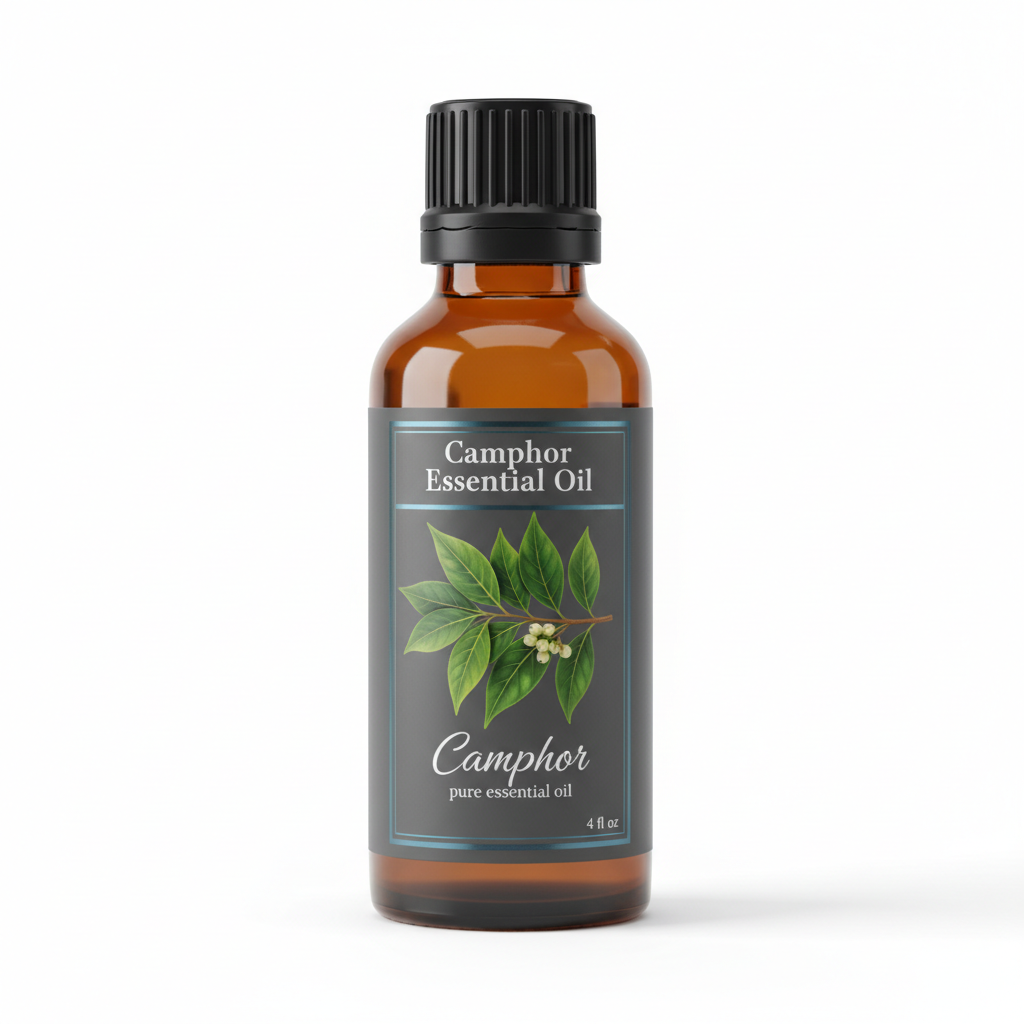
Camphor Essential Oil
Our own Camphor Essential Oil, in sizes from 0.5 oz to bulk.
From $8.69
Shop Now →What a patch test can and cannot tell you
A patch test answers one question: does this blend irritate or sensitize this patch of your skin? It says nothing about the reasons camphor oil is handled carefully in the first place. Camphor's serious hazards are systemic, meaning what happens when it is swallowed or absorbed in quantity, and a clean forearm does not speak to those. The Royal Children's Hospital Melbourne guideline notes camphor is readily absorbed through the skin, although most toxic exposures come from swallowing it.
So we draw a firm line. A patch test is a screening step for skin irritation and allergy, nothing more. It is not clearance to use camphor oil on a child, during pregnancy, on broken skin or near the face, and it does not replace the household rules in Is camphor oil safe?
Why 24 to 48 hours is not enough
A lot of online advice says to dab a little on your arm and look the next day. That window is real, since irritation often shows up quickly. But allergy works on a delay. The American Academy of Dermatology describes its clinical patch test as patches left on for 48 hours, followed by a second visit four to seven days later "because it can take time for your skin to develop an allergic reaction." Its home guidance for new skin care products is to apply the product to a test spot twice daily for seven to ten days (AAD: How to test skin care products).
Where we go beyond the sources: the AAD wrote that guidance for skin care products, not essential oils. Applying it to a diluted camphor oil is our extension, made because the delayed-reaction logic is the same. Treat the 24 and 48 hour looks as checkpoints inside the longer test, not as the test.
Before you start: who should skip the home test
- Anyone with a history of strong reactions to fragrance or essential oils, or active eczema or broken skin in the test area: ask a dermatologist first. The AAD says a medical patch test can identify the cause of recurring reactions.
- Anyone pregnant or breastfeeding: ask an OB-GYN or midwife before testing, and read camphor oil during pregnancy and breastfeeding.
- Children: do not patch test camphor oil on a child. The FDA labeling for over-the-counter camphor products says children under 2 should not use them without asking a doctor, and the household rules for older children are in camphor oil and children.
Step by step
- Fix the blend first. Decide the exact strength and carrier you would use, using the camphor oil dilution guide. Test that blend. A test of undiluted oil tells you about irritation from neat oil, which you should not be using, and a test of a weaker mix tells you little about the stronger one.
- Add a control if you can. Put the carrier alone on a second spot a few centimeters away. If both spots react, the carrier is a suspect, not the camphor.
- Pick the spot. The AAD advises a quarter-sized area where the product will not be rubbed or washed off, such as the underside of the arm or the bend of the elbow.
- Use a normal amount. The AAD says to apply the amount and thickness you would normally use and to leave it on as long as you normally would. For a wash-off use, five minutes or the label time.
- Repeat twice daily for seven to ten days. Keep the spot dry and uncovered by new products or bandages during the test, so a reaction has one possible cause.
- Look at set times. Check about 24 hours in, at 48 hours, and at the end. Note redness, itching, swelling, bumps, or stinging that lingers.
- Stop rules. If any reaction appears, gently wash it off as soon as possible and do not use the blend again. The AAD suggests a cool compress or petroleum jelly, and a dermatologist if the reaction is severe or does not settle.
| When | What to do | What to write down |
|---|---|---|
| Day 1, first application | Apply blend and carrier-only spot; leave as normal | Time, blend strength, carrier used |
| Hour 24 | First look, then continue the schedule | Skin color, itch, any warmth or swelling |
| Hour 48 | Second look | Same notes; compare with the control spot |
| Days 3 to 7 | Keep applying twice daily | Any new rash, even a faint one |
| Days 8 to 10 | Last look; finish the test | Final result for this blend on this site |
What counts as a reaction
The FDA says allergic reactions to cosmetics most often appear as itchy, red rashes, which is contact dermatitis, and lists hives, flaking or peeling skin, facial swelling, and irritation of the eyes, nose and mouth among possible signs. Anaphylaxis (trouble swallowing, shortness of breath, a rapid weak pulse, loss of consciousness) is an emergency: call 911. The FDA also invites consumers to report an adverse event after using a cosmetic product through its allergens in cosmetics page.
Fragrance ingredients can also reach the airways. The FDA notes they are essentially vapor and can be inhaled, which matters most for people with asthma, allergic rhinitis or recent respiratory infections. A skin test cannot check that.
What the numbers say about essential oil allergy, and what they leave out
Large dermatology registries give a sense of scale, though none of them answers a camphor question directly. In a study of 62,354 patients tested in North America and Central Europe from 2009 to 2014, 18.6 percent reacted to at least one fragrance marker or essential oil, and 1.4 percent reacted to an essential oil without reacting to any fragrance marker (Dermatitis, 2018). The oils tested there were sandalwood, ylang ylang, jasmine, peppermint, oxidized tea tree and lavender, not camphor. A later analysis of the same Central European network (IVDK) tested 12 essential oils in 10,930 patients and found 908 (8.3 percent) reacting to at least one; only six oils exceeded 1 percent positive, led by ylang ylang at 3.9 percent (Contact Dermatitis, 2022). Camphor was not among those six, but the abstract does not say which 12 were tested, so we do not read it as a camphor result.
The fair reading: skin sensitization to essential oils is real but, in most cases, uncommon; these patients were already at a skin clinic, so the figures overstate what a general population would show; and nothing here gives a camphor-specific rate. That is exactly why testing your own skin on your own blend is more informative than any statistic.
Can I patch test neat camphor oil?
We would not. Neat oil answers a question you should not be asking, since you should not be applying it undiluted. Test the blend you will actually use.
Does a clear result mean I can use it on my face or scalp?
It means that blend did not react on a forearm or elbow spot in that period. Skin differs from site to site, so we repeat a small test at a new site before wider use. That is our reasoning, not a published rule.
Do I need to repeat the test for a new bottle or a new carrier?
Changing the carrier changes the blend, so retest. A new bottle of the same oil at the same strength is a judgment call; if you have ever reacted, retest.
What if I react but want to know why?
Stop using the blend and see a board-certified dermatologist. The AAD says patch testing in a clinic can find the specific cause. A related read is camphor oil on skin: evidence, irritation risk and limits.
Buying for the test
A patch test uses a tiny amount, so a small bottle covers it. We sell Camphor Essential Oil in sizes from 0.5 oz up, and the handling basics are in our dilution and handling guide. If you want the smallest size for a first trial, see the shop page. Whatever you buy, label the bottle in plain words and store it out of reach of children and pets.
This article summarizes published guidance and our own reasoning. It is not medical advice and has no medical reviewer. Last reviewed: October 2026.
Sources & Further Reading
- American Academy of Dermatology: How to test skin care products
- American Academy of Dermatology: Patch testing can find what is causing your rash
- FDA: Allergens in cosmetics
- Positive patch-test reactions to essential oils in consecutive patients from North America and Central Europe, Dermatitis (2018)
- Contact sensitization to essential oils: IVDK data of the years 2010-2019, Contact Dermatitis (2022)
- Royal Children's Hospital Melbourne: Camphor poisoning clinical guideline
- FDA OTC Monograph M017: External analgesic drug products (children under 2 labeling)