How to Diffuse Camphor Oil Safely (and When Not To)
Diffuse camphor oil only in an adult-only, well-aired room, with no young children, no pets that cannot leave, and no history of seizures among the people present. Use the lowest scent you can detect, run the diffuser 30 to 60 minutes on and 30 to 60 minutes off, and never use a heated burner or an open flame.
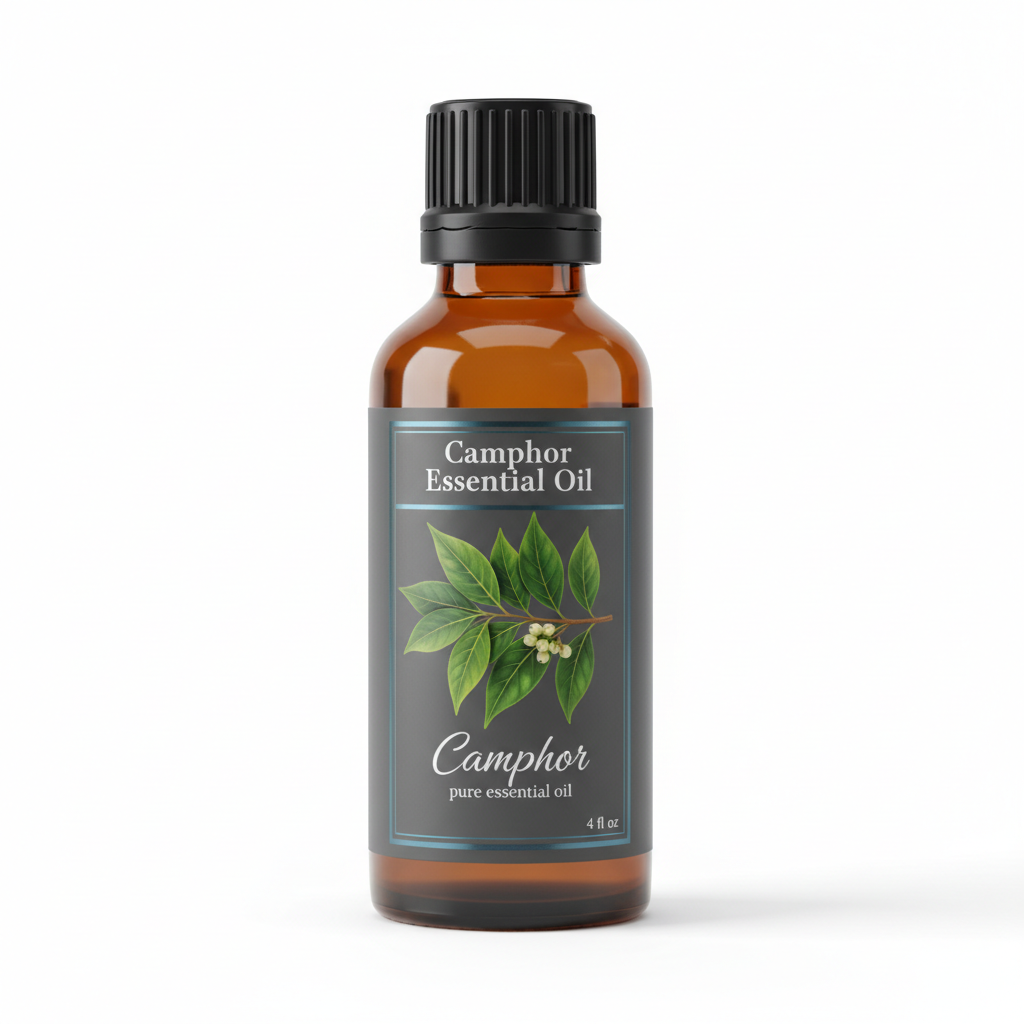
Camphor Essential Oil
Our own Camphor Essential Oil, in sizes from 0.5 oz to bulk.
From $8.69
Shop Now →First decide whether to diffuse it at all
Most diffuser guides start with drops and settings. We would start with a gate, the way a buyer conversation ought to go. Camphor is not a gentle oil, and a diffuser puts it into the air a whole room shares. Our Inside the Still page calls camphor genuinely hazardous: neurotoxic in quantity, contraindicated for infants and young children, to be avoided by anyone with a history of seizures, and never taken internally. We repeat that as a position, not a disclaimer.
The gate has three questions. Is anyone in the home an infant or young child, or likely to be in the room? Does anyone have a seizure history? Is there a pet that cannot leave the room freely? If the answer to any of those is yes, we would not diffuse camphor, and our piece on camphor oil and children and the pet safety article explain the evidence behind that advice.
The pet point has a source. Pet Poison Helpline states that camphor is readily absorbed across the skin of dogs and cats, should never be applied to them, and lists vomiting, depression and, in large amounts, seizures among the signs of poisoning. A diffuser is not skin contact, but it is a source of airborne oil that may settle on a coat. That last step is our reasoning, not a finding, and it is the reason we want any animal to be able to leave the room.
If swallowing is ever a possibility, call Poison Help at 1-800-222-1222 (people) or your veterinarian or Pet Poison Helpline (animals). Call 911 for a seizure, trouble breathing or someone who cannot be woken.
What an exposure limit says, and what it does not
There is no consumer standard for camphor in room air that we could find, so we use the nearest reference and say exactly what it is. The CDC NIOSH Pocket Guide lists a recommended exposure limit for camphor of 2 mg/m3 as a time-weighted average, matched by the OSHA permissible limit, and an immediately-dangerous level of 200 mg/m3. It lists irritation of the eyes, skin and mucous membranes, nausea, vomiting, headache, dizziness and epileptiform convulsions as symptoms of exposure. These are workplace figures for adult workers. They are not home guidelines, and they do not include children or pets.
They are still a useful ruler. The table below is arithmetic, not measurement. It assumes one drop of 0.05 mL (drop size varies, so this is an assumption for the arithmetic only), a density of 0.878 g/mL (the specific gravity on our posted certificate), and treats the whole oil as if it were camphor, which overstates the camphor. It also assumes every drop evaporates into a closed room with no air exchange.
| Room volume | Example room | One drop, all in room air (mg/m3) | Compared with NIOSH 2 mg/m3 |
|---|---|---|---|
| 20 m3 | Small bedroom, about 8 m2 at 2.5 m ceiling | 2.2 | Above |
| 30 m3 | Average bedroom, about 12 m2 | 1.5 | Below, but close |
| 50 m3 | Living room, about 20 m2 | 0.9 | Below |
| 100 m3 | Large open room, about 40 m2 | 0.4 | Below |
The arithmetic is 0.05 mL x 0.878 g/mL = 0.0439 g, or about 44 mg, divided by the volume. In a real room, air exchange lowers the average, and the air right at the diffuser is stronger than the room average. The point is not safety by the numbers. It is that one drop in a small bedroom can approach a workplace limit that was set for an adult workday, and that is why we lean toward fewer drops, not more. It is also why guides that tell you to add five drops to a small room for camphor deserve suspicion.
How to diffuse it, if the gate is clear
1. Choose the room
Pick a room larger than the one you were thinking of, with a window you can open. Use it when adults only are present, and keep the door closed to the rest of the house so scent does not drift to children or pets. Do not run a diffuser in a room where someone sleeps.
2. Use less than you think
Tisserand Institute guidance says very low levels of diffusion, with the oil barely noticeable, are fine for any length of time, and that you may need to adjust the amount for room size, diffuser size and air flow. Taking that literally for camphor, we recommend starting with a single drop in a larger room and stopping when you can first notice it. If you can smell camphor strongly, you have used too much. These are our recommendations from the cited guidance and the arithmetic above, not tested figures.
3. Time it, then ventilate
Robert Tisserand defines intermittent diffusion as 30 to 60 minutes on, then 30 to 60 minutes off. Use that rhythm rather than running a diffuser all day, and open the window during the off period. Stop at once if anyone has a headache, dizziness, nausea or irritated eyes or throat, which match the symptoms NIOSH lists. See a physician for symptoms that persist.
4. Keep heat out of it
NIOSH lists a flash point of 150 degrees Fahrenheit for camphor and names strong oxidizers as incompatible. From that, our position is to avoid candle-warmed burners, heated nebulizers and any open flame for camphor, and to keep the bottle away from heat sources. A cool ultrasonic unit, in a room where nobody sleeps, is the least bad option for the few adults who pass the gate.
5. Clean and store properly
Wipe out the reservoir between uses so camphor does not linger as residue, and put the bottle back on a high, latched shelf. Our oil ships in dark amber glass with a tight closure for a reason: it evaporates readily, and a bottle left open loses oil and scents the room.
Who should not diffuse camphor at all
| Situation | Our position | Basis |
|---|---|---|
| Infant or toddler in the home | Do not diffuse; keep the bottle locked away | Site statement; pharmacist column on child toxicity (1,000 mg can be fatal to a 10 kg child) |
| Seizure history | Do not diffuse; ask a physician | Site statement; NIOSH symptoms include epileptiform convulsions |
| Cat or dog without a free exit | Do not diffuse | Pet Poison Helpline on skin absorption; our reasoning on settling droplets |
| Pregnancy or breastfeeding | Ask an OB-GYN or midwife first | We have no sourced guidance and will not guess |
| Asthma or other lung condition | Ask a physician first | Not assessed in this article |
A scent job a diffuser does badly
Camphor's volatility makes it a poor candidate for room diffusion: NIOSH lists a vapor pressure of 0.2 mmHg, so it needs little help getting into the air. A closed closet or drawer holds a small amount of scent where a diffuser spreads it across a room. If that is the kind of crisp scent you want, read camphor oil uses around the home first. If you still want a blend, our blend starting points keep camphor as the smallest share and say so, and our older cool, clarifying blends article offers a different set of pairings.
A word on steam. A bowl of hot water with oil is not diffusing, and it adds burn and vapor risks. We explain why we take a firm position against it in our steam inhalation piece.
Choosing the oil for a diffuser
If you pass the gate and want to diffuse, grade matters. Our oil is described on our pages as the white fraction of the camphor wood distillate, 100 percent pure and undiluted, distilled and fractionated in China by a producer held on file against each lot, from 0.5 oz to 400 lb. Buy the smallest size first from the shop. The posted certificate for batch CMPQGACCCNC003A reports a specific gravity of 0.878, refractive index 1.467 and optical rotation of +5.80 degrees. It has no GC/MS or safrole figure, so it cannot show the fraction on its own; a safrole result at or below detection is requested for each lot and given when you ask, as set out on Inside the Still. The oil is sold as an aromatic and cosmetic material, not a drug.
Quick answers
How many drops of camphor oil belong in a diffuser?
There is no sourced number, so we will not invent one. Our recommendation is one drop in a larger room and stopping at first detection. Tisserand Institute guidance says to adjust for room size, diffuser size and air flow.
Can I diffuse camphor with other oils?
Yes, but camphor should be the smallest share, and the other oils bring their own safety questions. We did not test blends, so treat any ratio as a starting point.
Can I leave a camphor diffuser running overnight?
No. Intermittent use is the guidance, and nobody should sleep in a room being diffused with camphor.
Last reviewed October 2026. This is general safety information, not medical advice. Speak to a physician, pharmacist or veterinarian about any exposure or health condition.