DIY Camphor Vapor Rub: The 11% Cap and Why Adult-Only
A homemade camphor chest balm is an aromatic product for adults, not a copy of an over-the-counter vapor rub. Those drug products contain about 4.7 to 5.3 percent camphor and are labeled for ages 2 and up. White camphor oil has an unknown camphor content without GC/MS, so this recipe caps total oil at 1 to 2 percent and is never made for children.
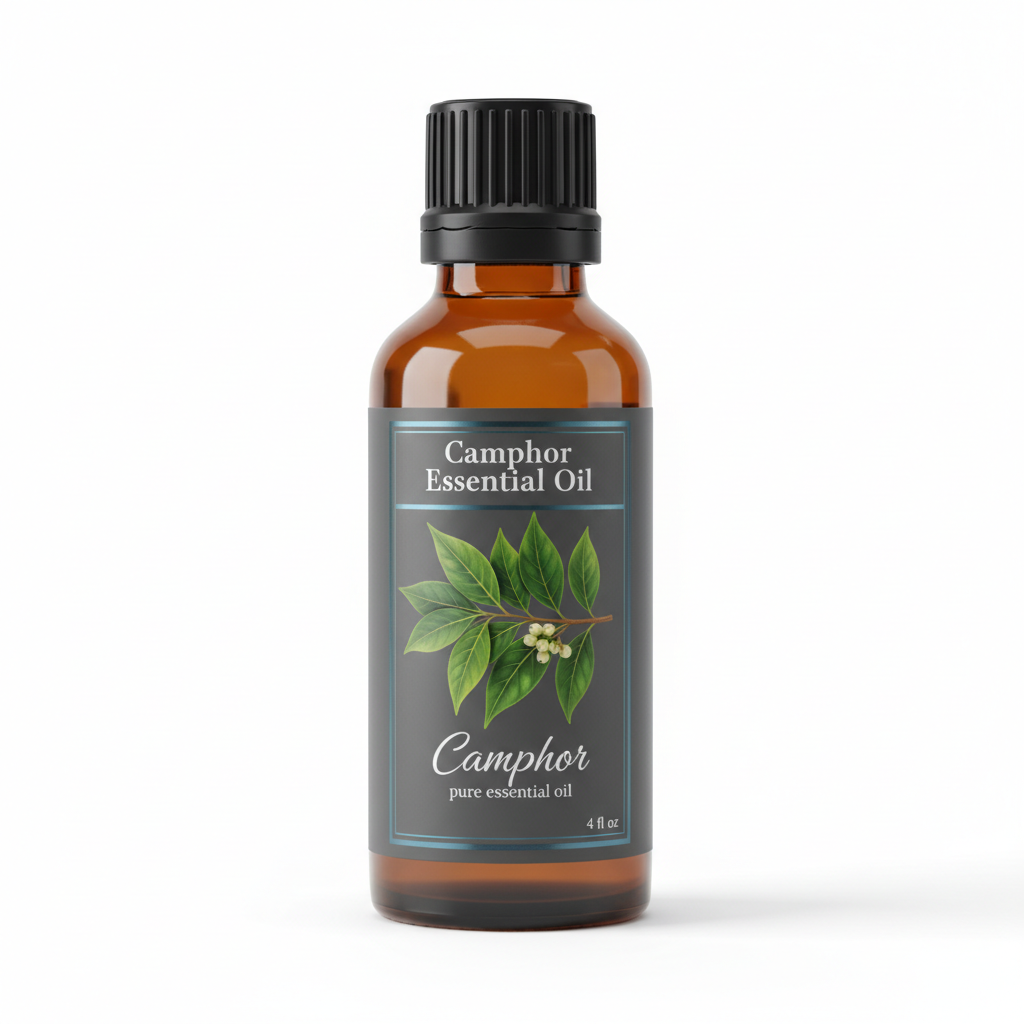
Camphor Essential Oil
Our own Camphor Essential Oil, in sizes from 0.5 oz to bulk.
From $8.69
Shop Now →
Know what you are copying before you copy it
The reason people search for a "DIY vapor rub" is the familiar jar from the pharmacy shelf, so start with what is in it. The Drug Facts label for the best-known product lists synthetic camphor at 4.8 percent, eucalyptus oil at 1.2 percent and menthol at 2.6 percent (label data for Vicks VapoRub, NDC 58933-0544-45). FDA's topical antitussive rule sets camphor ointment at 4.7 to 5.3 percent and allows it for adults and children 2 years and over, with children under 2 told to ask a doctor (21 CFR 341.74).
Note the word "synthetic." That product uses measured camphor crystal, made and labeled as a drug, with batch controls a kitchen cannot match. A white camphor essential oil is a different material. One published specification for a commercial "camphor white oil" lists camphor at under 0.1 percent, with 1,8-cineole at 27 to 43 percent and limonene at 18 to 27 percent (EFSA opinion on camphor white oil). That is one specification, not a statement about every oil, and our own certificate of analysis lists no GC/MS profile, so the camphor content of our lot is not published. The practical consequence is the heart of this article: you cannot build an equivalent of a 4.8 percent camphor product from a white camphor oil, and you should not try.
What the 11 percent cap actually says
The 11 percent figure comes from two separate pieces of FDA history, and they are often blurred together.
- The camphorated oil rule. FDA's rulemaking history lists a proposed rule on 26 September 1980 (45 FR 63869) and a final rule on 21 September 1982 (47 FR 41716) on "camphorated oil" drug products, now carried at 21 CFR 310.502(a) (FDA rulemaking history, OTC camphorated oil). Camphorated oil is a drug preparation, which is not the same thing as camphor essential oil.
- The concentration ceiling. A pediatrics news report summarizes the result: FDA says OTC products cannot contain more than 11 percent camphor, and the report lists a topical product at 10.8 percent as the highest it names (Healio, camphor use entails unique safety concerns, 2012). FDA's current external analgesic monograph lists camphor in the cooling-sensation (counterirritant) category at "exceeding 3 to 11" percent (FDA OTC Monograph M017).
Both statements are regulatory facts about OTC drug products. They are not permissions for a home recipe, and our oil is sold as an aromatic and cosmetic material, not as a drug. For the longer legal story see FDA camphor rules explained.
Using the cap as a ceiling, not a target
There is one sensible use of the 11 percent number in a home recipe, and it is arithmetic. The cap is on camphor, not on camphor oil. If you assume the worst case, that the oil were pure camphor, then keeping total oil in the finished balm at or below a stated percentage guarantees camphor cannot exceed that percentage. A white oil is far from pure camphor, so the real figure is lower, and unknown. That is a ceiling you can compute. It is not a recommendation to approach it.
Here is the arithmetic for a 30 g batch (the general method is in the camphor oil dilution guide). The conversion uses the specific gravity of 0.878 on our posted certificate of analysis for batch CMPQGACCCNC003A (grams divided by 0.878 gives millilitres), and drops use the average of about 30 per mL, with the range of 20 to 40 reported by the Tisserand Institute (Tisserand Institute, How big is a drop?).
| Total oil in the balm | Oil in a 30 g batch | Volume (g / 0.878) | Drops at 30 per mL (range 20 to 40) | Camphor ceiling in the balm |
|---|---|---|---|---|
| 1 percent | 0.30 g | 0.34 mL | about 10 (7 to 14) | 1 percent |
| 2 percent | 0.60 g | 0.68 mL | about 20 (14 to 27) | 2 percent |
| 5 percent (shown for scale only) | 1.50 g | 1.71 mL | about 51 (34 to 68) | 5 percent |
The 5 percent row is there so you can see what an OTC-like figure would take: roughly 50 drops in a small jar of balm. We do not recommend it, because that much of a skin-irritating oil in an untested home mixture is a bigger bet than the scent justifies. At 1 to 2 percent the worst-case camphor ceiling sits far below the OTC range, which is the point of the choice.

The recipe, stated as arithmetic
Everything here is a starting point from reasoning, not a tested formula. We have no batch logs or trials behind these ratios, and we will not claim any. The wax share is a design choice: a higher share is firmer, a lower share softer.
- Base (30 g total). 6 g beeswax and 24 g carrier oil, which is 20 percent wax. Choose the carrier by how long the balm will sit; the carrier oil comparison explains why jojoba suits a jar that will be kept and almond suits one you finish quickly (skip almond for anyone with a tree-nut allergy).
- Melt gently. Beeswax melts at about 61 to 65 degrees Celsius according to one chemical reference (beeswax properties, ChemicalBook). Use a heatproof jar in a pan of hot water rather than a direct flame, and keep the hot wax away from skin.
- Cool before adding the oil. Take the jar off the heat and let it cool until the edges start to cloud. This is reasoning, not a test: the lighter constituents of an essential oil evaporate readily, so adding the oil to very hot wax loses more of it and raises the risk of a splash. Commercial vapor rub labels carry a "do not heat" warning for the finished product (label data), and the same instinct applies at home.
- Weigh the oil. For 1 percent, add 0.30 g; for 2 percent, 0.60 g. A kitchen scale that reads to the nearest gram cannot do this, so use a scale that reads to 0.01 g, or count drops using the table, accepting the spread.
- Stir, pour, cool undisturbed, label. Put the date and "adult use only, keep away from children" on the tin, and keep a child-resistant container if there are children in the home.
Test a small amount first. Our patch test guide describes the steps, and the oil's own risk profile is the reason: the EFSA opinion considers the white oil an irritant to skin and eyes and a skin and respiratory sensitiser. If you want a blend with other oils, the blending guide explains why the total oil, not each oil, is what you cap.
Why adult-only, and who should not make this at all
We take a firmer line than the OTC label's age limit of 2, for five reasons.
- The American Academy of Pediatrics Committee on Drugs recommended in 1994 that camphor not be used in children, according to a pediatrics news summary, which also notes that poison centers reviewed 10,000 camphor ingestion exposures in the United States from 1990 to 2003 (Healio, 2012).
- Poison Control states that swallowed camphor in a chest rub can cause nausea, vomiting, seizures and death, and describes a 3-year-old who had a seizure after about 10 hours of chest rubbing and exposure to camphor tablets in a vaporizer (Poison Control, Is Vicks VapoRub safe?).
- The European eucalyptus oil monograph contraindicates 1,8-cineole preparations for children under 30 months because of a risk of laryngospasm (EMA community herbal monograph on eucalyptus oil, superseded version). A cineole-rich white oil is a different material, and we are applying the reasoning by analogy.
- A homemade balm has no verified concentration. Parents cannot tell how much camphor a child would receive.
- The commercial label tells pregnant or breastfeeding users to ask a health professional first (label data), and a homemade balm gives you less information than that label does.
Also skip it if you have a history of seizures, are pregnant, or have asthma, without asking a physician or pharmacist. Do not apply it to wounds or damaged skin, do not bandage the area tightly, and keep it out of the eyes and nostrils: those warnings appear in FDA's external analgesic monograph (FDA OTC Monograph M017) and the topical antitussive rule (21 CFR 341.74). For children and for an honest comparison of how the sensation differs from what it does to breathing, see camphor oil and children and camphor chest rubs: what the sensation does and does not do.
If the reason you are reading this is a cough or congestion that will not go away, that is a question for a physician or pharmacist, not a recipe. The Drug Facts label above tells users to ask a doctor if a cough lasts more than a week or comes with fever, rash or persistent headache (label data). If anyone swallows any of this, call Poison Control at 1-800-222-1222 and do not wait for symptoms.
The oil, in the ingredients list
For the aromatic oil itself, we sell one camphor essential oil: the white fraction of the wood distillate, bottled 100 percent pure and undiluted in dark amber glass, from 0.5 oz up to 400 lb. A 0.5 oz or 1 oz bottle is plenty for several batches of this size, and the posted certificate of analysis (specific gravity 0.878, refractive index 1.467, optical rotation +5.80 degrees) is what we can show today. It does not report GC/MS, so it does not show camphor content or a safrole figure; the Inside the Still page says a safrole result is asked for on every lot and given when you ask. Camphor oil sizes are in the shop.
Frequently asked questions
Can I add eucalyptus and menthol to copy the commercial blend?
We would not. Each addition adds another strong, skin-active material to an untested mixture, and the commercial formula is made under controls you do not have. Read the dilution and handling FAQ before adding anything.
Is 11 percent a safe amount to use?
No. It is the upper limit in FDA's rules for camphor in OTC drug products, not a safety recommendation for a home mixture.
Can I make a version for my child?
No. See the reasons above, and ask a pediatrician about any product for a child.
This article is general information, not medical advice. Last reviewed October 2026 against the sources listed below; no medical reviewer has examined it.
Sources & Further Reading
- 21 CFR 341.74: Labeling of antitussive drug products (topical camphor and menthol)
- FDA OTC Monograph M017: External Analgesic Drug Products for OTC Human Use
- FDA: Rulemaking history for OTC camphorated oil drug products
- Healio: Camphor use entails unique safety concerns (2012)
- Poison Control: Is Vicks VapoRub safe? (1-800-222-1222)
- Drug Facts label data for Vicks VapoRub (NDC 58933-0544-45)
- EFSA opinion on camphor white oil
- EMA community herbal monograph on eucalyptus oil (superseded)
- Tisserand Institute: How big is a drop?
- ChemicalBook: beeswax properties