Best Carrier Oils for Camphor Oil
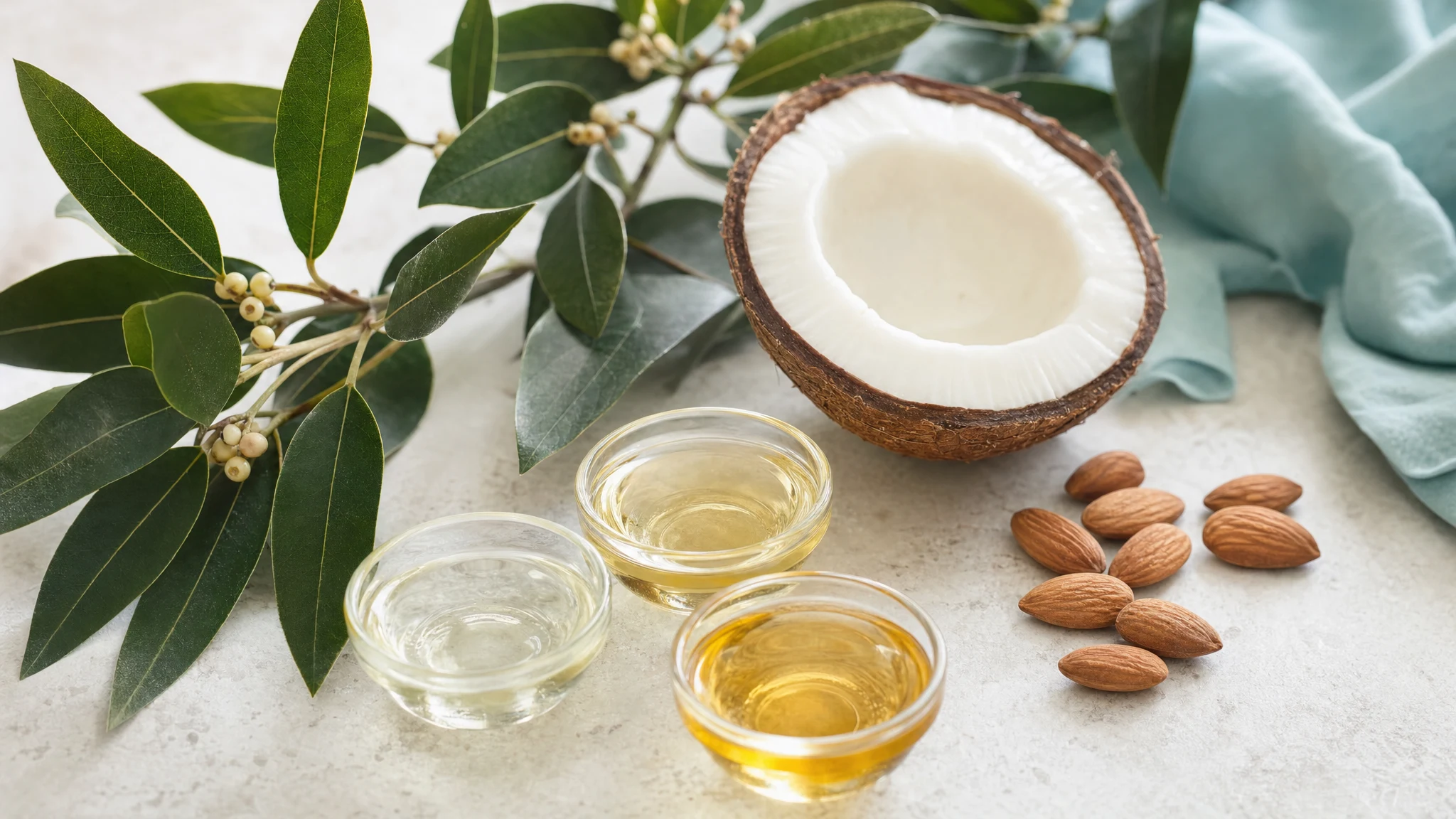
For camphor oil, choose jojoba when the mixture will sit for months, sweet almond for a small batch you will use up quickly, and coconut mainly where firmness helps, as in a balm. Published data supports differences in stability and composition. We found no sourced evidence that any carrier makes camphor "absorb" better or worse.
Camphor Essential Oil
Our own Camphor Essential Oil, in sizes from 0.5 oz to bulk.
From $8.69
Shop Now →The wrong question and the right one
Most carrier-oil lists rank oils by how "nourishing" they are, which says little about the problem you face with camphor oil. Camphor oil is a strong, volatile material that has to be spread across a lot of carrier, kept for a while in a bottle that gets opened repeatedly, and applied to skin that may react to it. The European Food Safety Authority's opinion on a commercial white camphor oil describes the material as an irritant to skin and eyes and a skin and respiratory sensitiser (EFSA opinion on camphor white oil). That is a feed-additive assessment of one specification, not a test of our oil, but it is a fair reminder that the carrier is not the only thing on your skin. So the useful questions are: how long will this mixture sit, what will it be used for, and does the carrier add its own risk?
That order, shelf life first, then format, then individual sensitivities, is how we would walk a buyer through the choice at a counter. If you have not yet settled how much oil goes in, start with the camphor oil dilution guide, because the dilution decides how much carrier you need to buy at all.
What the evidence supports, and what it does not
Three facts that we could verify are worth building on.
- Jojoba. A review of plant oils for the skin notes that jojoba has a high content of wax esters and describes it as showing high oxidative stability and resistance to degradation (Lin, Zhong and Santiago, International Journal of Molecular Sciences, 2018). The review gives no percentages for jojoba.
- Coconut. The same review lists the fatty acids of coconut oil as lauric acid 49 percent, myristic 18 percent, palmitic 8 percent, caprylic 8 percent, capric 7 percent, oleic 6 percent, linoleic 2 percent and stearic 2 percent, a profile that is mostly saturated. Those figures are cited in the review to a secondary source.
- Sweet almond. In a study of sweet almond kernel oils from different genotypes, oleic acid ranged from 62.43 to 76.34 percent and linoleic acid from 13.97 to 29.55 percent (sweet almond fatty acid composition study, PMC7520497). Almond oil is therefore far more unsaturated than coconut.
What follows from those facts is reasoning, and we mark it as such. Unsaturated fatty acids oxidize more readily than saturated ones, so a carrier rich in oleic and linoleic acid is the more likely of the three to go off in a long-stored mixture, while a wax-ester oil and a saturated fat are the more stable choices. We did not find a trustworthy, sourced shelf-life figure in months for any of the three, and brand blogs disagree with each other, so this article gives none. Buy the smallest bottle you will use up, date the jar, and smell it before each batch.
What we could not verify is anything about absorption. We found no sourced comparison of how a given carrier changes how much camphor or cineole reaches or passes through skin. A claim that "coconut carries camphor deeper" or "jojoba is absorbed faster" would be a guess, and with a potent oil a guess about absorption is the wrong thing to build advice on.
Side by side: the three carriers
| Carrier | What is documented | What follows by reasoning | Where we would use it with camphor | Watch for |
|---|---|---|---|---|
| Jojoba | High wax-ester content; high oxidative stability (Lin et al., 2018) | The best bet for a mixture that sits in a roll-on or jar for a long time | Roll-ons, leave-on blends you make in advance | Check the label: it should be plain jojoba oil with nothing added |
| Sweet almond | Oleic 62.43 to 76.34 percent, linoleic 13.97 to 29.55 percent (PMC7520497) | More oxidation-prone than jojoba because it is unsaturated | Small body-oil batches you will finish quickly | Almond is a tree nut. FDA lists tree nuts among the major food allergens (FDA food allergies), so skip it for anyone with a tree-nut allergy |
| Coconut (virgin) | Lauric acid about 49 percent, mostly saturated (Lin et al., 2018) | Stable and firm; can set solid in a cool room, so it behaves differently in a roll-on than in a jar | Balms and solid mixtures where firmness helps | Can leave a heavier feel; see our two-ingredient camphor and coconut oil article |
The firmness point is reasoning, not a measurement: a fat that is mostly saturated tends to be firmer at room temperature than one that is mostly unsaturated, so a coconut mixture in a cold bathroom may not pour. Test with a small jar before you fill a roll-on.
Our position: choose by storage time, not by label
Here is where we part ways with the common advice. Lists tend to say any "light, skin-friendly" oil works, and that the carrier "helps" the active material. We would not choose on that basis. Our order of priorities is:
- Will the mixture be stored? If yes, jojoba. If no (you will use it within the batch), sweet almond is a reasonable and often cheaper choice for those who are not allergic.
- Does the product need to be firm? If yes, coconut (or a wax-based balm), as in the DIY vapor rub and muscle balm recipes.
- Does the person have any allergy or sensitivity to the carrier? If so, that carrier is out, whatever the list said.
The same list explains a related habit we recommend dropping: mixing a big batch "to save time". A large batch stored for a long period is the situation in which a less stable carrier is most likely to go off, and in which a camphor mixture will have been opened the most times.
The measuring problem
A carrier decision includes how much of it you pour. The Tisserand Institute reports that across three studies the average weight of 20 drops of essential oil was 0.66 g, about 30 drops per mL, and that studies ranged from roughly 20 to 40 drops per mL (Tisserand Institute, How big is a drop?). We work from that average and show the spread, because drop size changes with the opening, the bottle and the oil.
| Total oil in carrier | In 15 mL (1/2 fl oz) | In 30 mL (1 fl oz) |
|---|---|---|
| 0.5 percent | 0.075 mL: about 2 drops (1 to 3) | 0.15 mL: about 4 to 5 drops (3 to 6) |
| 1 percent | 0.15 mL: about 4 to 5 drops (3 to 6) | 0.3 mL: about 9 drops (6 to 12) |
| 2 percent | 0.3 mL: about 9 drops (6 to 12) | 0.6 mL: about 18 drops (12 to 24) |
The arithmetic: percent times volume gives millilitres of oil, and millilitres times 30 gives average drops. The range in brackets uses 20 and 40 drops per mL. These are totals for all essential oils combined, so a blend such as those in our camphor blending guide must share the total. The 0.5 to 2 percent band is a deliberately cautious zone for a potent oil that we chose for the arithmetic. It is not a published safe limit for camphor oil, and no table replaces a patch test. For anything beyond a few drops, weigh the oil on a small scale instead of counting drops.
Who should skip this altogether
Camphor in a carrier is a skin product, and it is not for everyone. Do not use any camphor oil mixture on or near children, and keep it away from the face. Camphor can be dangerous if swallowed, and Poison Control states that when swallowed, the camphor in a chest rub can cause nausea, vomiting, seizures and death (Poison Control). If you are pregnant or breastfeeding, have a seizure history or have asthma, speak to a physician or pharmacist first. A mixture in a carrier is also more likely to be mistaken for a plain body oil, so label it and keep it up high. If anything is swallowed, call Poison Control at 1-800-222-1222.
Where our oil fits
Our camphor oil is sold as an aromatic and cosmetic material, not as a drug. It is the white fraction of the wood distillate, bottled 100 percent pure and undiluted in dark amber glass, from 0.5 oz up to 400 lb, so a first small batch does not need more than a 0.5 oz or 1 oz bottle. The posted certificate of analysis lists specific gravity 0.878, refractive index 1.467 and optical rotation +5.80 degrees. It carries no GC/MS profile, so it will not tell you the camphor or cineole content of your lot; the Inside the Still page says a safrole result is asked for on every lot and given when you ask. See the available sizes if you are ready to buy a small bottle.
Frequently asked questions
Which carrier is the safest for camphor oil?
None is safe in the sense of removing the risks of the oil. The carrier's job is to dilute and spread it. Choose on storage time and allergy, and use the lowest total oil that gives the scent you want.
Can I use olive oil?
We have not assessed olive oil for this use. One review reports that olive oil applied to skin was associated with increased transepidermal water loss in adult volunteers (Lin et al., 2018), which is a reason we leave it off our list.
How long does a camphor and carrier mixture keep?
We could not find a trustworthy sourced figure, so we will not give one. Make small batches, date them, store them in dark glass with a tight cap, and discard anything that smells rancid or has changed.
This article is general information, not medical advice. Last reviewed October 2026 against the sources listed below; no medical reviewer has examined it.
Sources & Further Reading
- EFSA opinion on the safety and efficacy of camphor white oil as a feed additive
- Lin TK, Zhong L, Santiago JL. Review of topical plant oils and skin barrier repair. Int J Mol Sci. 2018
- Effect of almond genotypes on fatty acid composition, tocopherols and mineral contents of sweet almond kernel and oils
- Tisserand Institute: How big is a drop?
- FDA: Food allergies
- Poison Control: Is Vicks VapoRub safe? (1-800-222-1222)