
What Camphor Blends Well With: 10 Crisp Pairings
Camphor has a scent that stops you mid-breath. Cool, sharp, and unmistakably itself, it carries a presence that most oils simply cannot fake. That quality makes it one of the more interesting challenges in blending: camphor can anchor a formula or overwhelm it, depending entirely on what you place beside it.
This guide walks through ten of the most reliable camphor oil pairings, drawn from perfumery tradition, modern aromatherapy blending practice, and the logic of scent families. For each pairing, you will find notes on why it works, how to approach the ratio, and a practical takeaway you can apply right away. If you want a deeper foundation first, the overview of white camphor oil in perfumery and blending covers sourcing, grades, and the chemistry behind that signature coolness.
A Quick Word on Ratios Before You Start
Camphor is potent. Even a small percentage in a blend shifts the entire character of the formula. Most experienced blenders keep camphor between 2 and 8 percent of a finished blend. Start at the lower end, evaluate after 24 hours (scents shift as they marry), and adjust slowly. Always dilute properly before any skin contact: 1 to 3 percent in a carrier oil is the standard range for leave-on applications.
If you are still sourcing your oil, it is worth reading a smart shopper's guide to buying camphor oil online before you commit to a supplier. Quality varies considerably, and what blends well with camphor of one grade may not translate to another.
1. Eucalyptus Globulus
This is the most instinctive camphor oil pairing. Eucalyptus globulus shares camphor's clean, penetrating character while adding a greener, slightly medicinal edge. Together, they reinforce each other without competing. The result reads as crisp and expansive, the kind of scent profile associated with mountain air or fresh linen dried outdoors.
In a diffuser blend, a ratio of roughly 3 parts eucalyptus to 1 part camphor tends to let the eucalyptus carry the blend while camphor sharpens it from below. Reverse that ratio and camphor dominates, which works well in small spaces where you want intensity without sweetness.
Practical takeaway: Try 4 drops eucalyptus globulus, 1 drop camphor, and 2 drops peppermint in a 100ml diffuser. This is a classic cool-air blend for morning routines or a focused work session.
2. Peppermint
Peppermint brings menthol to the table. Camphor brings its own distinct coolness. Side by side, they create a layered chill that is more complex than either oil alone. Where peppermint skews sweet and bright, camphor grounds it with a woody undertone that keeps the blend from tipping into candy territory.
This pairing works especially well in cooling body products such as foot scrubs, muscle-focused massage oils (always properly diluted), and room sprays intended for warm environments. The two oils have similar volatility, so they tend to diffuse at a comparable rate, which means the blend stays coherent from the first spray to the last.
Practical takeaway: For a cooling foot soak, add 2 drops peppermint and 1 drop camphor to a tablespoon of carrier oil or unscented bath salts first, then disperse into warm water. Never add undiluted essential oils directly to bath water.
3. Lavender
On paper, lavender and camphor look like opposites. Lavender is soft, floral, and balsamic. Camphor is hard, sharp, and penetrating. In practice, they balance each other beautifully. The lavender rounds off camphor's severity, and camphor lifts lavender out of the sweetness it can fall into at high concentrations.
This is a classic pairing in traditional European aromatic traditions, particularly in preparations associated with linen care and calm evening atmospheres. Lavender's linalool content also blends seamlessly with camphor's borneol notes on a chemical level, which gives the combination a natural coherence that blenders often describe as effortless.
Practical takeaway: A simple linen spray of 10 drops lavender, 3 drops camphor, and 1 ounce of distilled water (shaken well before each use) refreshes bedding and adds a quietly complex scent to pillowcases.
4. Rosemary
Rosemary is a natural companion for camphor because the two share chemical relatives. Rosemary ct. camphor is an entire chemotype built around camphor content, so the pairing feels native rather than constructed. Even standard rosemary verbenone or rosemary ct. 1,8-cineole blends smoothly with camphor, leaning into the herbal, green character both oils share.
In hair and scalp formulations, this pairing has a long history of use. Both oils contribute to a brisk, clean scent profile that feels purposeful without being perfume-forward. The combined aroma supports a sense of clarity and alertness, which is why this blend appears frequently in morning shower products and pre-workout preparations.
Practical takeaway: Add 3 drops rosemary and 1 drop camphor per tablespoon of jojoba oil for a scalp massage blend. Massage in, leave for 20 minutes, then shampoo out. Perform a patch test 24 hours before use.
5. Cedarwood Atlas
Camphor is a top-to-mid note. Cedarwood Atlas is a deep, resinous base. Paired together, they form a vertical structure that gives a blend genuine longevity. Camphor opens bright and cold; cedarwood holds it down and adds warmth as the blend dries. The contrast is what makes this pairing interesting.
This combination reads as woody and bracing rather than floral or sweet. It suits masculine-leaning fragrance profiles and blends intended for wooden surfaces like furniture polish or drawer liners. In perfumery, this is a foundation worth building on: add a small amount of vetiver to deepen the base further, or a touch of bergamot to brighten the top.
Practical takeaway: For a simple reed diffuser blend, combine 8 drops cedarwood Atlas, 3 drops camphor, and 2 drops vetiver in a base of unscented diffuser carrier. The camphor fades first, leaving a warm cedar-vetiver trail.
6. Clove Bud
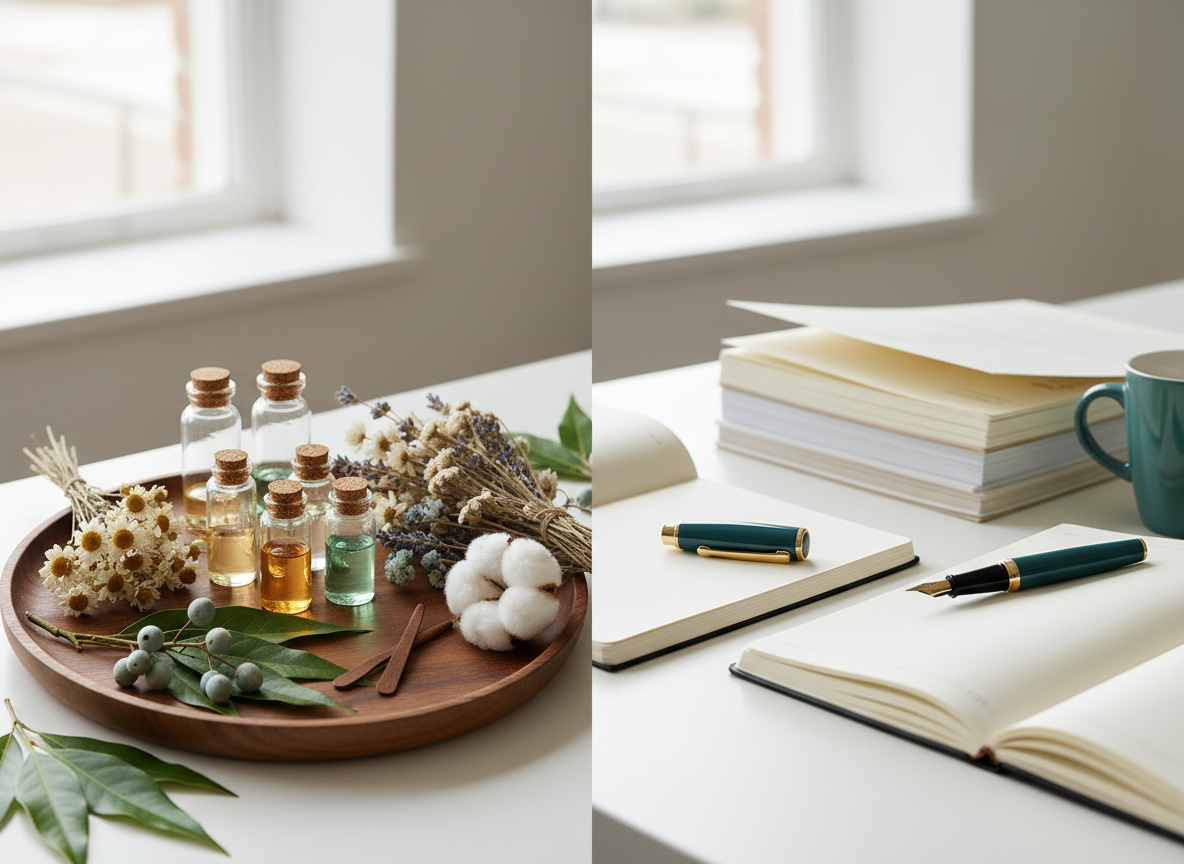
This is a less obvious pairing, and it rewards experimentation. Clove bud is spicy, warm, and slightly medicinal in its own right. Camphor provides the cool counterweight that stops clove from becoming cloying. Together, they produce a blend that feels complex and slightly antique, reminiscent of old apothecary cabinets and spice routes.
Clove bud should be used carefully in any blend intended for skin contact. Its eugenol content makes it a potential skin sensitizer at higher concentrations. Keep clove bud at or below 0.5 percent in leave-on products, per standard formulation guidance. For diffuser blends, the usual consideration is simply ratio: camphor at roughly double the concentration of clove bud keeps the spice in check.
Practical takeaway: In a diffuser blend for cooler months, try 3 drops camphor, 2 drops cedarwood, and 1 drop clove bud. Warm, cool, and complex without being seasonal-sweet.
7. Bergamot
Bergamot is one of the great bridge oils in blending. It connects citrus brightness with a soft floral depth, and it sits comfortably beside camphor's sharpness without either note erasing the other. Camphor adds an unexpected freshness to bergamot blends, lifting them out of the purely citrus-floral category and into something crisper and more bracing.
This is a pairing worth exploring if you find straight bergamot blends too soft or predictable. The camphor component introduces a tension, a slight astringency, that gives the overall blend more interest. In candle or room spray formulations, bergamot and camphor together produce a clean-living scent profile that works in almost any room.
Practical takeaway: Use bergamot FCF (bergapten-free) for any skin-contact application. In a 10ml roller blend, 5 drops bergamot FCF, 2 drops camphor, and 1 drop lavender in jojoba oil creates a brisk, wearable personal fragrance. Patch test before use.
8. Tea Tree
Tea tree has a sharp, green, slightly medicinal character that overlaps with camphor in interesting ways. Where camphor is cold and crystalline, tea tree is warmer and earthier. Blended together, they produce something that feels clean and purposeful, a scent profile suited to household preparations, surface sprays, and foot-care products.
This is one of the most practically useful camphor oil pairings for DIY formulators who want products that smell genuinely effective rather than artificially fragranced. The combination reads as serious and purposeful, which suits cleaning and grooming applications well. Neither oil is particularly sweet or floral, so the blend skews utilitarian in the best sense of the word.
Practical takeaway: For a surface-freshening spray (non-food-contact surfaces only), combine 10 drops tea tree, 5 drops camphor, and 5 drops lemon in 100ml of water with a small amount of solubilizer or unscented liquid soap to help the oils disperse. Shake before each use.
9. Frankincense
Frankincense brings resinous depth, incense-like warmth, and a quiet spirituality to any blend it enters. Camphor, by contrast, is immediate and cold. Together, they evoke something ritualistic, a tension between the earthy and the ethereal that has made both oils constants in ceremonial and contemplative traditions for centuries.
This pairing works particularly well in blends intended for meditative or focused atmospheres. The frankincense holds the blend in place while camphor keeps it from becoming heavy or suffocating. For those exploring the camphoraceous family as a perfume note, frankincense is a valuable base to experiment with because it can support the camphor without competing for attention.
Practical takeaway: Diffuse 4 drops frankincense, 2 drops camphor, and 2 drops sandalwood during reading or quiet evening time. The blend is slow-burning and complex, evolving over an hour or two in the diffuser.
10. Juniper Berry
Juniper berry is fresh, dry, and slightly resinous. It shares a coniferous edge with camphor without duplicating it, which makes the pairing feel coherent rather than redundant. Together, they produce a blend that reads as northern and bracing: think cold pines, frost on bark, and clean winter air.
This combination suits unisex fragrance formulations and cold-weather room blends exceptionally well. It is also worth noting that juniper berry pairs well with the cedarwood and camphor combination from earlier in this list. Adding all three creates a multi-layered coniferous blend with real complexity: juniper at the top, camphor in the mid, cedarwood at the base.
Practical takeaway: For a cold-season room spray, blend 6 drops juniper berry, 3 drops camphor, 4 drops cedarwood Atlas, and 1 drop black pepper in 50ml of distilled water with a natural solubilizer. Spray into the air, not onto fabrics directly.
Blending Notes: What to Keep in Mind Across All Pairings
A few principles apply regardless of which camphor oil pairings you are exploring.
- Start low with camphor. It is easier to add than to subtract. Even 1 or 2 additional drops can shift a blend significantly.
- Let blends rest. Camphor-forward blends often smell sharper immediately after mixing. Give the formula 24 to 48 hours before making final ratio adjustments.
- Mind the application. Diffuser ratios and skin-safe dilutions are not interchangeable. What works beautifully at full strength in a diffuser may be too concentrated for a roller or lotion.
- Patch test always. Before using any new blend on skin, apply a small amount to the inner forearm and wait 24 hours. Discontinue use if any reaction occurs.
- Avoid use during pregnancy, with young children, or around pets without consulting a qualified professional first. Camphor requires particular care in these contexts.
Building Your Own Camphor Blending Practice
The ten pairings above are starting points, not finished formulas. Real blending happens through iteration: small batches, careful notes, and a willingness to discard what doesn't work. Camphor is a challenging partner precisely because it is so distinctive. The oils that coexist with it most gracefully tend to have either a shared sharpness (eucalyptus, peppermint, rosemary) or a complementary warmth that tempers camphor's edge (cedarwood, frankincense, lavender).
What mixes with camphor oil most successfully is ultimately about balance. Camphor wants a counterpart, something that either mirrors its intensity or absorbs it. The worst camphor blends are the ones where every oil in the formula is competing at the same volume. Give camphor room, give it contrast, and it rewards you with a clarity that few other oils can produce.
Keep experimenting. Write everything down. And when you find a ratio that works, name it something worth remembering.