DIY Camphor Muscle Balm: Dilution Math First
Decide the total oil percentage before you buy a single ingredient, then weigh the oil instead of counting drops. For a 30 g aromatic balm, 1 percent is 0.30 g of oil and 2 percent is 0.60 g. FDA's camphor figures for OTC drugs, exceeding 3 to 11 percent, belong to drug products, not to this recipe.
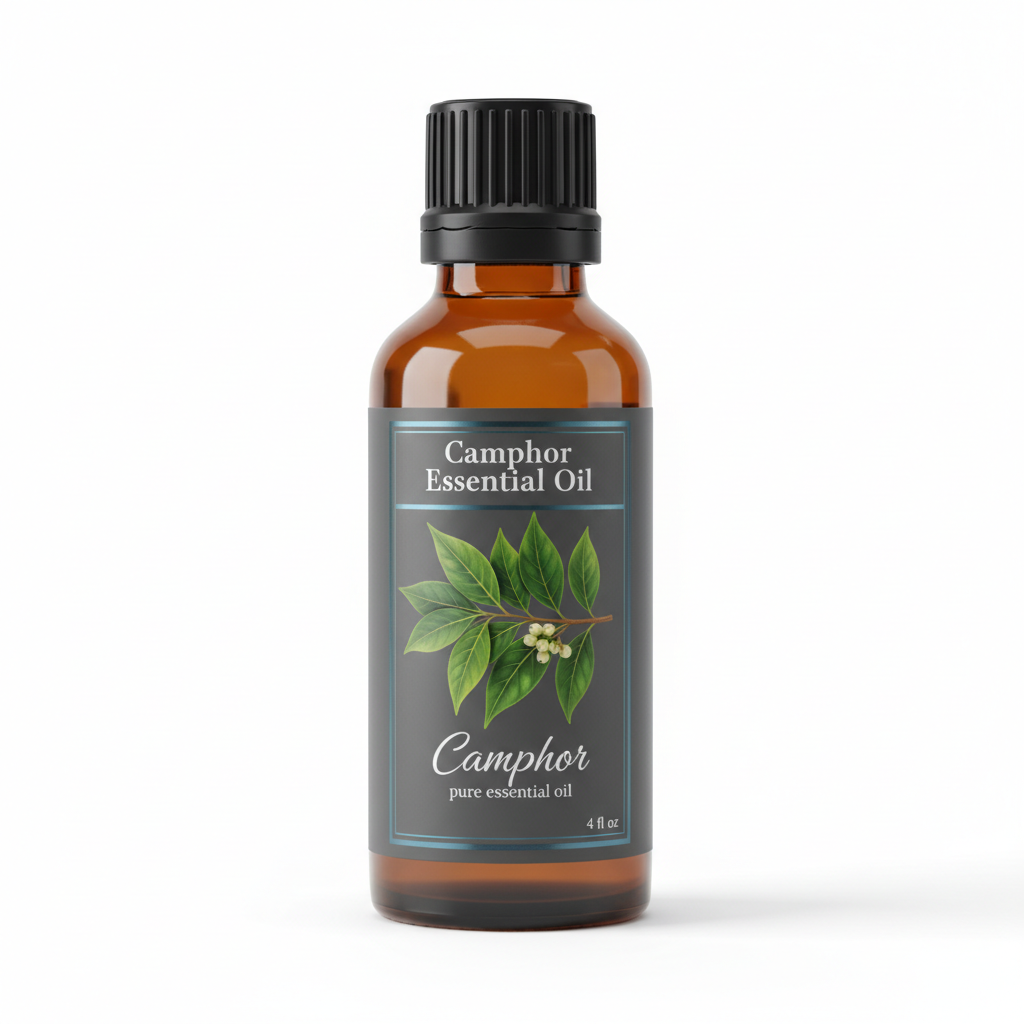
Camphor Essential Oil
Our own Camphor Essential Oil, in sizes from 0.5 oz to bulk.
From $8.69
Shop Now →
Why the math has to come first
Most balm recipes begin with a list of ingredients and finish with "add 20 drops." That order hides three decisions that matter more than the wax: what the percentage is a percentage of, how you will measure it, and how much error you can live with. With a skin-irritating oil, the measuring step is where most home recipes quietly go wrong.
The first decision is the unit. Percent of the finished balm by weight is the only version that survives scaling up and down, so every number in this article is grams of oil per gram of base. The second is the measuring tool. The Tisserand Institute reports that across three studies the average weight of 20 drops of essential oil was 0.66 g, about 30 drops per mL, and that studies ranged from roughly 20 to 40 drops per mL (Tisserand Institute, How big is a drop?). Take the extremes: if your bottle gives 20 drops per mL when the recipe assumed 30, you add one third less than planned, and if it gives 40, one third more. A recipe that wants "about 1 percent" and can miss by a third in either direction has no precision to speak of. The same logic applies to our dilution guide, which shows the drop table for small batches.
| Measuring tool | Typical error on a 0.30 g target | Verdict |
|---|---|---|
| Counting drops (assumed 30 per mL) | About 33 percent low to 33 percent high, from the 20 to 40 drops per mL range | Acceptable only for rough scent work |
| Kitchen scale, reads to 1 g | Cannot register 0.30 g at all | Not usable for this |
| Small scale reading to 0.01 g | About 3 percent per 0.01 g of display step (0.01 divided by 0.30) | Our recommendation |
The percentages in the right-hand column are arithmetic from the figures shown, not tested results. The third decision, how much error you can live with, depends on the product, and for a camphor balm the answer is "not much."
What FDA's numbers do and do not mean for a home balm
The reason this topic attracts attention is that camphor appears in OTC muscle products. FDA's external analgesic monograph lists camphor in a category of cooling-sensation irritants (counterirritants) at "exceeding 3 to 11" percent, and menthol in the same category at 1.25 to 16 percent. It also allows camphor to be combined with menthol. Its labeling provisions for external analgesic products give directions for adults and children 2 years of age and older, applied to the affected area not more than 3 to 4 times daily, with children under 2 told not to use the product and to consult a physician or doctor (FDA OTC Monograph M017). The same document's warning provisions include statements such as: for external use only, avoid contact with the eyes, do not apply to wounds or damaged skin, do not bandage tightly, and discontinue use and consult a physician or doctor if the condition worsens or symptoms persist for more than 7 days.
These are regulatory facts about OTC drug products made to a standard, with a defined camphor ingredient. They are not instructions for a kitchen. Our camphor oil is sold as an aromatic and cosmetic material, not as a drug, and the camphor content of a white camphor oil is not the same as pure camphor. One published specification for a commercial white camphor oil lists camphor at under 0.1 percent, with 1,8-cineole at 27 to 43 percent (EFSA opinion on camphor white oil). That is a single specification, and our posted certificate of analysis has no GC/MS profile, so the camphor content of our lot is not published. The upshot: you cannot dial a white oil up to a drug's camphor level, and the 3 to 11 percent range tells you nothing about how much oil to use. For the history behind the upper limit, read FDA camphor rules explained. For what the research does and does not say about sore muscles, see camphor oil for sore muscles: what the research covers.
The ceiling we use instead
We cap total oil in a home balm at 1 to 2 percent of the base weight. That figure is a conservative design choice for a skin-irritating oil that we made for this arithmetic, and it is not a published safe limit. The same EFSA opinion considers the white oil it assessed to be an irritant to skin and eyes and a skin and respiratory sensitiser. The ceiling also has a useful side effect. Even if the oil were pure camphor, which a white oil is not, a balm at 2 percent total oil could not exceed 2 percent camphor, far below the monograph's range.

The recipe, as weights
Everything below is a starting point from reasoning. We have no batch logs or trials behind these proportions and will not claim any. The wax proportion is a design choice; a larger share makes a firmer balm.
| Batch (base weight) | Beeswax (20 percent) | Carrier oil (80 percent) | Oil at 1 percent | Oil at 2 percent |
|---|---|---|---|---|
| 30 g | 6 g | 24 g | 0.30 g (about 0.34 mL) | 0.60 g (about 0.68 mL) |
| 60 g | 12 g | 48 g | 0.60 g (about 0.68 mL) | 1.20 g (about 1.37 mL) |
| 100 g | 20 g | 80 g | 1.00 g (about 1.14 mL) | 2.00 g (about 2.28 mL) |
The millilitre figures divide grams by 0.878, the specific gravity on our posted certificate of analysis (batch CMPQGACCCNC003A). At the average 30 drops per mL, the 30 g batch at 1 percent is about 10 drops, but we would weigh it.
- Weigh the wax and carrier into a heatproof jar. For the carrier, the carrier comparison explains why jojoba suits a balm you will keep and almond one you will finish quickly. Skip almond for anyone with a tree-nut allergy.
- Melt in a water bath. One chemical reference lists beeswax melting at 61 to 65 degrees Celsius (beeswax properties, ChemicalBook), hot enough to burn skin. Do not melt it over a direct flame.
- Cool, then add the oil by weight. Take the jar off the heat and wait until the edge of the balm begins to cloud. This is reasoning, not a test: the lighter terpenes in an essential oil evaporate readily, so oil added to very hot wax is partly lost.
- Stir thoroughly, pour into a clean tin, cool undisturbed. Label it with the date, "adult use only" and "keep away from children."
The menthol question
A menthol pairing is a common request, and the monograph does list menthol with camphor. We take a different position. Crystalline menthol at the monograph's lower figure, 1.25 percent, is 0.375 g in a 30 g batch, and the margin on a quantity like that is thinner than any kitchen scale can respect. Peppermint oil, the more accessible source, carries its own caution: one encyclopedia entry states that the menthol in peppermint oil may cause serious side effects in children and infants if inhaled (Peppermint oil, Wikipedia). If you still want a peppermint note, count it inside the total oil budget, not on top of it. A scent-first split would be three parts camphor oil to one part peppermint oil, so at 2 percent total on a 30 g batch that is 0.45 g camphor oil and 0.15 g peppermint oil. We have not tested that split, and the blending guide explains the reasoning behind keeping the share small. For how the two compare, see camphor versus menthol.
Using it, and when not to
- Patch test first. The steps are in our patch test guide.
- Thin layer, clean hands, never near the eyes. Wash your hands afterwards, since the oil carries to the eyes and mouth on fingers.
- Not on wounds or damaged skin, and not under a tight bandage. These are among the warning statements in the FDA monograph above.
- Adults only. We do not make or recommend this for children. Poison Control states that when swallowed, the camphor in a chest rub can cause nausea, vomiting, seizures and death (Poison Control, Is Vicks VapoRub safe?), and a tin of balm is easy for a child to reach.
- Ask a physician or pharmacist first if you are pregnant or breastfeeding, have a seizure history or asthma, or use other topical products on the same area.
If aches are the reason you are reading this and they get worse or last more than 7 days, the monograph's warning statement is to discontinue use and consult a physician or doctor. A balm does not substitute for that visit. If anyone swallows any of it, call Poison Control at 1-800-222-1222.
Where our oil fits
We sell one camphor essential oil: the white fraction of the wood distillate, 100 percent pure and undiluted, in dark amber glass in sizes from 0.5 oz to 400 lb. The arithmetic shows how little a balm uses. If the 0.5 oz bottle is measured as fluid ounces, it holds about 14.8 mL, roughly 13 g at a specific gravity of 0.878, enough for about 43 batches of 30 g at 1 percent. The Inside the Still page describes the safrole result we ask for on every lot and give when you ask, and it says nothing about camphor content, which is why we told you above not to build a drug-level product from it. Browse the sizes if you want a small bottle.
Frequently asked questions
Can I use the same recipe for a joint rub?
It is the same product at the same limits. We make no claims for it, and the monograph's warnings above apply.
Why weigh instead of using drops?
Because drop size varies from about 20 to 40 per mL, which changes the amount by a third in either direction. Weight does not.
Can I store the balm in a plastic container?
We have not found a source that settles how essential oils interact with different plastics, so we would use a tin or glass jar with a tight lid and avoid guessing.
This article is general information, not medical advice. Last reviewed October 2026 against the sources listed below; no medical reviewer has examined it.