Camphor Oil for Sore Muscles: What the Research Covers
Camphor is a listed counterirritant in FDA's over-the-counter monograph for external analgesics, at more than 3% up to 11%, and it produces a cooling sensation on skin. A literature search for this article found no placebo-controlled trial of camphor alone for sore muscles. Our undiluted oil is an aromatic material, not an OTC rub.
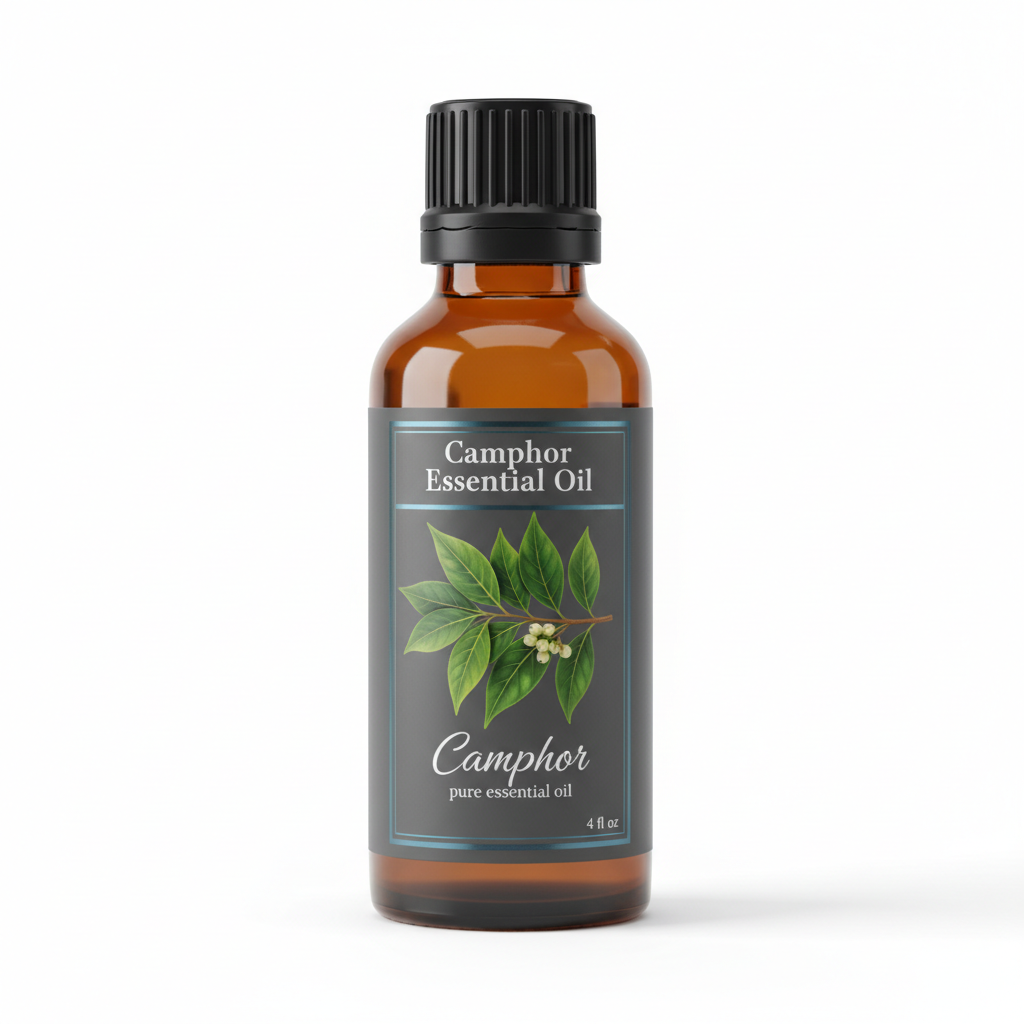
Camphor Essential Oil
Our own Camphor Essential Oil, in sizes from 0.5 oz to bulk.
From $8.69
Shop Now →Start with the word "counterirritant"
The word sounds like a claim. It is actually a regulatory category, and knowing what it means removes most of the confusion on this topic. In FDA's external analgesic monograph (OTC Monograph M017), a counterirritant is a topical drug that irritates or mildly inflames the skin in order to change pain felt in muscles, joints or viscera away from the site of application, by stimulating sensory receptors in the skin. The theory is distraction by stimulation: a strong skin sensation competes with the sensation of deeper discomfort.
That is a theory about how a class of products is intended to work. It is not a finding that every ingredient in the class does so, and it is certainly not a finding about a bottle of essential oil. This article walks through what the monograph lists, what the research on camphor itself shows, and what that means for a buyer deciding whether to put a camphor oil anywhere near a sore muscle. For the wider picture of camphor's evidence, see the benefits and uses overview.

What the monograph actually lists
M017 is the current form of FDA's external analgesic rules. It was posted May 2, 2023 as a final administrative order effective March 27, 2020, and it carries forward a rulemaking that began in 1983. Its counterirritant section sorts the permitted actives by the kind of skin response they cause.
| Group in M017.12 | Active and permitted range |
|---|---|
| Irritants that produce redness | Allyl isothiocyanate 0.5% to 5%; diluted strong ammonia solution (1% to 2.5% ammonia); methyl salicylate 10% to 60%; turpentine oil 6% to 50% |
| Irritants that produce a cooling sensation | Camphor exceeding 3% to 11%; menthol 1.25% to 16% |
| Irritants that produce vasodilation | Histamine dihydrochloride 0.025% to 0.10%; methyl nicotinate 0.25% to 1% |
| Irritants that do not produce redness | Capsaicin 0.025% to 0.25% (and capsicum preparations at that capsaicin content) |
Three details in that table matter more than they look. First, camphor sits in the cooling group with menthol, not in the group with methyl salicylate, so the sensation people associate with camphor rubs is a cooling one by the monograph's own sorting. Second, the order allows camphor and menthol to be combined, which is why many rubs contain both. Third, the monograph excludes patches, plasters and poultices from this section, and the required warnings include "For external use only," "Avoid contact with the eyes," "Do not apply to wounds or damaged skin," and "Do not bandage tightly." It also tells users to stop and consult a doctor if symptoms persist for more than 7 days, and directs that children under 2 should not use these products without asking a doctor.
A related FDA rule for topical cough-suppressant ointments sets camphor at 4.7% to 5.3% (21 CFR 341.74(d)(2)). That figure is why a chest rub and a muscle rub can share a camphor level while being labeled for different uses.
What the research on camphor itself shows
Here the honest answer is short. At the cell level, Xu, Blair and Clapham reported in The Journal of Neuroscience (2005) that camphor activates the TRPV1 channel and then desensitizes it faster and more completely than capsaicin, which the authors suggested may contribute to camphor's use in topical balms. They also found that repeated camphor sensitized TRPV3, and that it inhibited TRPA1, so the picture is not a clean one. This is laboratory work on cells, not a trial in people with sore muscles.
In people, we looked. A search of the Europe PMC literature database for camphor, counterirritant and balm trials in muscle pain returned reviews, a poisoning case report, an analytical chemistry paper and a handful of trials of menthol (for example, a comparison of topical menthol with ice during delayed onset muscle soreness by Johar and colleagues in 2012). It did not return a placebo-controlled trial of camphor alone for muscle soreness. That is a statement about one search by one writer, not proof that no such trial exists, and a reader who finds one should weigh it.
The nearest systematic review is the Cochrane review of rubefacients for musculoskeletal pain (Derry and colleagues, 2014). It included trials of products containing salicylates, in 560 participants in acute pain and 489 in chronic pain (placebo-controlled comparisons), and concluded the evidence does not support salicylate-containing rubefacients. Because every included trial involved a salicylate, the review tells us nothing direct about camphor. We raise it because people sometimes cite it as if it settled the camphor question in one direction or the other. It does not.
Why a bottle of oil is not a monograph product
This is the part we would tell a buyer in person. A monograph rub has a declared camphor percentage, a base that spreads and holds it, a label with a use statement, and warnings. A bottle of essential oil is concentrated. Its camphor share is a property of the lot, our posted certificate of analysis lists physical constants (specific gravity 0.878, refractive index 1.467, optical rotation +5.80 degrees) and no camphor percentage, and nothing on it can tell you where a given dilution would land against the 3% to 11% window.
That matters because camphor's margin is narrow in the other direction. The 2006 American Association of Poison Control Centers guideline notes that severe toxicity and convulsions are still reported with the lower-concentration products on the market, and that skin exposure to camphor is managed by washing thoroughly with soap and water and watching for symptoms. The child who reaches the wrong bottle is the case to plan for, not the careful adult with a measured drop.

If you are weighing a camphor product for a sore muscle
We sell a single aromatic oil, so we are not the people to advise on a drug choice, but we can say how we would think about the decision in the order a practitioner would.
- Is it a muscle question at all? Muscle soreness that follows unusual exertion is a different matter from pain that comes with swelling, fever, numbness, chest symptoms or a recent injury. Those belong with a physician or pharmacist, not with a rub.
- If you want a counterirritant rub, buy a labeled one. A product made for the purpose comes with a stated percentage, directions and warnings you can read, and a pharmacist can compare it with what else you take.
- If you still want to experiment with an aromatic oil on skin, the issue is dilution and skin tolerance, not benefit. Work through the dilution guide, patch test first, keep it off damaged skin and the face, and stay away from it entirely if you have a history of seizures or are pregnant or breastfeeding without asking your physician or midwife.
- Keep camphor away from children. The monograph directs that children under 2 should not use these products without asking a doctor, and camphor poisoning in toddlers is documented (see our safety guide).
A homemade balm is not a monograph product either. If you decide to make one anyway, our DIY muscle balm article puts the dilution arithmetic first, because that is where mistakes are made. If you want to understand the two cooling actives side by side, camphor versus menthol covers how the two differ.
What this means for our own oil
We offer Camphor Essential Oil as an aromatic and cosmetic material: the white fraction of the wood distillate, bottled undiluted in dark amber glass, 0.5 oz to 400 lb, as described on Inside the Still. That page is also blunt that camphor is genuinely hazardous. If a fragrance ingredient is what you need for a balm or a room, the sizes are in the shop. We do not recommend it for muscle complaints, and we do not claim it does anything for them.
Frequently asked questions
Is camphor proven for sore muscles?
No such claim is supported by the sources we could verify. Camphor is a recognized counterirritant ingredient in OTC products at set concentrations, and it produces a cooling sensation. A controlled trial of camphor alone for muscle soreness was not found.
Is the cooling the same as the product working?
Not necessarily. Cooling is a sensation with a documented nerve-channel basis. Whether it changes how a sore muscle feels or recovers is a separate question, and the camphor-specific human evidence for that is thin.
How is camphor different from methyl salicylate in a rub?
The monograph sorts them differently. Camphor and menthol are in the group that produces a cooling sensation, while methyl salicylate (at 10% to 60%) is in the group that produces redness. Methyl salicylate is also a salicylate, which is the class the Cochrane review examined.
Can I rub neat camphor oil on a sore muscle?
We advise against it. Undiluted oil is far above the 3% to 11% range used in labeled products, and counterirritants work by irritating skin, which is why the monograph's label warnings are so specific. A physician or pharmacist is the right person for a question about a specific pain.
Last reviewed
Sources were last checked in October 2026. This page has not been reviewed by a physician or pharmacist and is not medical advice. In the US, call poison control at 1-800-222-1222 about any swallowed camphor product.
Sources & Further Reading
- FDA OTC Monograph M017: External Analgesic Drug Products for OTC Human Use
- 21 CFR 341.74, labeling of antitussive drug products
- Xu H, Blair NT, Clapham DE. Camphor activates and strongly desensitizes TRPV1. J Neurosci 2005
- Derry S et al. Salicylate-containing rubefacients for acute and chronic musculoskeletal pain in adults. Cochrane Database Syst Rev 2014
- Johar P et al. A comparison of topical menthol to ice on pain, evoked tetanic and voluntary force during delayed onset muscle soreness. Int J Sports Phys Ther 2012
- Manoguerra AS et al. Camphor poisoning: an evidence-based practice guideline for out-of-hospital management. Clin Toxicol 2006