Edible Camphor vs Regular Camphor: Why the Names Cause Harm
"Edible camphor" is a trade label for camphor sold for South Indian sweets. It is not a safety grade that makes camphor safe to swallow. It is built on the same toxic ketone as ceremonial camphor, camphor tablets and camphor oil. Purity, dose and who swallows it decide the risk, and a small child has almost no margin.
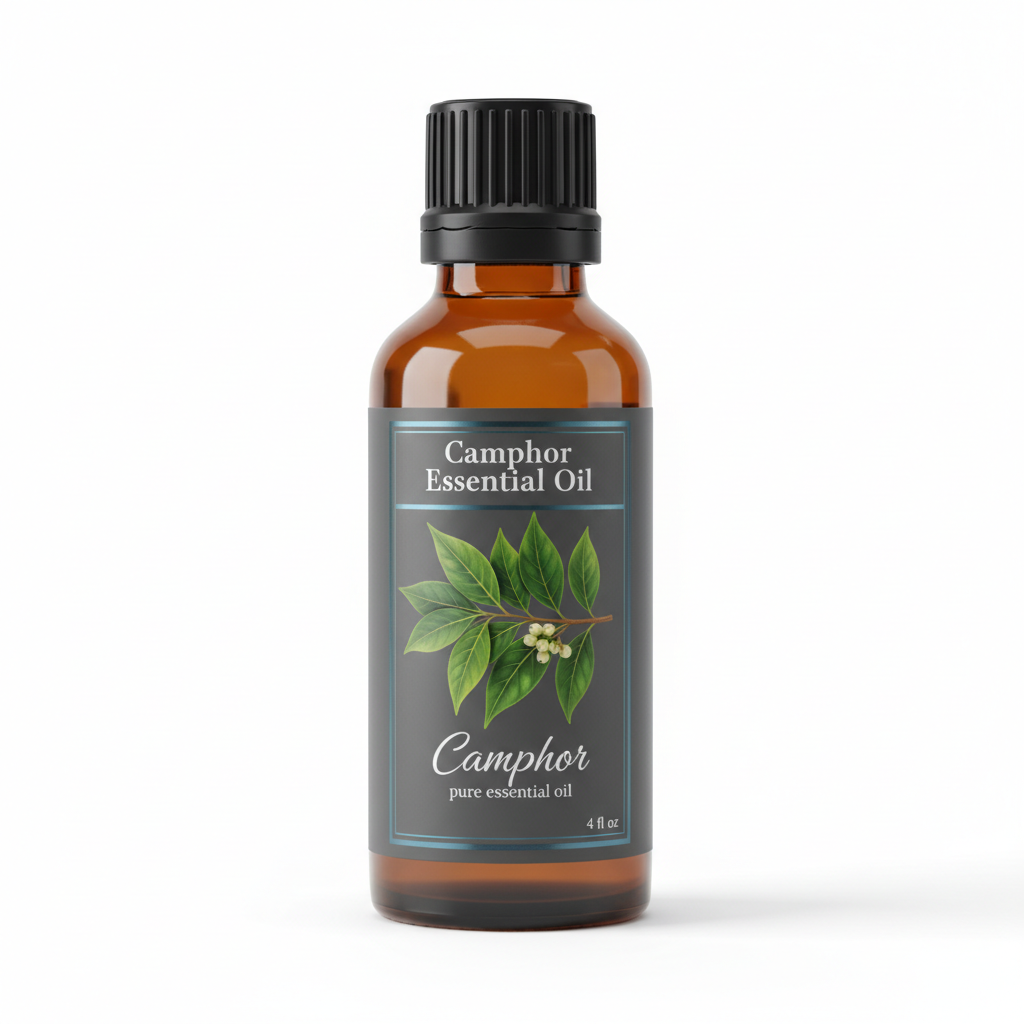
Camphor Essential Oil
Our own Camphor Essential Oil, in sizes from 0.5 oz to bulk.
From $8.69
Shop Now →The problem is the vocabulary, not the chemistry
Search for camphor in a South Asian grocery and you may find two or three products that look alike: crystals or cubes for ritual burning, a pack sold as "edible camphor," and sometimes tablets or blocks for closets. Search online and you meet more names: kapur, pachai karpooram (also spelled pachha karpooram), "pure camphor," "Borneo camphor," borneol. The words suggest a ladder of purity with an edible rung at the top. The chemistry does not work that way, and that gap between label and compound is where the harm happens.
Wikipedia notes that camphor is a main constituent of a spice known as "edible camphor" used in traditional South Indian desserts such as payasam and chakkarai pongal. That sentence describes a culinary tradition. It does not describe a dose, a purity specification or a safety margin, and when we looked for one we could not find a published standard that defines "edible" for camphor. That absence is the first thing to understand: the label tells you the seller's intended use, not a tested limit.
We sell a camphor essential oil, so our view is simple and consistent with our Inside the Still page: camphor is genuinely hazardous and is never taken internally. This article explains why the food label does not change that, and how to tell the products apart.
The same molecule under five names
Most of the confusion clears up once you compare the products side by side. The table separates what each product is from what people assume about it.
| Name on the pack | What it generally is | Main compound | What the label does not tell you |
|---|---|---|---|
| "Edible camphor" (kapur, pachai karpooram) | Crystals or cubes sold for use in sweets | Camphor, a ketone | How pure it is, who tested it, and any safe quantity |
| Ceremonial camphor (puja, aarti) | Cubes or tablets made to burn in ritual | Camphor, natural or synthetic | Source, and that a cube is a child-sized object that smells strongly |
| Camphor tablets and blocks | Closet and storage products | Camphor | Whether it is a registered pest product |
| Camphor essential oil | Steam-distilled liquid from Cinnamomum camphora fractions | Camphor, 1,8-cineole and others, varying by fraction | Composition without a lot-level test |
| Borneo camphor or borneol | A different alcohol, historically from Dryobalanops aromatica | Borneol, not camphor | That it can be sold under the word "camphor" |
Notice that the first three rows share a compound. Nothing in the word "edible" changes how camphor behaves in a child's body. A camphor cube, a tablet and a food-labeled crystal can each deliver the same ketone, and the difference between them is mainly the packaging and the story told at the shelf.
What the poisoning literature says about the dose
Two clinical references give numbers that are worth reading slowly. The Royal Children's Hospital Melbourne guideline states that serious toxicity has been reported after more than 30 mg/kg and a lethal oral dose is considered to be about 0.5 to 1 g in a child, with seizures usually within 90 minutes. The INCHEM poison information monograph states that toxic effects appear after ingestion of approximately 2 g, with an adult lethal dose of 4 g and a child lethal dose of 1 g of pure camphor, and that symptoms begin 5 to 90 minutes after ingestion depending on whether the product is solid or liquid.
Here is the arithmetic, since those figures are easy to read past. For a toddler weighing 10 kg, 30 mg/kg works out to 300 mg, or 0.3 g. The INCHEM monograph puts the child lethal dose at 1 g of pure camphor, so the gap between a serious dose and a lethal one is not wide. The 10 kg weight is our illustration, not a figure from the sources. Product weights vary, so weigh what is in your own cupboard before assuming a cube is harmless.
The risk is not theoretical. A case report in the Journal of Pediatric Neurosciences describes a one-and-a-half-year-old boy who had a generalized seizure after swallowing a camphor cube used in religious ceremonies. His parents first denied ingestion, and it was the smell of camphor on the child that prompted further questions. He recovered without long-term anticonvulsants. That detail, a family unaware that a ritual cube was dangerous, is the pattern this article is about: a familiar household object with a respectable cultural use, mistaken for harmless.
Why "edible" is the wrong question
People usually ask whether edible camphor is safe. We think the better question is what, exactly, the word is promising. Three things matter, and the label settles none of them.
- Purity. A food label implies someone checked for contaminants. We found no public standard that says what an edible camphor must contain or exclude, so we cannot tell you what the word guarantees.
- Quantity. Traditional recipes use a tiny amount. A recipe is not a dose study. The University of Texas at El Paso herbal safety sheet states plainly that the dose that produces an effect is close to the dose that poisons and advises against taking camphor preparations internally.
- Who eats it. Adult-sized quantities in a sweet say nothing about a child who finds the pack. The clinical thresholds above are per kilogram of body weight.
This is our position, and we hold it as a seller of camphor oil: nothing on a camphor label, edible or otherwise, should be read as permission to swallow it, and we do not give amounts for eating camphor. If a family cooks with a food-labeled product as part of a tradition, the person to ask about quantity and age is a physician or pharmacist, and the person to call about an accident is poison control.
Borneo camphor and borneol: a different molecule with the same word
The second naming trap is historical. The Sumatran port of Barus was known for camphor from the Borneo camphor trees (Dryobalanops aromatica) that grew in the region. That resin is dominated by borneol, an alcohol, not by camphor, the ketone from the Asian camphor laurel. A 2024 paper in Molecules identifies Dryobalanops aromatica as the earliest record of natural D-borneol extraction and notes that borneol is also found in some Cinnamomum species. The same paper adds that synthetic borneol, which is derived chemically from turpentine oil or camphor, is inherently impure and may carry residual camphor.
The practical effect is that a shopper reading "Borneo camphor" or "natural camphor" on a pack cannot tell from the name alone whether the contents are borneol, camphor or a blend. We do not offer a conclusion about any specific pack, only the advice that a name is not an analysis. For the tree itself, see our overview of Cinnamomum camphora, the tree behind camphor oil.
Natural or synthetic: it does not change the hazard
A related belief is that natural camphor is the safer one. Natural camphor from the laurel is the (+) enantiomer, while camphor made from turpentine-derived alpha-pinene is racemic, as described in a ChemBioChem paper on camphor synthesis. That distinction is real and it matters to chemists and to labeling. We do not know of evidence that it makes the swallowed amount safer, and we would not infer it. Our separate piece on natural vs synthetic camphor goes through how the two are made and how labels describe them.
How to sort the products in your home
We would walk through it in this order, the way we would at a counter.
- Read the pack, not the picture. New York City's health department states that unlabeled camphor products are unsafe and illegal, and that stickers showing animals or boats are not proper labels. If there is no ingredient list and no manufacturer, do not use it for anything.
- Separate food, ritual and closet items physically. A food-labeled pack in the spice shelf, a ritual pack at the shrine and tablets in the closet should never share a container, because lookalike cubes are how substitutions happen.
- Store everything at height, closed. Not merely out of sight. Our comparison of camphor oil and camphor tablets covers storage by format.
- Do not use any camphor product for pest control unless the label says so. The New York City page says pest repellents must meet EPA requirements. The National Pesticide Information Center describes U.S. mothballs as containing naphthalene or paradichlorobenzene, which is yet another product that gets called camphor in conversation.
Frequently asked questions
Is edible camphor safe for children?
We cannot find a source that sets a safe amount for children, and the poisoning thresholds above are low. Keep every camphor product, food-labeled or not, locked away from children. A pediatrician or pharmacist is the right person to ask about a family recipe.
Can I cook with ceremonial camphor?
Ceremonial camphor is sold for burning. We do not know of any standard that makes a ritual cube a food ingredient, so we would not substitute one for the other.
Is camphor essential oil edible?
No. Our oil is sold as an aromatic material and our Inside the Still page says it is never taken internally. Our fuller answer is in can you ingest camphor oil.
What should I do if a child swallows camphor?
Call Poison Control at 1-800-222-1222 immediately, or emergency services if the child is having a seizure or trouble breathing. The poison.org site confirms that number as free, expert and confidential. Do not wait for symptoms, because the clinical sources above describe seizures beginning within minutes to 90 minutes. Tell the responder what the product was and bring the pack.
Why do some people say edible camphor is a different compound?
Some of the confusion is the borneol history above, and some is marketing. The sources we read describe edible camphor as camphor used in sweets, not as a separate chemical. If you need to know what is in a specific pack, ask the maker for the ingredient list and a certificate of analysis.
Where our oil fits, and where it does not
Our camphor essential oil is a fragrance and craft material, sold in sizes from 0.5 oz to 400 lb in dark amber glass. It is not a food, not a drug, and not a substitute for anything in the kitchen or the puja room. If you came here to buy a food ingredient or a ritual product, this is not a fit. If you want a camphor aroma for blending or closet scenting, the shop page lists the sizes, and our piece on camphor in ritual and tradition explains how the crystal and the oil relate culturally. Our posted certificate of analysis lists physical constants for one batch and is not a food-safety document.
Sources & Further Reading
- Royal Children's Hospital Melbourne, Camphor poisoning clinical guideline
- INCHEM, Camphor poison information monograph
- Camphor poisoning: An unusual cause of seizure in children, Journal of Pediatric Neurosciences, 2015
- NYC Health, Camphor
- University of Texas at El Paso, Herbal Safety: Camphor
- Unpredictable Chemical Diversity of Essential Oils in Cinnamomum burmanni, Molecules, 2024
- Synthesis of (-)-Camphor from Renewable Starting Materials, ChemBioChem, 2021
- Wikipedia, Camphor
- National Pesticide Information Center, Mothballs
- Poison Control, poison.org