Camphor Oil vs Camphor Tablets and Blocks: Choosing a Format
Camphor tablets and blocks are solid camphor that slowly sublimes into air. Camphor oil is a distilled liquid with its own mix of constituents. Both carry the same ingestion hazard. For scent, oil gives you control over how much you use. For anything sold as pest control, buy a product whose label says so, not an oil.
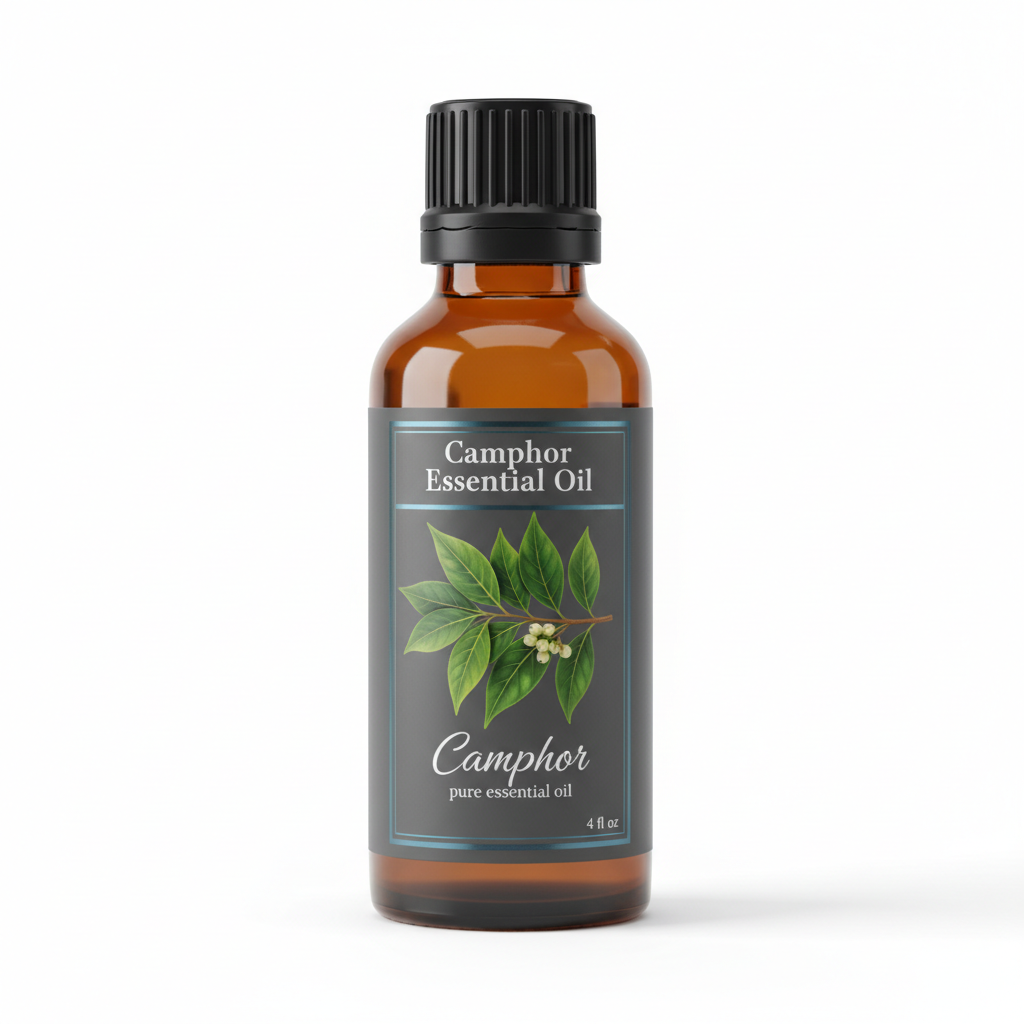
Camphor Essential Oil
Our own Camphor Essential Oil, in sizes from 0.5 oz to bulk.
From $8.69
Shop Now →Start with the decision, not the product
Most comparisons of camphor formats list pros and cons in a neutral table and leave you to guess. We would rather walk through the decision the way a shop does at the counter: what are you actually trying to do, who else lives in the house, and which format fails more gently if something goes wrong. Those three questions sort the formats better than any feature list.
A disclosure before the comparison. We sell camphor essential oil only, in sizes from 0.5 oz to 400 lb, so we have an interest in the oil side of this question. We do not sell tablets, blocks or crystals, and we have no affiliate arrangement with anyone who does. Where oil is the wrong choice, we say so.
What each format actually is
Solid camphor, the crystalline ketone, is what tablets, cubes and blocks are made from. The INCHEM poison information monograph describes camphor as white, translucent crystals at room temperature that sublime appreciably at room temperature and normal pressure. That is the whole mechanism of a camphor block: the solid slowly turns to vapor and fills a closed space with its smell. New York City's health department notes that camphor is sold as solid cubes or balls, as a balm or ointment, or in vapor-steam products.
Camphor essential oil is a different material. It is the liquid distillate from Cinnamomum camphora, fractionated by boiling point, and our Inside the Still page describes ours as the white fraction. It is a mixture, so it contains more than camphor. Which constituents it contains depends on the fraction, which is why our guide to types of camphor oil exists. One consequence is that an oil is not simply liquid camphor, and "camphor oil" and "camphor tablets" should not be treated as interchangeable products with different shapes.
A format chooser
| Question | Tablets and blocks | Camphor oil |
|---|---|---|
| How does the scent reach the room? | The solid sublimes slowly and steadily | The liquid evaporates from whatever surface it is on |
| Can you adjust the strength? | Only by adding or removing pieces | Yes, by amount and by the surface used (our reasoning) |
| Is it sold as a pest product? | Some products are; check the label | Ours is sold as an aromatic and cosmetic material, not as a pest control |
| What does a child find? | A small, sweet-looking, solid object | A bottle of liquid, usually with a cap |
| How is it kept? | Closed container, cool | Dark glass, tight closure, cool (our shelf-life guidance) |
| Where does it make sense? | Fixed, long, closed-space use | Variable scenting, blending and craft work |
Read that table as a map, not a verdict. The rows marked "our reasoning" follow from the sublimation behavior in the INCHEM monograph, not from tests we ran. We have no closet trials, and we do not claim any.
The pest-control question: where oil is the wrong tool
People often reach for camphor to protect clothes. Here is our position: we sell an oil for scent, we make no pest-control claim for it, and a product used against pests should be one whose label says it is for that. New York City's health department says that pest repellents must meet EPA requirements, advises against using camphor products for pest control, and calls unlabeled products "unsafe and illegal," adding that stickers with animals or boats are not proper labels. If a pack has no ingredient list and no manufacturer, do not use it.
The vocabulary is also tangled. The National Pesticide Information Center states that U.S. mothballs contain very high concentrations of naphthalene or paradichlorobenzene as active ingredients and are classed as insecticides, not camphor. The Royal Children's Hospital Melbourne guideline notes that some mothballs contain naphthalene or paradichlorobenzene instead of camphor, which means a pack called "mothballs" cannot be assumed to be camphor, and a pack called "camphor" cannot be assumed to be an approved pest product. Our deeper look at the moth question is in does camphor repel moths. For the scent side, our existing piece on camphor for closets and wardrobes sets out the aroma use.
Safety: the part that does not depend on format
Neither format is safe to swallow, and the literature we reviewed does not rank one as clearly safer. The INCHEM monograph reports that toxic effects appear after ingestion of approximately 2 g, with symptoms beginning 5 to 90 minutes after ingestion depending on whether the product is solid or liquid. The Royal Children's Hospital guideline states that serious toxicity has been reported after more than 30 mg/kg in children, with seizures usually within 90 minutes. We would not use either source to argue that a solid is safer or that a liquid is, because neither says so.
What a case report shows is how ordinary the exposure is. A one-and-a-half-year-old described in the Journal of Pediatric Neurosciences had a generalized seizure after a camphor cube used in religious ceremonies. The parents first denied ingestion, and it was the smell on the child that raised the question. NPIC adds that mothball-type products used in the open can be harmful to people, pets or wildlife that touch or eat them or breathe in the vapors.
So the format difference that matters most is how each looks to a child. A solid cube in a drawer is small, fits in a mouth and may look like a sweet. A bottle is harder to open, but a liquid can be spilled or swallowed straight from the neck. We do not know which is worse, and we would not claim to. Our recommendation is the same for both: keep every camphor product in a closed cabinet above a child's reach, not merely out of sight. Our camphor oil safety guide and the companion piece on edible camphor and regular camphor go further.
Two more warnings from the same New York City page apply to both formats. First, heating camphor can cause splattering and burns, so we would not warm either one to speed up scent. Second, the page advises against using camphor products in humidifiers. If you are thinking of diffusing, read our safety guide before you decide, since that is a separate question from this one.
How to pick: three cases
You want a steady smell in a closed trunk or drawer
A solid format is the more natural fit, because the mechanism is slow sublimation in a closed space. If the goal is moths, choose a product that is labeled for that use, and do not substitute an oil. We cannot offer an efficacy source for either format in this article, and the pest question deserves its own answer, which is in the moth article linked above.
You want a camphor note for blending or craft
Here oil is the format that makes sense, because blending and scenting need to be measured in small amounts and tablets cannot do that. Check the paperwork first, since the fraction matters: our buyer's checklist sets out what to ask for. The shop page lists every size.
You are buying for a ritual or a household that follows one
Ritual camphor is its own category, and the meaning behind it is covered in our piece on why camphor is burned in puja and aarti. We do not sell ritual camphor, and our oil is not a substitute for it.
Frequently asked questions
Is camphor oil just melted camphor tablets?
No. Tablets are solid camphor. The oil is a distilled mixture taken in fractions, and its composition depends on the fraction. A tablet and a bottle of oil are different materials that share one major compound.
Can I swap an oil for a block in a closet?
We would not. A block is made to release vapor slowly from a solid in a closed space, while an oil is a liquid that spreads wherever it lands. If you want an aroma, use the oil sparingly and not on fabric you will wear against skin. If you want pest control, use a product labeled for it.
Are tablets safer around children because they are solid?
The sources we read do not say so. Both formats cause serious poisoning when swallowed, so we keep both locked away. If a child swallows either one, call Poison Control at 1-800-222-1222 right away.
Who should not buy either
If you have young children and nowhere secure to store a camphor product, the honest answer is that neither format is a good idea until you do. If you want a food ingredient, a medicine or a pest-control product, neither the tablets nor our oil is the right item. Camphor is genuinely hazardous, as our own site states, and a format that fits your project is worth less than a storage plan that fits your home.