Camphor Oil Side Effects and Who Should Avoid It
The side effects of camphor oil range from skin irritation and headache to, with swallowing, vomiting and seizures. People who should avoid it include children, anyone pregnant or breastfeeding, people with epilepsy or a seizure history, people with sensitive airways, and pets. Ask a physician or pharmacist if you are unsure where you fall.
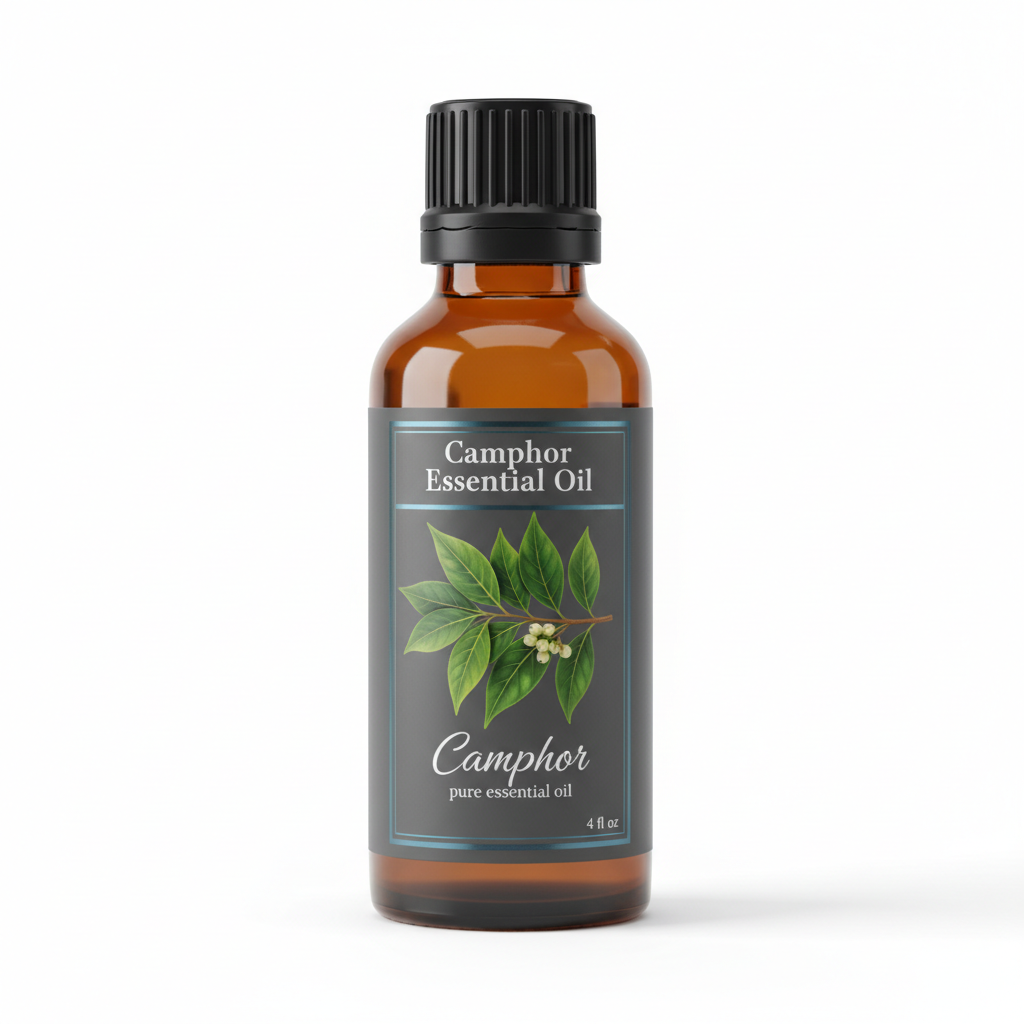
Camphor Essential Oil
Our own Camphor Essential Oil, in sizes from 0.5 oz to bulk.
From $8.69
Shop Now →
Start with the route, not the symptom list
Most side-effect pages list symptoms in one long block, as if skin redness and a seizure were the same kind of problem. They are not. What goes wrong depends on how camphor got into the body, so it helps to sort by route first.
| Route | Effects reported in the sources | How serious |
|---|---|---|
| On the skin | Irritation. Allergic contact dermatitis to camphor appears in a few case reports (AAAAI). Camphor is also readily absorbed through the skin (Royal Children's Hospital). | Usually local. Systemic toxicity from skin exposure is documented, mostly in young children. |
| Eyes and mucous membranes | Burning and irritation. A US poison center guideline says there is no published information on camphor eye exposures and advises irrigation. | Local, but flush and call Poison Control. |
| Breathed in | The guideline advises fresh air and referral based on symptoms. | Depends on the dose and the person. |
| Swallowed | Mouth and stomach burning, nausea, vomiting, abdominal pain, headache, dizziness, confusion, agitation; convulsions are often the first sign of significant toxicity. | Potentially severe and fast. See camphor poisoning symptoms. |
The swallowed row comes from the American Association of Poison Control Centers guideline by Manoguerra and colleagues, which reports that mucous membrane irritation, nausea, vomiting and abdominal pain commonly begin within 5 to 15 minutes, and that convulsions can occur as early as 30 minutes after ingestion (Manoguerra et al., 2006). The Royal Children's Hospital in Melbourne adds that most toxic exposure is by ingestion, that skin exposure can also be significant, and that clinical toxicity typically resolves within 24 hours (RCH guideline).
The usual real cause: stacking and unlabeled products
Reading the case literature, the pattern is not that people used a measured dose of a labeled product and misjudged it. It is that they did not know what was in the container or how many sources they were using at once.
- In a 2007 case report, a child in Paris had status epilepticus after an abdominal massage with an unlabelled solution; the authors urged parents not to use unlabelled home remedies on children (Guilbert et al.).
- In a 2009 cluster of three toddlers in the Bronx, the camphor was imported and illegally sold, and many such products fail US labeling and content requirements (Khine et al.).
- In a study of Indian children with a first unprovoked seizure after a herbal product, 13 of 15 had taken one multi-ingredient liquid containing camphor, eucalyptus oil, menthol and thymol. The authors could not separate camphor from the other ingredients and could not establish a toxic threshold (Bandi et al., Indian Pediatrics, 2021).
Our position follows from that: if you already use a camphor-containing rub, inhaler or balm, count it. Camphor essential oil on top of them is a second source of the same compound. RCH lists chest rubs, inhalers and some mothballs as common sources. We cannot tell you how much total camphor is too much for you, and nobody can from a bottle label. That judgment belongs to a physician or pharmacist who knows your products and health history.
What the evidence cannot tell you
Three limits are worth stating before the avoidance table, because side-effect pages rarely admit them.
There are no rates. The sources are case reports, case series and poison center tallies. They show that harms happen and in which circumstances. They do not tell you how often a given person using a given amount will react. When a page quotes a percentage chance of side effects for camphor oil, ask where it came from.
Dose data come from drug products, not essential oils. Camphorated oil (20% camphor in cottonseed oil, according to the AAPCC guideline), chest rubs and balms have printed concentrations. An essential oil bottle does not report camphor content in the way a drug label does, and our posted COA lists physical constants only. That is why we avoid turning drops into a dose.
Most reports mix ingredients. Camphor shows up with menthol, eucalyptus oil, thymol or methyl salicylate. The RCH guideline warns that co-ingredients can be toxic in their own right, for example salicylates in muscle rubs. A side effect blamed on camphor may belong to something else in the product. The reverse is also possible.
The practical consequence: absence of a documented reaction in your case is weak comfort, and a reaction after using a mixed product does not tell you which ingredient caused it. A physician or pharmacist can help sort that out.
Who should avoid camphor oil
This table says which groups to be cautious about, what the evidence is, and how firm it is. We have no medical reviewer, so the right-hand column is a position, not a clinical instruction.
| Group | Evidence | Our position |
|---|---|---|
| Epilepsy or past seizures | Camphor can cause seizures after swallowing. The mechanism is unknown (Guilbert). Case series of seizures after camphor-containing products exist, but none isolate camphor. We found no controlled study in people with epilepsy. | Avoid unless a neurologist says otherwise. Firmness: reasoned caution, not a proven rule. |
| Asthma or sensitive airways | Authors of a 2017 paper on infant balm use cite animal evidence that camphor and menthol balms may worsen breathing (Bazzano et al.). We found no study of camphor oil vapor in people with asthma. | Skip it, especially diffused, unless a physician agrees. |
| Pregnancy | Camphor crosses the placenta (Guilbert). We found no study establishing a safe level. See camphor oil during pregnancy. | Ask an OB-GYN or midwife first. |
| Breastfeeding | The e-lactancia database rates camphor limited compatibility and notes no published milk excretion data (e-lactancia). | Ask your OB-GYN, midwife or pediatrician. |
| Children | The AAP Committee on Drugs recommended in 1994 that camphor not be used in children (Healio review). OTC labels say children under 2: do not use, consult a doctor. See camphor oil and children. | Keep it out of reach and out of children's rooms. |
| Dogs and cats | Pet Poison Helpline says camphor should never be applied to dogs or cats because it is readily absorbed across the skin (Pet Poison Helpline). | Keep away from pets. Call a veterinarian if exposed. |
| Skin conditions or known fragrance allergy | Irritation is a recognized effect, and case reports of allergic contact dermatitis exist. | Ask a dermatologist before skin use. Never on broken skin. |

One caution about timing. In the Paris case, seizures began 72 hours after the massage, which the authors attributed to delayed absorption through the skin. One case is not a rule, and the poison center guideline found no documented progression after adequate washing. But it is a reason not to dismiss odd symptoms hours after skin exposure.
What to do if you have a reaction
For skin: the poison center guideline says to wash thoroughly with soap and water. For eyes, irrigate and call Poison Control. For inhalation, move to fresh air. For anything swallowed, call Poison Control at 1-800-222-1222 (poison.org); call 911 for a seizure, trouble breathing, or if the person cannot be awakened. The steps are laid out in the poisoning article, and the overall risk picture is in Is camphor oil safe?
When camphor oil is not a fit
We sell one product, a camphor essential oil in dark amber glass, described on our pages as the white fraction and sold as an aromatic and cosmetic material, not a drug. We would rather lose a sale than have it end up in the wrong household. It is not a fit if:
- there are toddlers or infants in the home and you cannot keep it locked away;
- anyone in the household has epilepsy and has not cleared it with a neurologist;
- you are looking for something to put on a child, or to swallow;
- you want it for a health problem, in which case see a physician or pharmacist, because we do not offer it for that.
If you are an adult buyer who knows the risks and wants a quality material for aroma or craft work, it is available on our shop page.
FAQ
Is a rash from camphor oil an allergy?
It may be irritation or allergy, and the two look alike. An allergist writing for the AAAAI notes only a few case reports of allergic contact dermatitis to camphor and says one involving a chest rub may have been caused by other essential oils. A dermatologist can sort out the cause.
Can camphor oil cause seizures?
Yes, with swallowing, and in children with skin exposure as well. Poison center experts consider more than 30 mg/kg, or any moderate to severe symptom such as convulsions, a reason for emergency referral.
Does white camphor oil have fewer side effects than brown?
It carries less safrole, which is a separate concern from camphor's neurotoxicity. White camphor is still camphor. The comparison is in white vs brown vs yellow camphor oil.
Sources & Further Reading
- Manoguerra AS et al. Camphor poisoning: an evidence-based practice guideline for out-of-hospital management. Clin Toxicol 2006;44:357-70
- Royal Children's Hospital Melbourne: Camphor poisoning clinical guideline
- Guilbert J et al. Emerg Med J 2007;24:859-60
- Khine H et al. Pediatrics 2009;123:1269-72
- Bandi R et al. Herbal medicine-induced seizures in children. Indian Pediatrics 2021;58:71-73
- Bazzano AN et al. J Trop Pediatr 2017
- Bell EA. Camphor use entails unique safety concerns. Infectious Diseases in Children, 2008
- AAAAI Ask the Expert: Camphor and menthol allergy
- Pet Poison Helpline: Camphor
- e-lactancia: Camphor and breastfeeding
- eCFR: 21 CFR 341.74
- FDA OTC Monograph M017: External analgesic drug products
- Poison Control (National Capital Poison Center)