Camphor Oil and Temple Rubs: What Is Known About Headaches
The best-known temple-rub headache trial tested a 10 percent peppermint oil solution, not camphor. The sources cited here include no trial of camphor oil on headaches, and FDA's camphor labeling does not list headache among its indications. Camphor oil near the temples also carries eye and skin risks, so we do not suggest it.
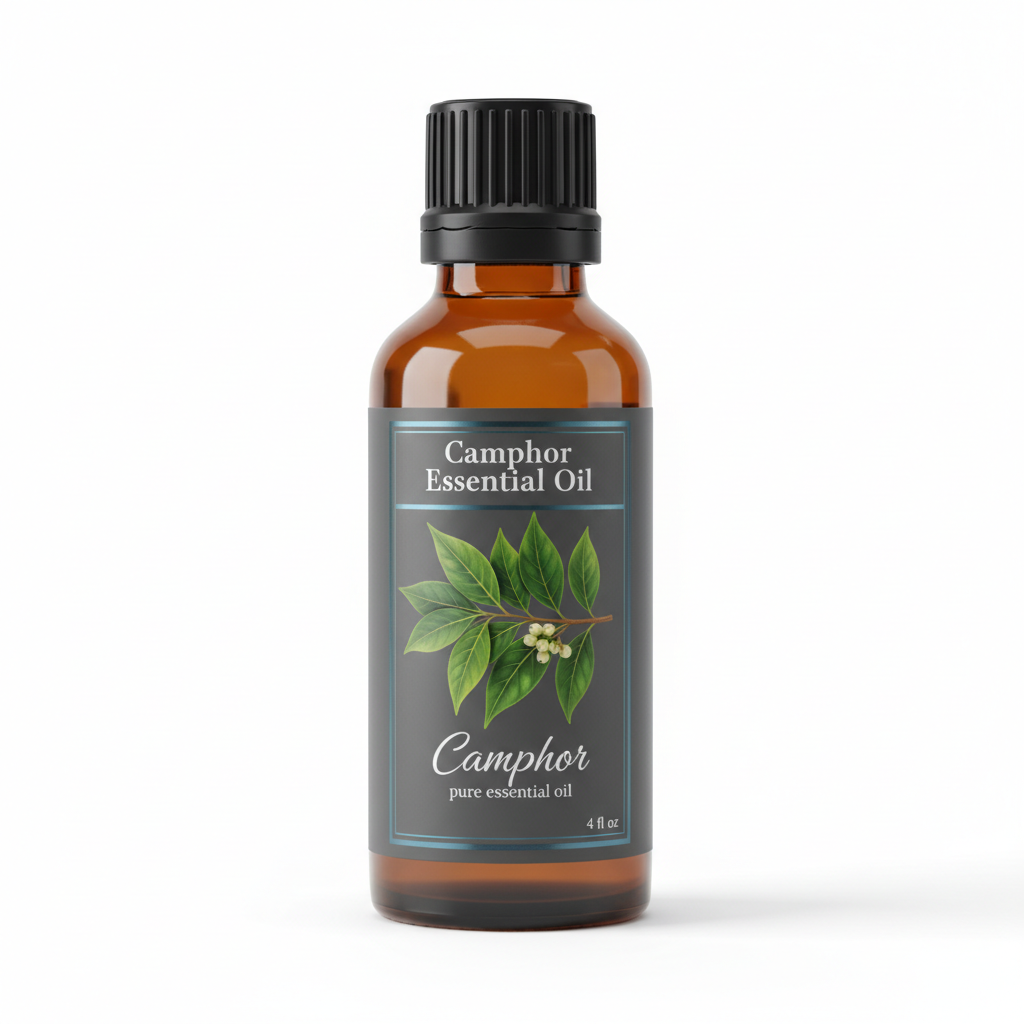
Camphor Essential Oil
Our own Camphor Essential Oil, in sizes from 0.5 oz to bulk.
From $8.69
Shop Now →Search for "camphor oil headache" and you will find temple rubs described as a time-honored habit. Habit is real, but it is not evidence. This page separates three things that tend to be mashed together: what a peppermint study showed, what camphor does at the level of sensation, and what regulators actually list for camphor. At the end we say where our oil does and does not fit, in the order a careful buyer would want to hear it.

The study people mean is about peppermint
The trial usually cited for topical oils and tension-type headache is Göbel and colleagues, published in Der Nervenarzt in 1996. According to its abstract record, it was a randomized, placebo-controlled, double-blind crossover trial in 41 adults with tension-type headache, analyzing 164 headache attacks. It compared a topical 10 percent peppermint oil in ethanol preparation with 1,000 mg of oral acetaminophen and with placebo. Both peppermint oil and acetaminophen reduced headache intensity significantly compared with placebo, with no significant difference between them. The two together showed an additive effect that did not reach statistical significance. No adverse events were reported.
That is a careful design, and it is also narrow. Forty-one people is small. The preparation was peppermint oil in ethanol at a stated 10 percent, which is a very particular product, and the comparison was with a standard oral drug. Nothing in the abstract involves camphor. Translating the result to camphor oil would mean assuming two different oils behave alike, and that is exactly the leap the research does not permit.
It helps to know what a crossover design does. Each person is treated, in effect, as their own comparison, receiving the active preparation for some attacks and placebo for others, which reduces the noise between individuals. It does not tell you how the result carries over to a different oil, a different concentration, a different carrier or a different kind of headache. The study also dealt with tension-type headache as defined for the trial, which is one category among many. When a page quotes it to justify a rub for headaches in general, it is stretching the paper well past what its authors tested.
For a side-by-side look at the oils people mix up in this context, we compare them in camphor vs peppermint oil.
Where camphor does connect: sensation
There is a reasonable mechanistic link, and it should be stated honestly. A 2013 paper in Chemical Senses by Selescu and colleagues reported that camphor activates TRPM8, the cold- and menthol-sensitive channel, in cells and in rat sensory neurons, and that it also inhibits the channel's response to menthol. So camphor and menthol-type compounds share a target, and both produce cooling sensations on skin.
A shared target is a hypothesis, not a result. It does not tell you how a rub on the temples affects a headache, whether camphor behaves like peppermint in a person with tension-type headache, or at what strength. The paper is cell and neuron work. We mention it because it explains why camphor feels the way it does on skin, not because it establishes anything about headaches.
| Question | What the cited sources show | Verdict |
|---|---|---|
| Did a trial test a temple or forehead rub for tension-type headache? | Yes: 10% peppermint oil in ethanol, 41 adults, 164 attacks (Göbel 1996) | Peppermint, not camphor |
| Is there a camphor oil headache trial in these sources? | None cited | No evidence either way |
| Does camphor share a sensory target with menthol? | Camphor activates TRPM8 in cell and neuron experiments (Selescu 2013) | Mechanism, not clinical |
| Is headache an OTC camphor indication? | The indication phrases in FDA monograph M017 refer to muscles and joints, and to pain or itching with minor burns, cuts, scrapes, insect bites and skin irritations | Headache not listed |
What FDA's camphor monograph does and does not say
FDA's external analgesic monograph (OTC Monograph M017) lists camphor in two ranges for finished over-the-counter products: 0.1 to 3 percent in the topical analgesic, anesthetic and antipruritic group, and above 3 percent up to 11 percent in the counterirritant group. The permitted label indications for the counterirritant group refer to minor aches and pains of muscles and joints, with examples such as simple backache, arthritis, strains, bruises and sprains. The other group lists pain or itching associated with minor burns, sunburn, minor cuts, scrapes, insect bites and minor skin irritations.
Headache does not appear in those phrases. We say this as a regulatory fact about OTC drug products. It is not a verdict on whether anything works, only on what FDA has listed. Our oil is not such a product.
The same labels carry cautions that apply to anything near the head: for external use only, avoid contact with the eyes, and for counterirritants do not apply to wounds or damaged skin. Temples sit close to the eyes. A rub placed there is a rub placed where hands, sweat and drips travel to the eye. For anyone working from the label logic, that is a reason for care.

Risks that matter more than the claim
- Eyes. Camphor near the eyes is a stated label hazard. If any gets in the eyes, follow the product's label directions and call Poison Help or a clinician for guidance.
- Skin. Counterirritants cause irritation by definition. Allergic contact dermatitis to camphor has been described: the AAAAI "Ask the Expert" page notes case reports in sunscreen and ear drops and a VapoRub report that may have involved other essential oils. The face is skin you want to protect, and a patch test on a small area comes first.
- Children. A pharmacy column in Healio by Edward Bell, PharmD, cites AAP Committee on Drugs advice from 1994 that camphor not be used in children, and reports that ingestion can be fatal. A child with a headache is a pediatrician conversation, never a camphor rub.
- Swallowing. If camphor is swallowed, call Poison Help at 1-800-222-1222 or 911 for seizures or trouble breathing. Our page on camphor poisoning symptoms explains what to do first.
- Pregnancy and breastfeeding. Ask an OB-GYN or midwife first. Our pregnancy page is conservative on purpose.
Why headaches deserve a clinician, not a rub
Headaches vary in cause and seriousness, and the clinicians who sort that out are physicians. Frequent, worsening or unusual headaches, or any sudden severe one, or one accompanied by fever, a stiff neck, confusion, weakness or vision changes, is the territory of a doctor, and sudden severe onset or those accompanying symptoms call for urgent care. We are an aromatics shop and nothing in this article is advice for a headache.
The peppermint trial itself is a good model for how to think. Even where a study finds an effect, the right takeaway is about a defined preparation, a defined population and a defined condition, not a license to improvise with a different oil. If you are curious about the wider evidence on camphor and pain, our sister article on what the research covers on camphor and sore muscles gives the picture for the one area where FDA lists camphor.
Where our oil fits, honestly
Our oil does not fit a headache. We sell one product, Camphor Essential Oil, Cinnamomum camphora, described on our pages as the white fraction of the wood distillate, bottled undiluted in dark amber glass with a tight closure, in sizes from 0.5 oz to 400 lb. It is an aromatic and cosmetic material, not a drug. For scent uses such as closets, linens and candles our shop page lists the sizes, and for how we source it see Inside the Still. The posted certificate of analysis (batch CMPQGACCCNC003A) lists physical constants such as specific gravity 0.878 and refractive index 1.467, but no GC/MS profile or safrole figure.
Questions we would expect
Does camphor oil on the temples help a headache?
The sources cited here show no trial of camphor oil for headache. The well-known temple-rub trial used peppermint oil, and FDA's camphor labeling does not list headache.
Is camphor the same as peppermint for this?
No. They share a sensory target in cell experiments, but a shared target does not mean the same effect on a person, and no trial in these sources compares them.
Is it safe near my eyes?
Labels for camphor products say to avoid contact with the eyes. The temples are close enough that we would keep camphor oil away from that area altogether.
This page was written from published sources and has not been reviewed by a medical professional. Talk to a physician about headaches.
Camphor Essential Oil
Camphor Essential Oil from our own shop, in sizes from 0.5 oz to bulk.
From $8.69
Shop Now →Sources & Further Reading
- Göbel H et al. Effectiveness of Oleum menthae piperitae and paracetamol in tension-type headache. Der Nervenarzt 1996
- Selescu T et al. Camphor activates and sensitizes TRPM8 to cooling and icilin. Chemical Senses 2013
- FDA OTC Monograph M017: External Analgesic Drug Products for OTC Human Use
- AAAAI Ask the Expert: Camphor and menthol allergy
- Healio: Camphor use entails unique safety concerns
- Poison Help (poison.org)