Camphor Foot Soak and Foot Balm: A Scented Routine, and the Dermatology It Sits On
A camphor foot routine adds a cool scent to ordinary foot care; it does not replace it. Keep the camphor out of the soak water, where the oil floats, and put 0.5 percent into a petroleum jelly balm instead. People with diabetes, numb feet, broken skin or children in the home should skip it.
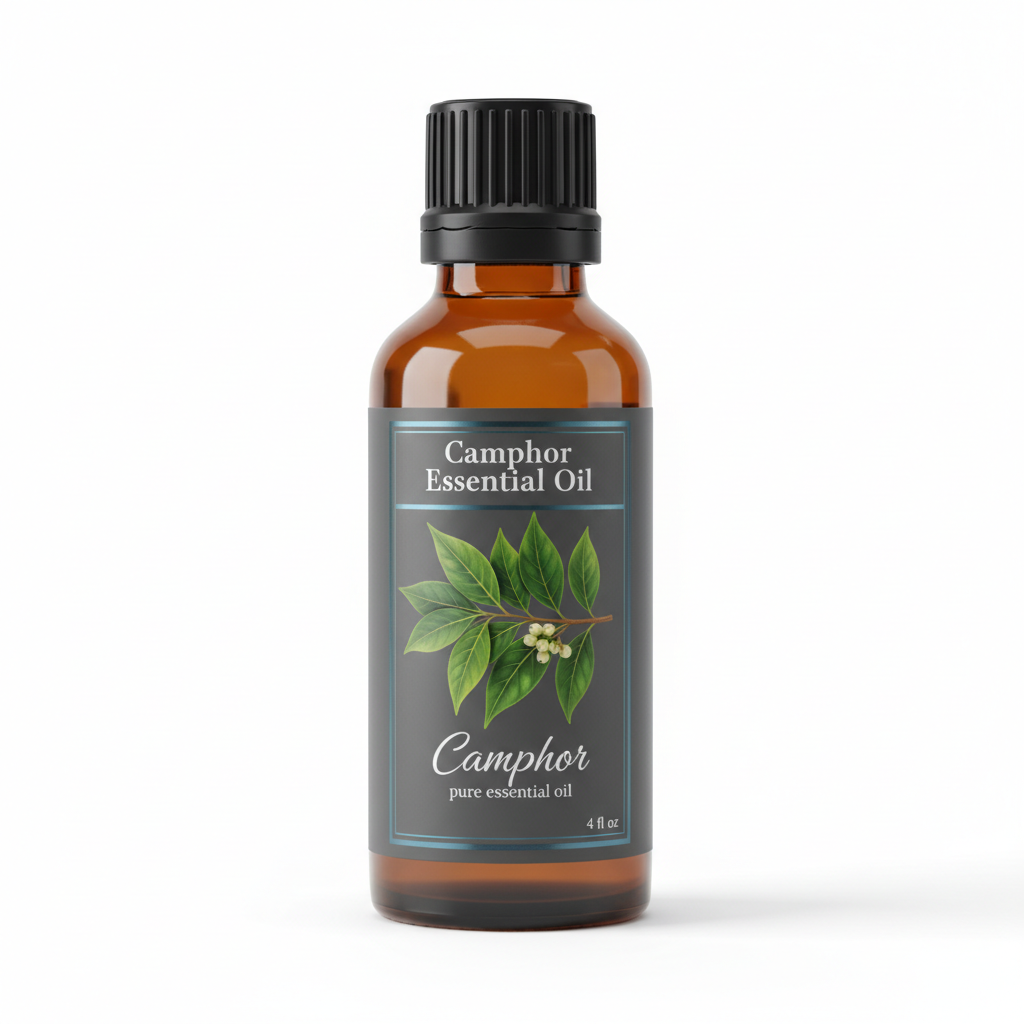
Camphor Essential Oil
Our own Camphor Essential Oil, in sizes from 0.5 oz to bulk.
From $8.69
Shop Now →We make a point of the order. Foot care advice that starts with the camphor puts the least-supported ingredient first. What dermatology guidance recommends for dry, cracked heels is short baths, moisturizer applied soon after, and plain petroleum jelly at night, none of which needs an essential oil. If you want camphor in that routine for how it smells, below is how to add it in a way that does not make the routine worse, plus the people who should leave it out. For a harder-working camphor balm aimed at muscles, see our DIY camphor muscle balm.

What the dermatology advice says first
The American Academy of Dermatology's guidance for dry, cracked heels (February 2022) says to limit baths and showers to 5 to 10 minutes, because long soaks strip moisture and worsen cracks; to moisturize within 5 minutes of bathing; to look for a cream with 10 to 25 percent urea, alpha hydroxy acid or salicylic acid; and, before bed, to apply plain petroleum jelly, with socks to protect bedding. It adds that cracked heels are sometimes caused by a medical condition such as diabetes, and that severe or persistent cracks should go to a board-certified dermatologist (American Academy of Dermatology, how to care for dry, cracked heels).
Two things stand out. The first is that the advice about soaking is to keep it short, which makes a long, scented foot soak the opposite of what the guidance describes. The second is the word "plain." The dermatologist's advice is plain petroleum jelly. Adding camphor changes that, so everything in the balm recipe below is a trade of a little skin-care simplicity for a scent. We think that trade is fine for most adults, but we would not pretend it is an upgrade.
Epsom salt: what the evidence supports
Most foot soak recipes call for Epsom salt, usually with a claim that magnesium is absorbed through the skin. The most-cited review is Gröber and colleagues, "Myth or Reality: Transdermal Magnesium?" in Nutrients (2017), which concluded that "the propagation of transdermal magnesium is scientifically unsupported" (Nutrients 2017;9(8):813). The abstract names magnesium salt baths among the products marketed for this purpose, but does not draw a separate conclusion about Epsom salt in particular.
That leaves the salt as what it plainly is: a familiar ingredient in a warm-water soak. If you like the feel, use it, but use whatever amount the package suggests, since no study supports a particular dose, and do not expect it to deliver anything but the soak. Warm water is doing the work people credit to the salt, and per the AAD, for dry heels warm water for too long does the opposite of helping.
Why we keep camphor out of the soak water
This is the position of the page that most recipes will disagree with, so here is the reasoning in two parts, one documented and one sourced.
- It floats. The certificate of analysis for our posted batch gives a specific gravity of 0.878, below water at 1.0. An essential oil dropped into a foot basin sits on the surface. Reference data lists camphor as poorly soluble in water, about 1.2 g per liter, though far more soluble in ethanol (Wikipedia, Camphor). So drops added to a basin do not become a mild dilute solution. They form beads and a film, and the first thing the skin meets when it enters the water is the undiluted film.
- Sharing a basin with the oil film is the worst dilution. The whole premise of every guide on our site is dilution. A soak that delivers neat oil to the skin on entry fails that premise, however many drops go in.
The fix is not a clever emulsifier. It is putting the camphor where you can measure it, in the balm applied after the soak, and leaving the water plain. If you want some camphor scent at the basin, put one drop on a cotton pad beside it, never in the water and never touching the skin.
The soak itself
- Fill a basin with warm water, not hot. The CDC's foot guidance for people with diabetes says to wash feet daily in "warm (not hot) water" (CDC, diabetes and your feet).
- Add Epsom salt if you like, following the package.
- Keep it short. The AAD's 5 to 10 minute figure is for baths and showers, and we apply it here by analogy, because the mechanism it names, moisture stripping, applies to feet as much as to the rest of the body.
- Pat dry, then moisturize within the AAD's 5 minutes while the skin is still damp. Do not put lotion between the toes, which the CDC says can lead to infection.

Camphor foot balm: arithmetic first
The base is plain petroleum jelly, the AAD's nighttime recommendation. The camphor share is 0.5 percent by weight, a starting point we chose because we could not find a verified dermal maximum for this oil to cite. Our camphor oil dilution guide covers the general method, and the camphor safety guide covers who should avoid the oil. The Tisserand Institute explains that some dermal maximums are set for skin reactions and others against whole-body exposure, so a small area does not make a higher percent automatically safe (Tisserand Institute, dermal maximums).
We work by weight because the specific gravity on our certificate lets us convert: 0.878 g per ml. For 1 oz (28 g) of jelly at 0.5 percent, the camphor oil is 0.14 g, which is 0.16 ml, or about 3 drops at a convention of 20 drops per ml. Drop size varies with the bottle and the temperature, so for accuracy count how many drops from your bottle make 1 ml.
| Balm size | Jelly by weight | Camphor share | Camphor oil | About how many drops |
|---|---|---|---|---|
| 1 oz | 28 g | 0.25% | 0.08 ml | 1 to 2 |
| 1 oz | 28 g | 0.5% | 0.16 ml | 3 |
| 2 oz | 57 g | 0.25% | 0.16 ml | 3 |
| 2 oz | 57 g | 0.5% | 0.32 ml | 6 |
| 4 oz | 113 g | 0.25% | 0.32 ml | 6 |
| 4 oz | 113 g | 0.5% | 0.64 ml | 13 |
These are weights of jelly and ignore the oil's own few tenths of a gram, a rounding that does not matter at this scale. At 1 oz and 0.25 percent the whole recipe is one or two drops, which is too small to measure well, so make 2 oz.
Method
We have not tested this recipe; it is stated as arithmetic only.
- Soften 2 oz of plain petroleum jelly by setting the jar in a bowl of warm water. Do not heat it over a flame, because camphor is classified as a flammable solid.
- Let it cool until it is soft but not hot, since camphor evaporates readily and would be lost to a hot base.
- Add 6 drops of camphor essential oil and stir thoroughly with a clean rod, scraping the sides.
- Pack into a clean jar with a tight lid, labelled with the date and 0.5 percent.
- Patch test on the inside of the forearm for 24 to 48 hours first (patch test guide).
- Apply a thin layer to clean, dry, intact skin of the heels and soles at night. Keep it off the skin between the toes, off any crack or open skin, and away from the face. Wash your hands afterward and put on socks.
The "intact skin" rule is not decoration. The FDA monograph for OTC external analgesic products requires products containing its counterirritant ingredients, camphor among them, to carry the label direction "Do not apply to wounds or damaged skin" (FDA OTC Monograph M017). That is a drug-label direction for a drug product, and our oil is sold as an aromatic material and not as one, but it shows how regulators handle the same idea. A deep heel fissure is damaged skin.
Fungus, and the study people bring up
Foot articles invariably get to toenail fungus. The study readers bring is a small 2011 case series in the Journal of the American Board of Family Medicine by Derby and colleagues, which followed 18 participants applying a branded mentholated chest ointment to affected nails for 48 weeks. By the end, 5 of 18 (27.8 percent) had both mycological and clinical clearance, 10 (55.6 percent) had partial clearance, and 3 (16.7 percent) showed no change (JABFM 2011;24(1):69-74). There was no control group, and the ointment was a commercial product with several actives, so the study cannot say which ingredient, if any, mattered. It does not test camphor oil, our oil, or this balm. A balm made from our oil is not a version of that ointment. If your nails are thick, discolored or painful, that belongs with a podiatrist or physician, and our page on camphor oil and toenail fungus goes through the study's limits in more detail.
Who should skip this routine
- Anyone with diabetes, reduced feeling in the feet, or poor circulation. The CDC's guidance for people with diabetes is unambiguous: "Don't soak your feet." Numb feet cannot judge water temperature or notice a reaction. Talk to a podiatrist or physician instead.
- Anyone with cracked skin that is bleeding, red, swollen or sore. The CDC says to see your regular doctor or foot doctor right away for a blister, sore, ulcer or ingrown toenail, and the AAD says severe or persistent cracked heels should go to a board-certified dermatologist.
- Children. Our site calls camphor contraindicated for infants and young children. A pharmacology column notes the American Academy of Pediatrics Committee on Drugs advised against camphor in children in 1994 (Healio, February 2008). Keep the jar where a child cannot reach it.
- Anyone pregnant, breastfeeding, or with a seizure history. Ask your physician, pharmacist, or OB-GYN or midwife first.
- Households with pets. Pet Poison Helpline says camphor is absorbed through the skin and should never be applied to dogs or cats (Pet Poison Helpline). Pets that lick feet or sleep on socks are the point.
If anyone swallows the balm, call US Poison Help at 1-800-222-1222 (poison.org) and call 911 for seizures or trouble breathing.
Buying camphor oil for this
This project uses a few drops, so the smallest bottle is the right one. A 0.5 oz bottle holds about 14.8 ml, and a 2 oz balm at 0.5 percent uses roughly 0.32 ml. You can see sizes on our shop page. We sell one Camphor Essential Oil, described on our pages as the white fraction, bottled undiluted in dark amber glass, with the safrole result provided on request. Our posted certificate of analysis lists physical constants for one batch and not a GC/MS profile, so for anything going on skin, ask for the result. The reasoning behind the fraction is on Inside the Still.
We also think a fair summary is that our oil is the least important part of this recipe. If you prefer the plain jelly the dermatologists recommend, you are following the better-supported routine.
Frequently asked questions
Can I put camphor oil in a foot soak?
We advise against it. Camphor oil floats on water, with a specific gravity of 0.878 on our certificate, so drops form a film and meet the skin undiluted. Put the camphor into a balm instead, where you control the percentage.
Does Epsom salt absorb through the feet?
The 2017 review in Nutrients concluded that claims for transdermal magnesium are scientifically unsupported. A warm foot soak may still be pleasant, but we would not credit the salt with an absorbed benefit.
How long should a foot soak last?
The AAD advises baths and showers of 5 to 10 minutes for dry skin, and we apply that to a foot soak by analogy. Longer soaks strip moisture and can make cracks worse.
Is camphor good for cracked heels?
No study we found tests camphor on cracked heels. The AAD's recommendations are moisturizer, urea creams, plain petroleum jelly at night and socks. Camphor in a balm adds scent, and it is not evidence-backed skin care.
Can people with diabetes use a foot soak?
The CDC says people with diabetes should not soak their feet. Check with a podiatrist or physician before using any soak or camphor product.
Sources & Further Reading
- American Academy of Dermatology: How to care for dry, cracked heels (February 2022)
- CDC: Diabetes and your feet
- Gröber U, Werner T, Vormann J, Kisters K. Myth or Reality: Transdermal Magnesium? Nutrients 2017;9(8):813
- Derby R, et al. Mentholated ointment case series, J Am Board Fam Med 2011;24(1):69-74
- FDA OTC Monograph M017: External Analgesic Drug Products for OTC Human Use
- Tisserand Institute: Safety maximums for dermal application
- Pet Poison Helpline: Camphor
- Bell EA, Healio Pharmacology Consult, February 2008
- Camphor (reference data)
- Poison Control: 1-800-222-1222