White Camphor Oil vs Camphor Fragrance Oil: A Crafter's Comparison
If you've spent any time shopping for camphor, you've probably hit the same fork in the road we did: one listing says "white camphor essential oil," steam-distilled from Cinnamomum camphora wood, and the other says "camphor fragrance oil," a lab-blended scent compound built to smell similar. They're often priced within a dollar of each other, sit side by side in the same supplier's catalog, and use nearly identical bottle art. It's a fair question: is camphor fragrance oil the same as essential oil, just cheaper? The short answer is no, not chemically, not in performance, and not in what you can honestly call it on a label. The longer answer is what this comparison is for.
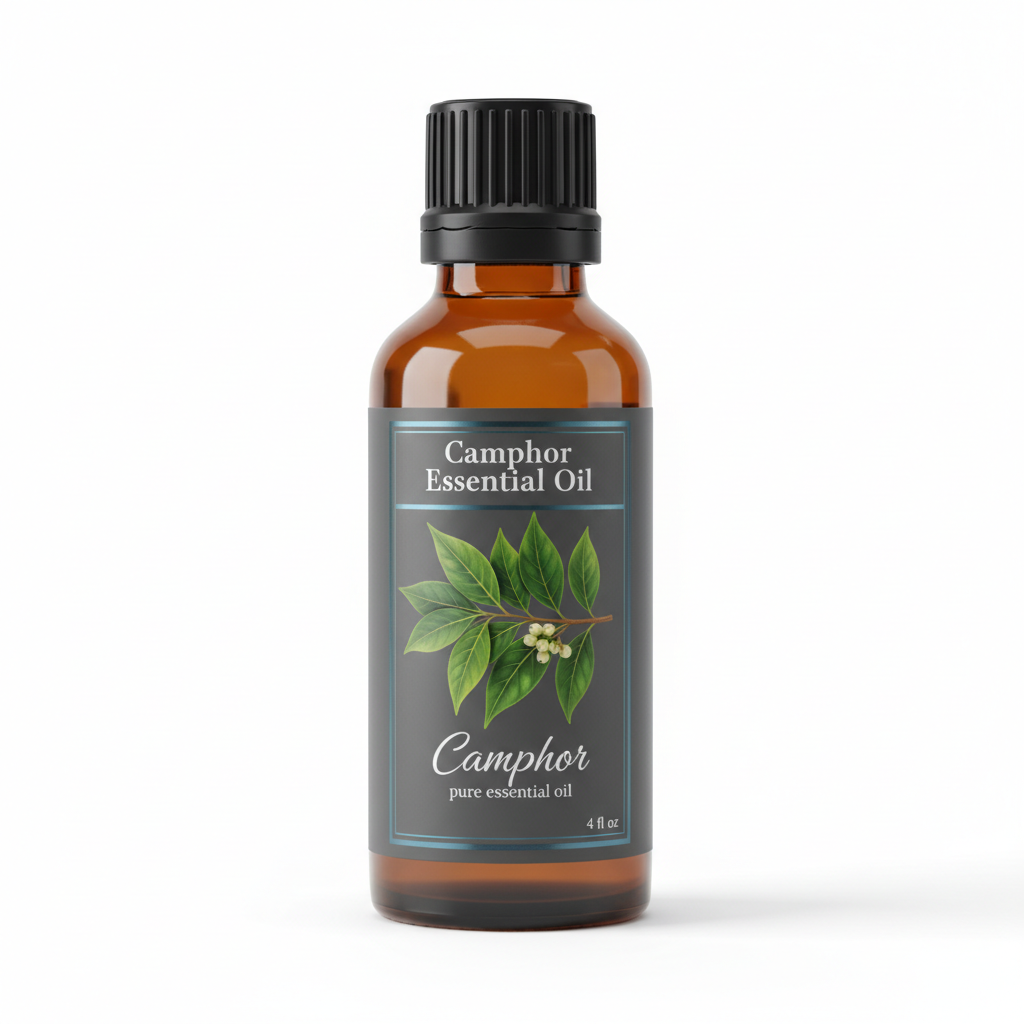
Camphor Essential Oil
Our own Camphor Essential Oil, in sizes from 0.5 oz to bulk.
From $8.69
Shop Now →We're going to walk through both side by side: what they actually are, how they behave in candles and cold process soap, what they cost, and where each one earns its place in a crafting kit. Neither is a villain here. They're built for different jobs, and buying the wrong one for your project is the real mistake, not buying the "wrong" oil in general.
What Each One Actually Is
White camphor essential oil is a natural distillate. Chipped or ground wood, bark, and leaf from the camphor tree goes through steam distillation, and the resulting oil is fractionally separated (the "white" fraction is the one considered acceptable for cosmetic and aromatic use, as opposed to the brown or yellow fractions, which carry higher levels of a compound called safrole and are generally kept out of consumer products). What you get is a complex mixture of naturally occurring constituents, camphor itself being the dominant one, alongside smaller amounts of cineole, pinene, and other plant compounds that shift slightly from batch to batch depending on harvest and region.
Camphor fragrance oil, by contrast, is a formulated product. It's built in a lab from a combination of synthetic aroma chemicals (and sometimes a small percentage of the real essential oil folded in for authenticity) designed to reproduce that sharp, cool, medicinal-green smell people associate with camphor. Because it's engineered rather than distilled, a fragrance oil house can tune it: brighten the top note, soften the sharpness, extend how long it lingers in a candle. That's the tradeoff in a sentence. One is a plant extract with natural variation. The other is a designed scent with consistency built in on purpose.
Neither is inherently "better." A crafter chasing traceable, single-origin ingredients for a cosmetic line wants the essential oil. A candle maker chasing a reliable, batch-to-batch identical cold and hot throw at a lower cost per ounce often reaches for the fragrance oil. Read the essential oil basics guide if you want the deeper backstory on how camphor moves from a solid crystal to a liquid distillate in the first place.
Side-by-Side Comparison
| Attribute | White Camphor Essential Oil | Camphor Fragrance Oil |
|---|---|---|
| Source | Steam-distilled from camphor tree wood/leaf | Formulated in a lab from aroma chemicals |
| Composition | Complex natural mixture, batch variation expected | Standardized synthetic (or part-synthetic) blend |
| Scent consistency | Varies slightly by harvest and supplier | Highly consistent bottle to bottle |
| Typical scent character | Sharp, cool, resinous, slightly medicinal, some batches lean sweeter or greener | Often brighter or "louder" up front, sometimes with added notes to round it out |
| Cold process soap behavior | Can accelerate trace and shift color slightly; scent tends to fade faster in a caustic base | Must be checked against soap-safe/IFRA data; some hold scent through saponification better |
| Candle throw | Moderate; a natural oil's throw can be inconsistent between suppliers | Usually stronger, more predictable hot and cold throw |
| Labeling | Can be labeled "pure" or "natural" essential oil | Should NOT be labeled essential oil; "fragrance" or "nature identical" is accurate |
| Price (per ounce, roughly) | Higher, tied to distillation yield and sourcing | Lower, especially at bulk/wholesale sizes |
| Shelf life | 1 to 3 years if stored well | Often longer and more stable in storage |
| Best documented for | Aromatic and cosmetic use, traditional applications | Candle making, soap making, air and linen products |
Natural Camphor Scent vs Synthetic: What Your Nose Actually Notices
Put a drop of each on a scent strip and let them sit for twenty minutes. The essential oil tends to open sharp and cool, almost like a gust of cold air, then settles into something rounder and slightly woody as the lighter molecules evaporate off. There's a texture to it, a sense of depth that shifts over the course of an hour. That's the nature of a natural distillate: it's not one note, it's dozens of compounds evaporating at different rates.
Camphor fragrance oil is often built to hit that same cool, medicinal impression right away and hold it. Depending on the house that formulated it, it may smell nearly identical to the essential oil at first spray, slightly "flatter" over time, or noticeably brighter and sweeter if the formulator added supporting notes to make it more wearable in a candle or soap. Some crafters describe synthetic camphor blends as smelling "cleaner" or more one-dimensional, which isn't a criticism so much as a description of what a designed scent does: it delivers the same experience every time, without the natural drift of a plant extract. If you want to get a feel for the natural version specifically, the full scent profile breakdown walks through how the top, middle, and base notes actually unfold.
Pros and Cons: White Camphor Essential Oil
Pros
- Traceable to a plant source, appealing for crafters who market natural or botanical product lines
- Can be labeled as a true essential oil, which matters for brand positioning and customer trust
- Traditionally used in aromatic blending and diffuser work, with a long documented history in perfumery and folk practice
- Complex, evolving scent that some noses find more interesting to work with over time
Cons
- Higher cost per ounce, particularly for well-sourced or organic-certified batches
- Batch-to-batch variation means a blend that worked perfectly last month may need re-tuning with a new bottle
- A genuinely potent, concentrated oil, so it requires careful dilution and handling rather than casual use
- Scent can fade faster in alkaline environments like cold process soap
Pros and Cons: Camphor Fragrance Oil
Pros
- Lower cost, which matters at candle- or soap-making scale where ounces add up fast
- Consistent scent from bottle to bottle and supplier to supplier
- Often formulated specifically for hot throw, cold throw, or cold process soap performance, with data sheets to match
- Generally more stable in storage, with less concern about oxidation changing the scent over time
Cons
- Cannot honestly be marketed or labeled as an essential oil, which matters if your brand promises "pure" or "natural" products
- Quality varies enormously by manufacturer; a cheap, poorly formulated fragrance oil can smell harsh or synthetic in an unpleasant way
- Some formulations use phthalates or other additives some crafters prefer to avoid; always request a safety data sheet
- Less useful for aromatic blending work where a natural profile is the whole point
Camphor Oil for Soap Making Comparison
Soap making is where this decision gets the most practical, and where a lot of first-time buyers get tripped up. Cold process soap is an unforgiving environment for any scent: the batter is highly alkaline during saponification, it heats up as it cures, and some fragrance compounds simply don't survive the process intact.
With white camphor essential oil, the biggest risk is scent fade. The lighter, more volatile compounds that give camphor its sharp top note can partially cook off during saponification, leaving a softer, less distinct scent in the finished bar than what you smelled in the bottle. Some soap makers also report that camphor's natural constituents can nudge a batch toward faster trace, so it helps to have your mold and additives ready before you add it.
Camphor fragrance oil formulated specifically for cold process work is usually the more predictable choice for soap makers chasing a strong, lasting scent in the final bar. The key phrase there is "formulated for cold process." Not every camphor fragrance oil on the market is soap-safe; some are built for candles or diffusers only and will separate, discolor, or seize a soap batter. Before buying, check the supplier's usage data for a documented cold process usage rate and any noted discoloration or acceleration warnings. A patch test in a small batch is worth the extra day it costs you, every time.
Whichever you choose, dilution matters. Camphor in either form is potent, and soap makers, candle makers, and anyone blending for skin contact should follow the supplier's recommended usage percentages rather than eyeballing it. For general handling guidance on the essential oil specifically, see the dilution and handling guide. Anyone with sensitive skin, a history of skin reactions, or specific health questions about using camphor in any form should check with a qualified healthcare provider before incorporating it into a product they'll use regularly.
A scent that survives the cure is worth more than a scent that impresses in the bottle. Test small, cure the full four to six weeks, and smell the bar again before you commit to a full batch.
Best For: Recommendations by Use Case
Candle Making
Lean toward a camphor fragrance oil formulated for candles. You'll get a more reliable hot throw, better wax compatibility, and a lower cost per pour, which matters if you're producing in any volume. Our cold throw guide for camphor candles covers wax types and load rates in more depth.
Cold Process and Melt-and-Pour Soap
A fragrance oil specifically labeled and data-sheeted for cold process soap is usually the safer bet for scent longevity. If your brand's identity depends on an all-natural ingredient list, the essential oil is still workable, just budget for potential scent softening after cure and test thoroughly first.
Diffuser Blends and Aromatic Work
This is essential oil territory. A fragrance oil's synthetic notes generally don't hold up to the scrutiny of an open diffuser the way a genuine botanical distillate does, and crafters chasing an authentic, traditional aromatic blend will notice the difference immediately.
Perfumery and Fine Fragrance Layering
Serious blenders tend to reach for the essential oil for its natural complexity and its compatibility with other true botanicals in a formula. Our perfumery blending guide goes into which other naturals pair well with camphor's cool top note.
Room Sprays, Linen Sprays, and Household Freshening
Either can work here, and this is where cost usually decides it. A fragrance oil stretches further for the price, while the essential oil appeals to crafters building an all-natural home line.
Budget-Conscious, High-Volume Production
Fragrance oil, without much debate. At scale, the price gap between the two compounds quickly, and a well-sourced fragrance oil formulated for your specific application will usually outperform a natural oil stretched thin to hit a price point.
Cost and Sourcing Notes
Pricing on white camphor essential oil tracks distillation yield, harvest region, and whether the batch is certified organic. Expect a noticeably higher per-ounce cost than a comparable fragrance oil, and expect that gap to widen at the smaller bottle sizes where labor and packaging eat a bigger share of the price. Our shopper's guide to buying camphor oil online and organic camphor premium breakdown both dig into what you're actually paying for at each price tier.
Fragrance oil pricing tracks the cost of the aroma chemicals used and the reputation of the formulator. Cheap fragrance oils exist, and cheap is sometimes exactly what it smells like: thin, harsh, or short-lived once poured or cured. A mid-tier fragrance oil from a supplier with published safety data and cold process test results is usually worth the few extra dollars over the bargain-bin option.
The Verdict
If your brand's promise is "pure," "natural," or "botanical," white camphor essential oil is the only honest choice, and you should budget accordingly. It costs more, it varies slightly from batch to batch, and it can soften in a soap cure, but it's the real thing, and customers who care about that will notice if you substitute a synthetic and call it natural.
If your priority is consistent, strong scent performance at a manageable cost, particularly for candles or soap made at any real volume, a well-formulated camphor fragrance oil built for your specific application is the more practical tool. Just verify it's actually rated for what you're making before you commit a full batch to it, and never let a fragrance oil get labeled or marketed as an essential oil. That's not a gray area; it's a line worth holding for your customers' trust and your own credibility.
Most crafters we talk to end up keeping both on the shelf. The essential oil for aromatic work and small-batch natural lines, the fragrance oil for candles and soap runs where reliability and cost per unit carry more weight. Knowing which is which, and reading your supplier's documentation before you buy, is most of the battle.