Ravintsara vs Camphor Oil: Clearing Up the Naming Mix-Up
Ravintsara and camphor oil both come from the camphor tree, Cinnamomum camphora, but they are different oils: ravintsara is a 1,8-cineole chemotype sold under a Malagasy name, while camphor oil is the white fraction of a distilled wood oil. Ravensara, spelled almost the same, is a different tree altogether.
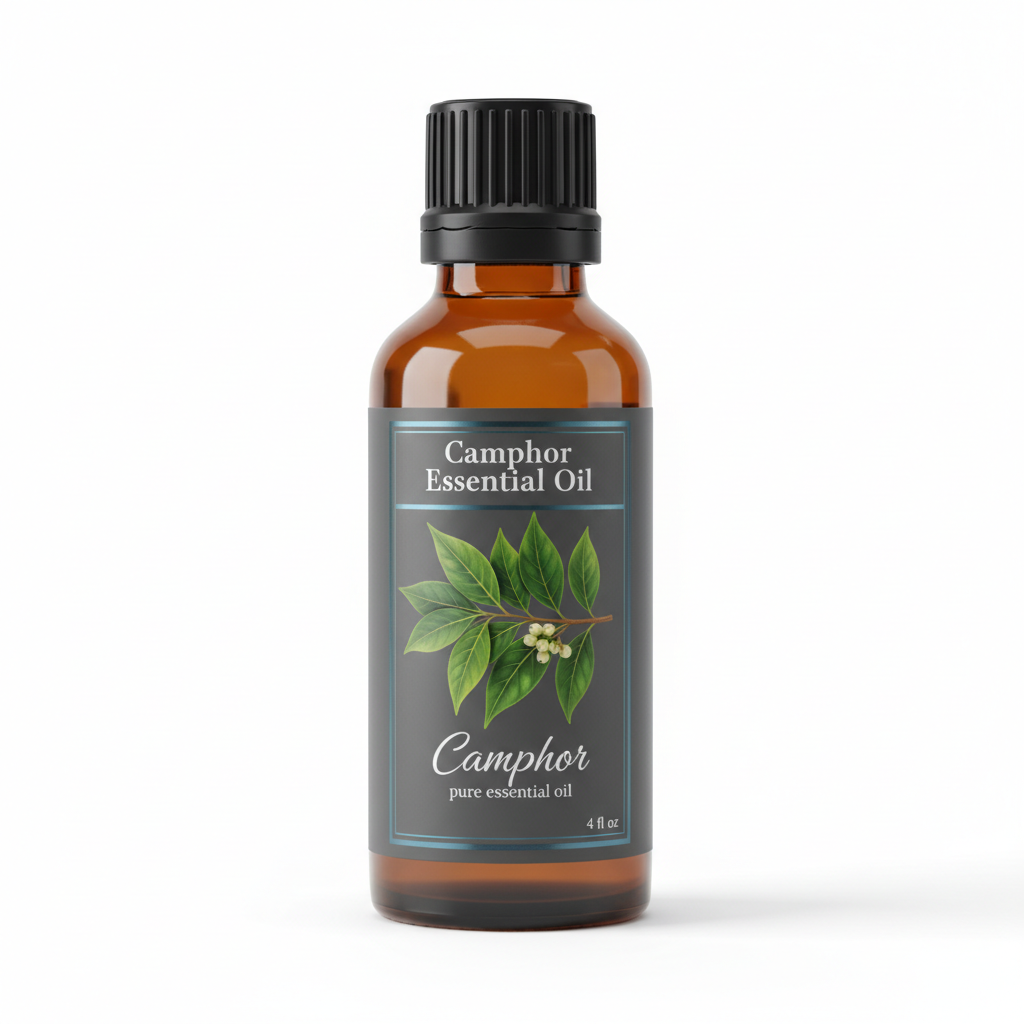
Camphor Essential Oil
Our own Camphor Essential Oil, in sizes from 0.5 oz to bulk.
From $8.69
Shop Now →Three near-identical names for three different materials is the problem, and the mix-up has been measured: in a study of 34 commercial batches, only 5 of the 14 labelled as ravensara were the real thing. This page sorts out which name means what, in the order we would ask a buyer to check. It describes materials, not remedies, and our own oil is sold as an aromatic material, not a drug. For the wider set of camphor oil names, see our guide to the types of camphor oil.
Three names, three materials
| Name | Botanical source | What leads the chemistry | What to ask for |
|---|---|---|---|
| Ravintsara | Cinnamomum camphora, a cineole chemotype | 1,8-cineole | Latin name, chemotype, plant part, GC/MS |
| Camphor oil (white) | Cinnamomum camphora, a fraction of the distilled oil | Mostly 1,8-cineole and other terpenes, little camphor | Fraction, lot-level safrole result |
| Ravensara | Ravensara aromatica, a different tree endemic to Madagascar | Depends on the tree: methyl chavicol, methyl eugenol, a terpinene or sabinene | Latin name, leaf or bark, GC/MS |
Everything below expands one of those rows. The short rule: if the Latin name on the bottle is Cinnamomum camphora, you are looking at the camphor tree, and then the question becomes which chemotype and which cut.
Ravintsara is the camphor tree, but not the camphor oil
The Tisserand Institute poses the question outright: "Did you know that Ho Wood, Ravintsara and Camphor oils all come from the same plant?" (Tisserand Institute). The species is chemically variable, so the same tree species yields oils dominated by different molecules. In a 2023 survey of leaf oils from 974 wild trees in 13 Chinese provinces, 249 trees were eucalyptol (1,8-cineole) types, with the dominant compound ranging from 11.63% to 65.33%, and 153 were camphor types (Zhang et al. 2023). A review of the species puts a cineole-type oil at 53.5% 1,8-cineole in one study and an average of 49.8% in another (Lee et al. 2022). Those are Chinese and other research samples, and we do not have a verified analysis of Malagasy ravintsara to quote, so treat the numbers as showing what a cineole type looks like, not what a given bottle holds.
That is the first correction: ravintsara is not "camphor oil from Madagascar". A cineole chemotype is by definition led by 1,8-cineole rather than by camphor. Our chemotype article lays out the whole family.
White camphor oil is a different cut, and it overlaps in one way
White camphor oil is not a chemotype at all, but a fraction cut from distilled camphor wood oil. According to PROSEA it is the first fraction, about 20% of the camphor-free oil, with 1,8-cineole the main constituent and an almost colourless, eucalypt-like odour (PROSEA). The Tisserand Institute adds that none of the camphor fractions carry much camphor, "up to 9%, more typically 3%".
So the overlap is real. Both materials are led by 1,8-cineole, and the compound's odour is described in reference books as camphor-like (PubChem, 1,8-cineole odor records). A reader comparing a ravintsara and a white camphor oil by nose could reasonably find them in the same family. That is reasoning from shared chemistry, not a scent panel of ours, because we have not run one.
The difference is that the white camphor fraction is a controlled cut, made to reduce safrole, whereas a chemotype oil is whatever that tree makes. One published white-oil specification, put to the European Food Safety Authority, gives 1,8-cineole at 27% to 43%, d-limonene at 18% to 27%, p-cymene at 6% to 15%, and safrole below 0.0002% (EFSA Journal 2022). That describes one applicant's product, not all white oils, but it shows large limonene and p-cymene shares alongside the cineole, and we have no verified figures showing that a cineole-type leaf oil carries the same. We do not have a published composition for our own lot, so we cannot place it on that map from the website alone.
Ravensara is another tree
Ravensara aromatica is a tree endemic to Madagascar, not a camphor tree. French researchers sampling individual trees found four leaf chemotypes: above 90% methyl chavicol; 72% to 80% methyl eugenol; 25% to 28% of a terpinene; and 25% to 34% sabinene. The bark oil was dominated by methyl chavicol in every tree, at 83% to 98% (Andrianoelisoa et al. 2010, Journal of Essential Oil Research). Methyl chavicol leads the ravensara bark oil and one leaf type, while a cineole-type camphor-tree oil is led by 1,8-cineole, which is why ravensara and ravintsara are not substitutes.
Because the two names sound alike and the oils often come from the same country, they get swapped. The same group tested 34 commercial batches labelled ravensara or ravintsara, collected between 2009 and 2011. Oils sold in Madagascar were authentic. In northern markets ravintsara labelling was mostly accurate, but of fourteen samples labelled Ravensara aromatica or Ravensara anisata, only five were authentic ravensara oil (Andrianoelisoa, Menut and Danthu 2013, Phytotherapie). The authors tie the mislabelling to natural chemical variation and to pressure on an endemic Malagasy resource.
Read that result as a warning about labels in general, not about any particular seller. The practical consequence is that a bottle labelled with a common name and no Latin binomial, plant part or chemotype is not enough to go on.
A label-reading chart
| If the label says | It could be | What settles it |
|---|---|---|
| "Ravintsara" | A cineole chemotype of Cinnamomum camphora | Latin name, cineole near the top of a GC/MS table, no methyl chavicol |
| "Ravensara" or "Ravensara aromatica" | Real ravensara, or ravintsara mislabelled | Methyl chavicol or methyl eugenol or sabinene leading means ravensara; cineole leading points to the camphor tree |
| "Camphor oil" or "white camphor oil" | The light fraction, or a loosely labelled other cut | Fraction named, and a lot-level safrole result |
| "Camphor" with no qualifier | Crystalline camphor, a chemotype oil, or a fraction | Ask which, and ask for the report |
The "it could be" column is our inference from the studies above, not a measurement. The GC/MS instructions are the same ones we give in our grade comparison.
What this means if you came for ravintsara
We sell one product, Camphor Essential Oil, and not ravintsara or ravensara, and there are two honest reasons not to treat ours as a stand-in.
- The composition differs. A cineole-type leaf oil and a white camphor fraction may share a main molecule, but the rest of the profile, including limonene in the white oil specification above, is not the same.
- The risk questions differ. Camphor oil carries the safrole question and the camphor hazard warnings on our pages. Ravensara carries a methyl chavicol question that we are not equipped to advise on. For exact limits on any of them, the reference to open is Tisserand and Young, Essential Oil Safety.
If a recipe, a blend or a product specification says ravintsara, buy ravintsara from a seller who gives you the Latin name, the chemotype and a lot report. If it says camphor oil and you want the white fraction, our shop lists it from 0.5 oz to 400 lb.
What we say about our own oil
Our oil is described on our pages as the white fraction of the wood distillate, 100% pure and undiluted, in dark amber glass, distilled and fractionated in China by a producer held on file against each lot. A safrole result at or below detection is requested for every lot and given when you ask (Inside the Still). Our posted Certificate of Analysis lists physical constants for batch CMPQGACCCNC003A, namely specific gravity 0.878, refractive index 1.467 and optical rotation +5.80 degrees, and it carries no GC/MS table. It cannot, on its own, show which chemotype the tree was.
Anything that is camphor oil is hazardous if swallowed, contraindicated for infants and young children, and best avoided by anyone with a history of seizures. For any ingestion call Poison Help at 1-800-222-1222 (poison.org), and ask a physician or pharmacist about health questions.
Frequently asked questions
Is ravintsara the same as ravensara?
No. Ravintsara is Cinnamomum camphora, a cineole chemotype. Ravensara is Ravensara aromatica, a different tree. Their leading compounds differ.
Is ravintsara camphor oil?
It comes from the same species but not from the same cut or chemotype. Camphor oil in our sense is the white fraction, and a ravintsara is a cineole chemotype.
Which spelling is correct?
They are two spellings for two different plants: ravensara is Ravensara aromatica and ravintsara is Cinnamomum camphora. That is the root of the problem, so go by the Latin name, not the common name.
How common is mislabelling?
In the 2013 study, 9 of 14 samples labelled as ravensara were not authentic ravensara. Ravintsara labels were mostly accurate. That is one study of 34 batches from 2009 to 2011.
Where do I go next?
Read about the linalool relative of camphor oil, ho wood.
Sources & Further Reading
- Tisserand Institute: Cinnamomum camphora, its many names and chemotypes
- Zhang T. et al. Chemical variation and environmental influence on essential oil of Cinnamomum camphora. Molecules 2023;28(3):973
- Lee S-H. et al. Phytochemistry and applications of Cinnamomum camphora essential oils. Molecules 2022;27(9):2695
- Andrianoelisoa H.S. et al. Chemical composition of essential oils from bark and leaves of individual trees of Ravensara aromatica. J Essent Oil Res 2010;22(1):66-70
- Andrianoelisoa H., Menut C., Danthu P. Ravensara aromatica ou Ravintsara : une confusion qui perdure parmi les distributeurs d'huiles essentielles en Europe et en Amerique du Nord. Phytotherapie 2013
- PROSEA: Cinnamomum camphora (L.) J.Presl
- EFSA Journal 2022: Safety and efficacy of camphor white oil (Cinnamomum camphora) as a feed additive
- PubChem: 1,8-cineole (eucalyptol), odor records
- Poison Help (poison.org), 1-800-222-1222